June 10, 2026

Capitalizations Index – B ∞/21M

Crypto Exchanges Begin to Shutdown: Bear Market in Full Force

Crypto exchanges begin to shutdown: bear market in full force

Crypto Exchanges Begin to Shutdown: Bear Market in Full Force

After miners, it is crypto exchanges that stand before the wrath of a bearish cryptocurrency market.

Liqui, a small but a long-running crypto trading company, announced today that it would close down its operations. In a straightforward goodbye note, the Ukrainian exchange said that it was unable to provide liquidity to its customers. Therefore, it had no economic reason to continue its services.

“We also do not see any economic point in providing you with our services,” the note read. “However, we do not want to return to where we were a month ago. Hence, we decided to close all accounts and stop providing our services. It broke our hearts to do that.”

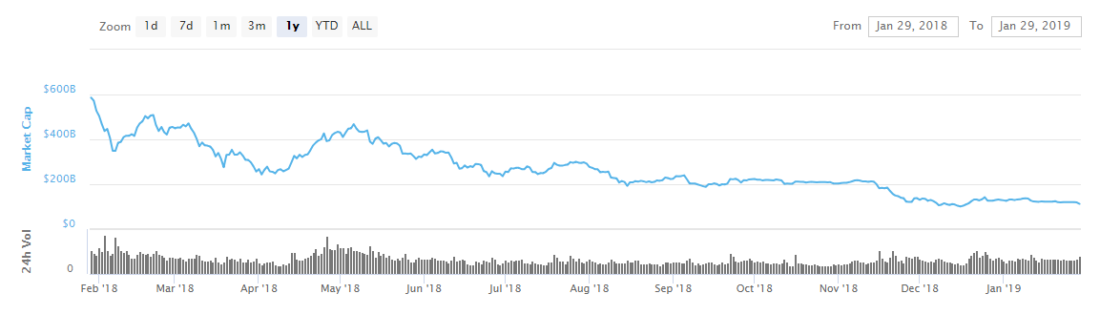
Liqui admitted that the overlong bearish cryptocurrency market was their reason for quitting. The exchange noted that the market had changed significantly since 2017, and their return would solely depend on whether or not it would correct. On December 31, 2018, the combined cryptocurrency market cap had erased 80% of its value since hitting its peak near $813.8 billion.
Crypto exchanges begin to shutdown: bear market in full force

Source: CoinMarketCap.com

Crypto Exchange Purge

The comments led the crypto community towards speculating the beginning of the death of crypto exchanges. Ran Neuner of CNBC predicted the closing down of more trading companies in 2019.

“I’m expecting more exchanges to shut down in this bear market,” he said on Twitter. “Last year everyone rushed to start an exchange. Exchanges require infrastructure that is expensive to maintain and most won’t survive this.”

The predictions drew inspirations from the current health of crypto mining industry. Miners admitted that minting cheap cryptocurrencies had turned uneconomical for them, especially in the face of expensive power bills and growing taxes. Bitmain, the leading crypto mining company, had to layoff 80% of its workforce to compensate for its quarterly financial losses. At the same time, many small miners had already succumbed to the growing bearish sentiment.

The same analogy fits the crypto exchange industry. Liqui, which is 180 ranks behind its competition by daily volume, could not sustain any more losses. And it is likely that other small exchanges would run out of business as well.

Large Exchanges Acquiring?

One other reason that explains why small crypto exchanges would die is the growth of larger players. For instance, the likes of Binance and Coinbase, which are reporting higher trading volume and revenue growth, will likely take over the customer base of smaller exchanges.

Regulation is another key factor that should be considered. Increased scrutiny led to the failure of many ICO projects that were bread-and-butter of the small crypto exchanges. Therefore, their revenue could have dropped drastically for they didn’t have liquidity of serious protocol tokens such as ₿itcoin, EOS, Ether, and similar coins.

Liqui will support withdrawals for the next 30 days – until February 28, 2019.

Published at Mon, 28 Jan 2019 16:18:26 +0000

Previous Article

GDET Confirms Delivery of Satoshi 2 ₿itcoin ATM Machine

Next Article

Bitcoin Stays Firm Despite ETF Setback and Davos’ Anti-Bitcoin Sentiment: BTCManager’s Week in Review Jan 28

You might be interested in …

Cryptocurrency and Blockchain Tech Market Could Reach $10 Trillion in 15 Years, Says RBC Analyst

RBC

In a report published on January 3, 2018, Royal Bank of Canada (RBC) Capital Markets analyst Mitch Steves confidently stated that the cryptocurrencies and blockchain technology applications market could increase thirteenfold in 15 years, reaching $10 trillion.

Steves’ report, titled “Crypto Currency & Blockchain Technology: A Decentralized Future  A Potential Multi-Trillion Dollar Opportunity,” has been sent to RBC’s clients. A short summary has been shared on Twitter.

In a video published by CNBC, Steves, who often covers high technology stocks including Nvidia, whose value has been boosted by cryptocurrency mining, defends his bullish expectations on blockchain technology and its applications. According to Steves, cryptocurrencies represent only a part of the $10 trillion pie, the bulk of which is in the rest of the ecosystem existing around blockchain technology and cryptocurrencies.

“I think what people misunderstand about the cryptocurrency space is that it’s not only a store of value, but it also allows you to secure the internet,” says Steves. Blockchain-based cryptocurrencies will permit creating decentralized versions of value storage services like Dropbox or iCloud. The $10 trillion figure represents one third of the current size of the market for value storage.

Steves argues that blockchain technology will permit creating a “Secure World Computer,” a decentralized world computer without a third-party intermediary, intrinsically more secure because there won’t be centralized servers that can be hacked, and suggests that next-generation killer apps will be built on top of this secure layer.

The smart move for investors, according to Steves, is to get involved with cryptocurrencies directly. As far as traditional stocks are concerned, Steves mentions public companies like AMS and Nvidia, whose chips power cryptocurrency mining hardware, and the private companies that make ASIC chips for bitcoin mining. At the same time, Steves warns that cloud service providers are likely to be the most impacted from blockchain technology, with negative results if they don’t manage to adapt.

According to Steves, the value of the blockchain technology market is also growing due to international remittances — the sending of payments overseas is currently estimated at half a trillion dollars per year — “fat protocol” layers that increase in value as the applications grow, and throughput scaling efforts, such as the Lightning Network, which “appear on track to deliver scaling that accommodates higher transactions/second, ultimately driving higher utility and network value.”

While warning that the cryptocurrency space has many risks, Steves argues that the opportunity appears vast, with constant technology updates, and a multi-trillion dollar market will likely emerge.

In a recent, related article published by the RBC, Frédérique Carrier, managing director and head of investment strategy for RBC Wealth Management in the British Isles, argued that, while cryptocurrencies are unlikely to replace traditional money, blockchain technology could have wide-ranging implications in many industries and for investors in the medium-to-long term.

The potential of blockchain technology “makes it a technology well worth watching closely, which we intend to do,” notes Carrier, adding that RBC is experimenting with blockchain technology in its personal, commercial and capital markets businesses. RBC recently announced the implementation of a blockchain-based shadow ledger for cross-border payments between the U.S. and Canada.

The post Cryptocurrency and Blockchain Tech Market Could Reach $10 Trillion in 15 Years, Says RBC Analyst appeared first on Bitcoin Magazine.

Remedy blockchain’s shortcomings with genetic information

Remedy Blockchain’s Shortcomings with Genetic Information

Remedy Blockchain’s Shortcomings with Genetic Information This is a submitted sponsored story. CCN urges readers to conduct their own research with due diligence into the company, product or service mentioned in the content below. January 3, […]