Bitcoin Cash Price Analysis: BCH/USD At Risk Of Break Below $500
NewsBTC
bitcoin Cash Price Analysis: BCH/USD At Risk Of Break Below $500
Key Points
bitcoin cash price is struggling to recover above $530 and $540 against the US Dollar.
Yesterday’s highlighted key bearish trend line is intact with resistance at $515 on the hourly chart of the BCH/USD pair (data feed from Kraken).
The pair is currently at a risk of more losses below the $500 and $490 support levels.
bitcoin cash price is currently well below $530 against the US Dollar. BCH/USD might accelerate declines once there is a close below the $500 level.
Yesterday, we discussed that bitcoin cash price is towards the $500 support against the US Dollar. The BCH/USD pair remained in a bearish zone and it struggled to move past the $530 resistance. The price even traded below the $500 level and formed a low at $495. Later, there was a minor upside correction above $500 and $505. Buyers pushed the price above the 23.6% Fib retracement level of the last slide from the $560 swing high to $495 low.
However, the price struggled to break the $525-530 . Besides, the 50% Fib retracement level of the last slide from the $560 swing high to $495 low also prevented gains. More importantly, yesterday’s highlighted key bearish trend line is intact with resistance at $515 on the hourly chart of the BCH/USD pair. There was a false break noted above the trend line since the price failed to settle above $530. Sellers pushed the price back below $510 and it is currently well below the 100 hourly simple moving average.
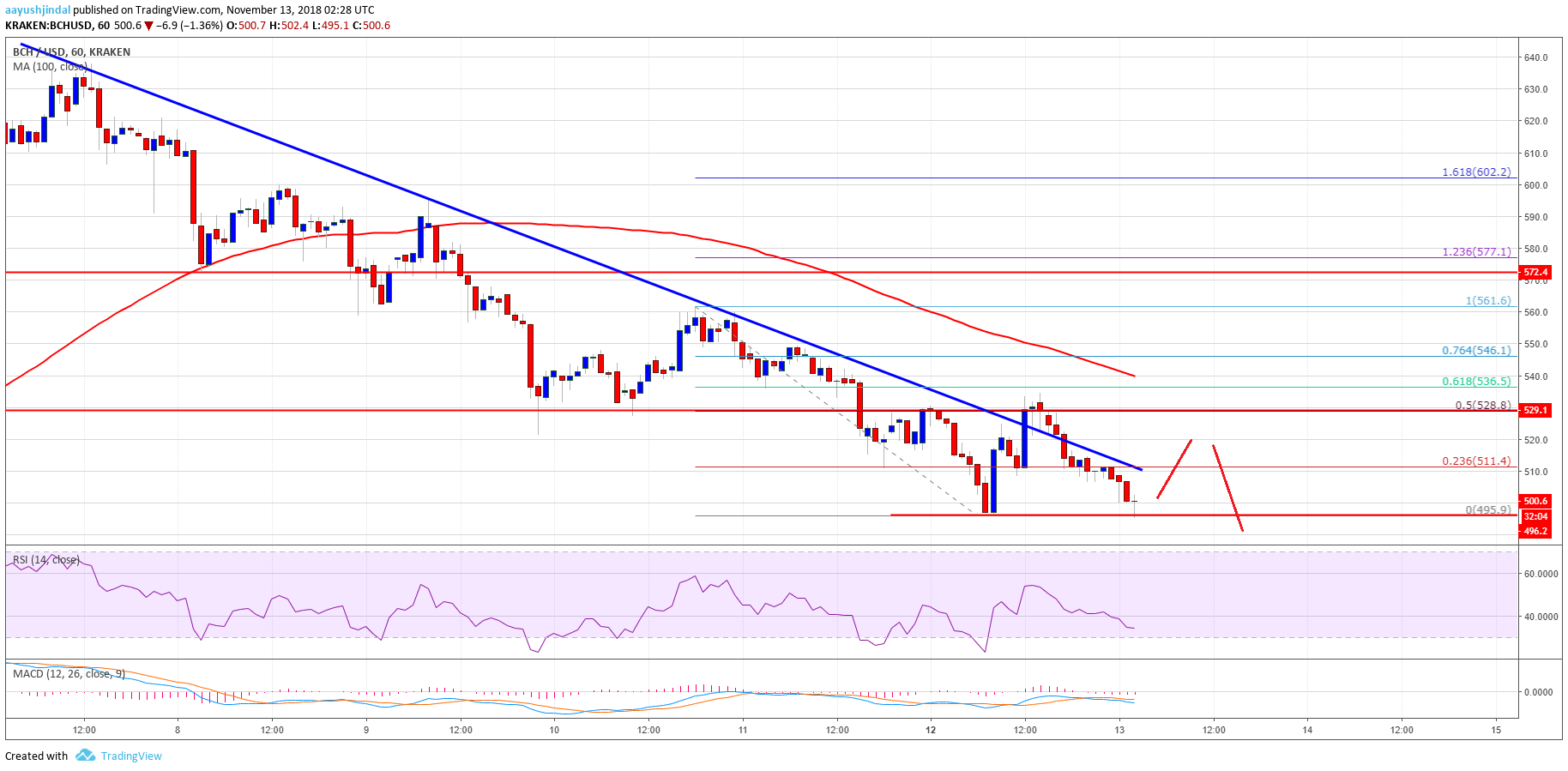
Looking at the , BCH price under a lot of pressure below $510 and $520. If there is no upward move, it could accelerate losses below $500.
Looking at the technical indicators:
Hourly MACD – The MACD for BCH/USD is currently in the bearish zone.
Hourly RSI (Relative Strength Index) – The RSI for BCH/USD is placed well below the 50 level.
Natural-gas condensate Natural-gas condensate is a low-density mixture of hydrocarbon liquids that are present as gaseous components in the raw natural gas produced from many natural gas fields. It condenses out of the raw gas […]
Blockstream is , a new programming language for blockchain-based smart contracts, intended for inclusion in Blockstream’s sidechains and eventually in bitcoin. The new language was presented by its creator, Russell O’Connor, Infrastructure Tech Developer at Blockstream, at the ACM SIGSAC Workshop on Programming Languages and Analysis for Security ().
“Simplicity is a blockchain programming language that is so simple, it fits on a t-shirt,” O’Connor told bitcoin Magazine. “It is critical that smart contracts behave in ways that all participants expect, and applying formal verification to Simplicity allows us to achieve that.”
Simplicity is still a Blockstream Research & Development project, but there’s potential for its use in Blockstream products in the future, according to the company’s announcement.
“Simplicity is flexible enough that I anticipate many new, domain-specific, languages will generate Simplicity, and this will give users the freedom to generate smart contracts using the tools that most suit their needs,” added O’Connor.
O’Connor’s paper, titled “,” presents Simplicity as “a new programming language, designed to be used for cryptocurrencies and blockchain applications, which aims to improve upon existing cryptocurrency languages, such as bitcoin Script and Ethereum’s EVM [virtual machine], while avoiding some of the problems they face.”
bitcoin script is limited by design and unsuitable for complex smart contracts that need more than a small set of simple templates to perform tasks like digital signature verification. Ethereum, on the other hand, includes a more expressive and flexible, Turing-complete programming language, which allows for arbitrarily complex smart-contracts in principle.
But, in practice, Ethereum doesn’t support static analysis to pre-determine the computing resources that a program will require and, thus, filter out too costly contracts and infinite loops. Therefore, pre-paid “gas” fees are lost when an Ethereum program “runs out of gas.” The simpler bitcoin scripting, which supports static analysis, doesn’t present similar issues.
In -dev mailing list
, O’Connor proposed Simplicity as an alternative to bitcoin Script, noting that static analysis is important for both node operators and for Simplicity program designers.
“Static analysis is a technique that provides a universal algorithm to determine how much any Simplicity program will cost to run before you stake your money on it,” O’Connor told bitcoin Magazine.
Simplicity can be seen as a more flexible alternative to bitcoin scripting, not Turing-complete but expressive enough to build useful smart contracts for blockchain applications, or as an alternative to Ethereum, which will support static analysis and other desirable features including improved safety, formal semantics, and Merkelized Abstract Syntax Trees (MASTs).
While Simplicity is intended as a low-level language for smart contracts, O’Connor envisages the possibility of compiling programs written in higher-level languages (like Ethereum’s Solidity) to Simplicity.
“Ivy and the Σ-State Authentication Language are existing programming language development efforts that may be suitable for being compiled to Simplicity,” notes O’Connor in the paper. “For the time being, generating Simplicity with our [] and [] libraries is possible.”
The next step in Simplicity’s development will be a bare-bones SDK (Software Developer Kit) that will include formal semantics and correctness proofs in Coq, a Haskell implementation for constructing Simplicity programs and a C interpreter for Simplicity. Then, the new language will be ready for initial deployment in the project, Blockstream’s open-source codebase for , so that developers can start experimenting with the code.
But, as O’Connor stated on -dev, “Only after extensive vetting would it be suitable to consider Simplicity for inclusion in bitcoin.”
Bitcoinist.com Max Keiser Interview: bitcoin Will ‘Gobble Up All Fiat’ and Rise Over $100K Bitcoinist once again caught up with the one and only Max Keiser, Wall Street veteran and host of the Keiser Report. […]