June 13: all of the top ten coins by market cap have fallen by between 9 and 14 percent over the 24-hour period, as data shows.
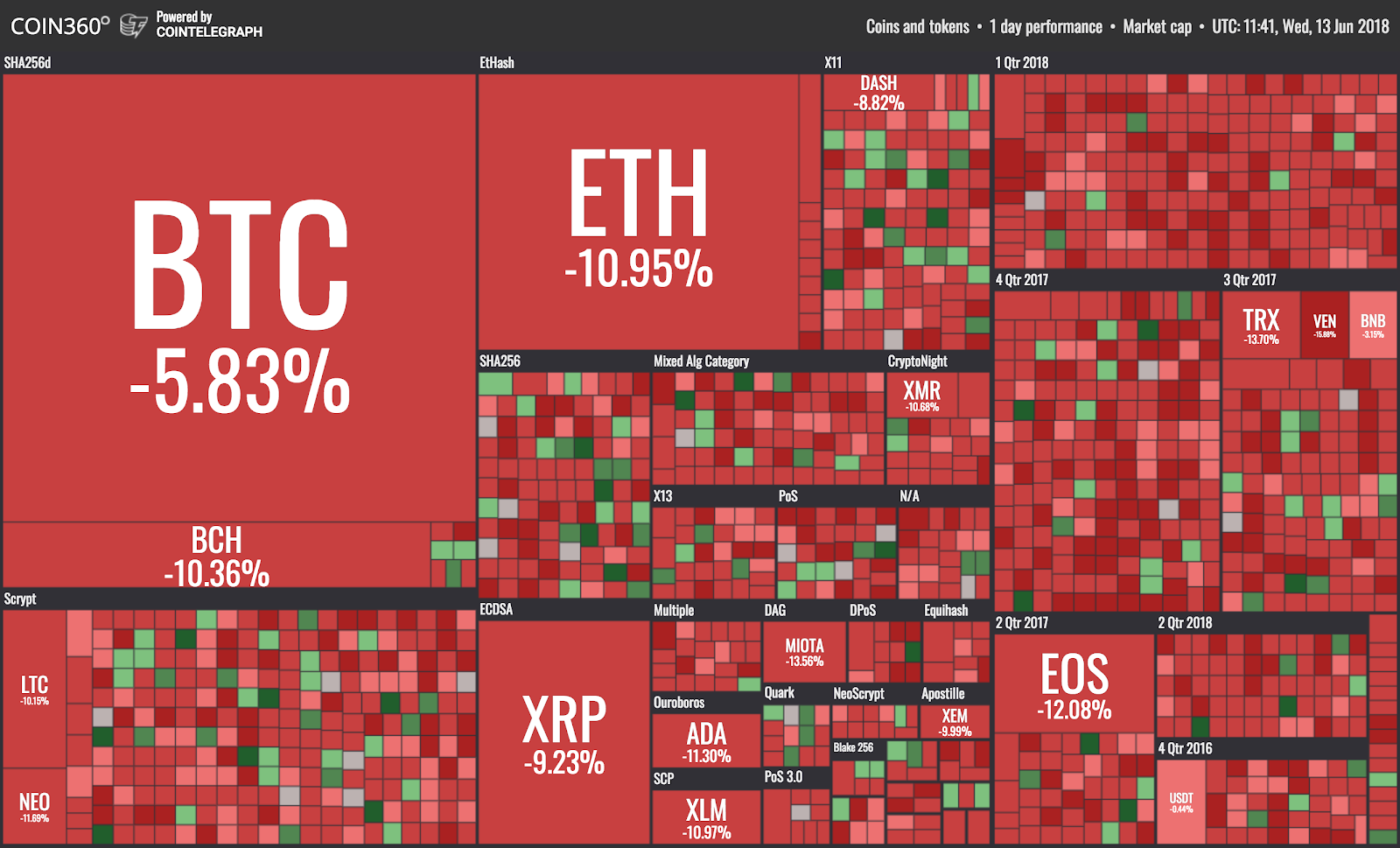
Market visualization from
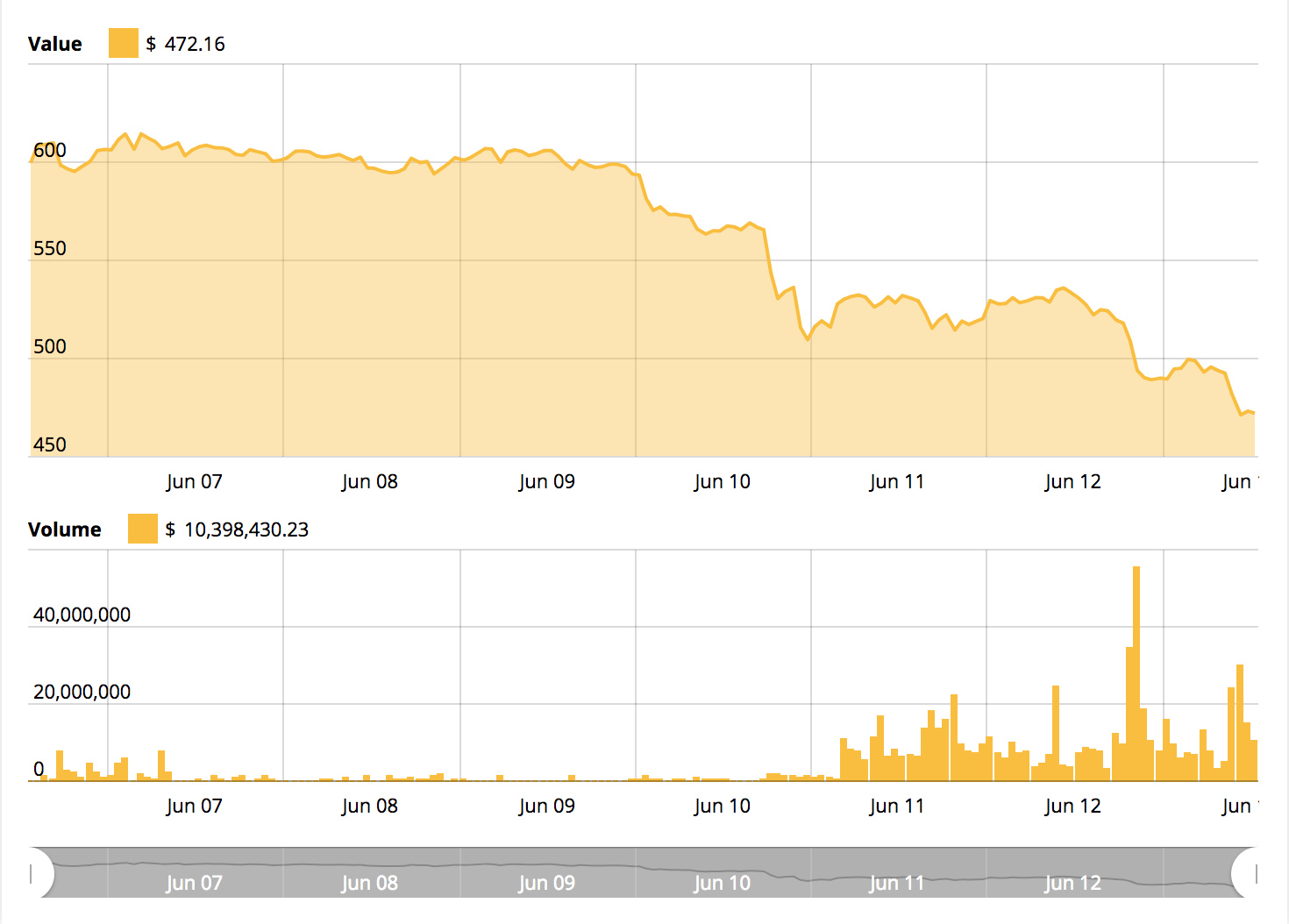
(BTC) has taken an over 11 percent negative hit, trading around to press time, bringing its monthly losses to almost 25 percent.
The leading cryptocurrency has now fallen below what some commentators consider to be an average BTC mining profitability threshold of $6,500. Robert Kelly told CNBC earlier today that this figure assumes that bitcoin miners need to update their hardware almost every 18 months, bringing the costs of mining to roughly between $5,900 and $6,000.
Mining profit margin globally have indicated a wide threshold, ranging between an extremely cheap $531 in Venezuela to a whopping $26,170 in South Korea. Aside from hardware costs, the local cost of electricity supplies is the other key factor affecting miners’ profits.

bitcoin price chart from Cointelegraph’s
As of press time, Coinmarketcap data 24-hour BTC trading volumes of $4.8 bln, up from their intra-weekly low of $3.8 bln.
Top altcoin (ETH) has fallen over 10 percent in the 24 hour period, trading around to press time. The coin has broken below its recent round figure low of $500, losing over 30 percent of its value in the last month.
Ethereum price chart from Cointelegraph’s
Of the top ten coins, (MIOTA) has suffered the heftiest losses, falling over 13 percent in the 24-hour period, trading at around $1.21 to press time.
The significant dip comes despite yesterday’s of a new Proof-of-Concept (PoC) to use IOTA’s system for Volkswagen’s new “Connected Car” systems at the major technology Expo Cebit ‘18 in Hanover, Germany.
Of all the top 100 cryptocurrencies on ’s listings, only 2 altcoins, (MANA) and (EMC) – ranked 94th and 95th respectively – are comfortably in the green.
(USDT) is just about stemming losses to see a negligible percentage point change over the 24-hour period, with a negative fluctuation of 0.06 percent as of press time.
Earlier , Circle CEO Jeremy Allaire emphasized the future importance of fiat-backed such as Tether for denominating financial contracts in a global tokenized economy. Allaire underscored their potential for use cases that require a less volatile price baseline – citing debt obligations as one example – but can still benefit from the decentralization and security of a blockchain infrastructure.
Total market capitalization for all cryptocurrencies is around bln to press time, down from their figure in early May.
The markets’ grim performance earlier this week drew considerable attention from international mainstream media, including , the (WSJ), , and the , who all attributed crypto losses to news of the of minor crypto exchange Coinrail over the weekend.
While short-term factors affecting the bearish market remain hard to pinpoint, news of a minor exchange hack is an for significant FUD – Fear, Uncertainty, and Doubt.
Notably, this week has seen a wave of crypto-regulatory news, including that the U.S. Commodity Futures Trading Commission (CFTC) has been demanding extensive trading data from major U.S. crypto exchanges to investigate whether price manipulation might be compromising prices in markets.
The Canadian government has also this week released an official draft of new regulations for crypto exchanges that seek to address a “number of deficiencies” outlined by the (FATF). The new measures will reportedly aim to strengthen Canada’s and Anti-Terrorist Financing Regime (AML/ATF).
Yesterday, further news from the FATF that the international watchdog will start developing binding rules for in June, as an upgrade to the non-binding resolutions which were adopted by the FATF in June 2015. The FAFT will reportedly evaluate existing guidelines on AML measures and the reporting of suspicious trading activity.
Yesterday, Cointelegraph auf Deutsch on fresh comments from the President of the Federal Financial Supervisory Authority in (BaFin) who stated that the regulatory authority:
“[would] not be able to protect every single investor from his fate, and that cannot be the task of state supervision. Once again, the maxim is that we must act prudently or regularly if financial stability as a whole is threatened or if consumers are systematically harmed."
Whatever may be pushing markets down, the crypto community has been actively mulling to the situation:
What’s hard, harder, and hardest about ? —> Buying bitcoin. —> Not selling it after a panic crash. —> Holding () bitcoin for 10+ years, to see a 1,000x to 10,000x increase in value. Maybe even more!
No one said it was easy.
What about you?— Bobby Lee (@bobbyclee)
My message to our Crypto Community for this morning. A heartfelt communion:
— John McAfee (@officialmcafee)
Published at Wed, 13 Jun 2018 12:36:47 +0000
