June 9, 2026

Capitalizations Index – B ∞/21M

Winklevi Twins Double Down On “Bitcoin Is Gold 2.0” Narrative

Winklevi twins double down on “bitcoin is gold 2. 0” narrative

Winklevi Twins Double Down On “Bitcoin Is Gold 2.0” Narrative

Winklevi twins double down on “bitcoin is gold 2. 0” narrative

Although the crypto industry has changed dramatically in its decade-long lifespan, the narrative surrounding Bitcoin (BTC), along with its cardinal value proposition. has been steady, more or less. Yet, there have been a few nuances.

Case in point, over recent years, proponents of the cryptocurrency have been wishy-washy with the asset being a Store of Value (SoV) or a of Exchange (MoE). As both arguments have their merits and proofs, a sometimes volatile dichotomy has formed between commentators, researchers, analysts, and investors touting the distinct thought processes.

Related Reading:  Bitcoin May Be Gearing Up for a Move to $10,000 as Upwards Momentum Continues

In fact, many argue that what catalyzed the now infamous hard fork of mid-2017 was an argument about whether BTC was actually, well, digital cash. More and more are coming to the conclusion though that prior to becoming a new form of money, Bitcoin will first need to become the go-to store of value.

bitcoin As Gold 2.0

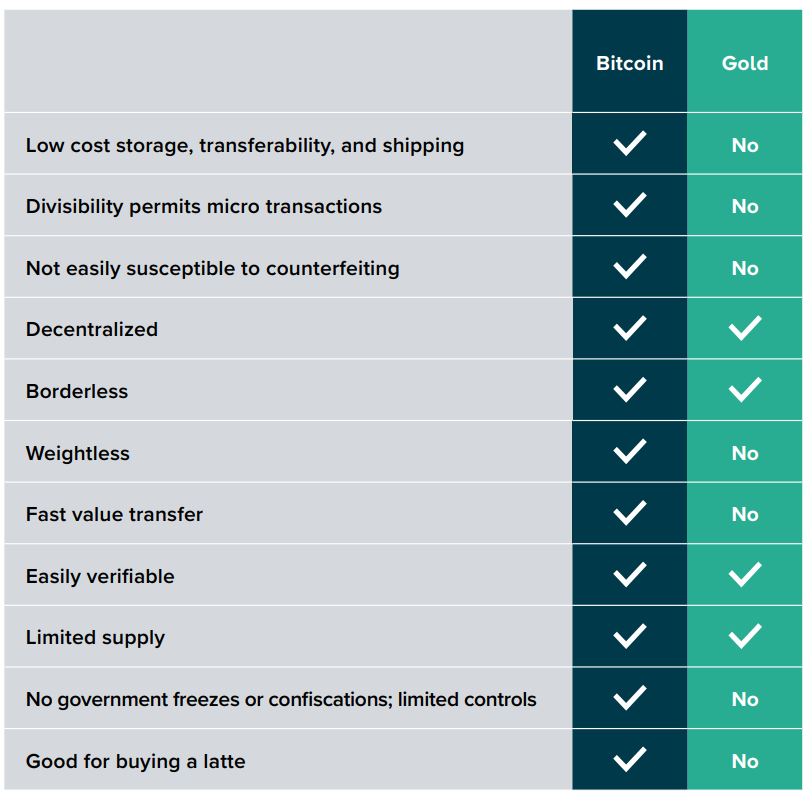
In a recent tweet, Tyler Winklevoss, one of the Winklevi(i) twins and the chief executive of Gemini, noted that he sees Bitcoin as “gold 2.0”. He states that the cryptocurrency “matches or beats” gold across the board. As he said in a previous interview, the only thing that gold has over BTC is a “3,000-year headstart.”

Factual data would confirm this. As Grayscale Investments explained, unlike the metal, BTC is mathematically scarce, capped at 21 million units; BTC is decentralized and verifiable through the Internet; BTC is portable and divisible through digital technologies, and is unconfiscatable. Gold, on the other hand, has an unlimited supply, centralization risks, an inability to be easily divided and moved around, and concerns around its purity. The chart below from Grayscale sums this controversial yet seemingly valid argument up fairly well.

Maybe that’s why Grayscale has begun to push for investors to “drop gold”. As NewsBTC reported previously, the firm launched an extensive ad campaign that touted BTC as “gold 2.0.” Grayscale released a 45-second advertisement that depicted two youngers physically “dropping gold” as those around them struggle with the heavy, cumbersome commodity, escaping to what is assumed to a society predicated on the use of digital assets.

A No-Gold World

Let’s say the world realizes the potential that Bitcoin holds, resulting in the world looking to store their value in BTC compared to gold. What would this hypothetical (yet totally possible) world look like? According to HodlWhale, a Seattle-based cryptocurrency investor, a world where Bitcoin has absorbed all the value of the gold in circulation would see BTC valued at $350,000.

This figure isn’t exactly baseless. Pre previous reports from this outlet, all physical gold products in circulation are currently valued at approximately $7.83 trillion, while all BTC has a mere $94 billion valuation. If the latter was to fully displace the value of the first, Crypto Voices, an industry analytics and research group, estimated that BTC would swell to a value of a casual $450,000 — slightly above HodlWhale’s estimate.

Featured Image from Shutterstock

Published at Mon, 20 May 2019 00:07:17 +0000

Previous Article

Winklevi Twins Double Down On “Bitcoin Is Gold 2.0” Narrative

Next Article

Lightning Hood Weekly Round-Up for the Week Starting 5/13/19

You might be interested in …

Can CREDO Take Its Place Alongside Visa and Mastercard?

Saint Petersburg, Russia-based CREDO have developed what is being dubbed a “next generation payment system” that makes everyday shopping easier for both buyer and seller alike.

[Note: This is a sponsored article.]


What is CREDO?

CREDO is a multi-functional payment system based on a financial algorithm that involves the participation of an independent agent in the transactions of purchase and sale of goods or services. Also called a derivative, the Electronic Certificate enables the parties (buyer and seller) to assume the right or obligation to perform certain actions with respect to the underlying asset.

Some of the features of CREDO include:

  • Innovative multi-brand loyalty program
  • Ultra-high discounts for all types of goods and services
  • Electronic certificates sold for crypto-currency
  • Electronic card linked to a personal bank card
  • Internal processing system independent of any banks
  • High-speed payment system using NFC technology
  • POS-terminals and EMV Java Cards
  • Created to work everywhere in the world just like VISA or MasterCard

CREDO internationality

CREDO’s primary competitive advantage is its internationality. Users of CREDO can buy and sell with any currency and from any country in the world. The payment model is extremely efficient and applicable not only to goods and services but intangible and tangible assets as well. It allows credit and payment operations not only through classic financial markets but through cryptocurrency as well.

Oksana Evseeva, an expert on international investments certified IFRS by the Institute of Financial Accountants in London, weighed in on the potential of CREDO in the global marketplace:

CREDO could be comparative and competitive as Visa and MasterCard using its model on B2B and C2C markets. […] It could work as on B2C as on B2B and C2C markets combining current financial and new crypto-currency markets.

B2C Payment Platform

CREDO’s B2C model works similar to a customer loyalty programs but gives more opportunities for market coverage. Customers can buy goods and/or services at a discount from any participating merchant around the world.

The basic mechanism of transactions in CREDO in B2C sector is as follows:

  1. The Retailer issues emission of Electronic certificates (Derivatives) for future sales of its goods/services
  2. The Operator works with the Retailer, providing payments for Derivatives, and also with Clients, providing sales of Derivatives, with a discount in case of rising clients’ base and loyalty
  3. Clients buy Certificates for goods and services.

The end result is a win-win for all participants. Retailers get more customers and increased working capital, Operators get an increased client base and profit margin, and customers end up paying less for the goods and services they purchase.

CREDO is Real World Tested

Unlike many ICO projects that seek to raise capital to fund the development of their service or platform, CREDO is already being used in real world scenarios, having undergone rigorous testing to ensure full compliance and adaptability for both domestic and international cross-border transactions.

Konstantin Galibus, CEO & Founder of CREDO

Konstantin Galibus, CEO & Founder of CREDO, describes some of their earlier tests:

We carried out a transaction in Europe through Deutsche Bank and VTB Bank in Russia executed a cross-border transfer for purchase liabilities of one of our Spanish counterparties. While Deutsche Bank, which acted as a correspondent bank, suspended the transfer of funds until the transaction structure was explained, when the processing model CREDO was presented to Deutsche Bank and the economic feasibility was proved, the funds were released and the transaction was concluded with success.

This example demonstrates not only the adaptability of our system to the strictest requirements of international banks but also our willingness to ensure cross-border transactions using an absolutely independent financial instrument.

Since then, CREDO has been used by over 1000 customers throughout China, UAE, Spain, and Russia. Over 9000 transactions have been completed totaling over 16,120,000 EURO. In a recent tweet, CREDO announced that additional pilot projects are in the works:

//platform.twitter.com/widgets.js

According to the project whitepaper:

CREDO has a patent for the designed system. The functional of the business model of CREDO has already been provided with all the necessary software and hardware and confirmed by positive test results in Europe. CREDO is a real financial project with its own technical processing, POS terminals, and EMV Smart Cards.

CREDO Pre-ICO in Progress

Launched on June 25, 2017, CREDO’s first round Pre-ICO is already under way. The ICO seeks to raise $5.5 million USD. Funds raised during the ICO will be used to:

  • Fund the cash turnover and create a new Operator in the system needed for the Cash-Forward payment model of CREDO’s B2C platform
  • Overall system improvements
  • Marketing

The Pre-ICO ends on July 10, 2017, after which it will transition into the main ICO. Investments in the ICO can be made with bitcoin, Litecoin, or Ethereum.

For more information about CREDO please visit their official website or download their whitepaper. CREDO’s ICO is being hosted at ICO Marketplace.

Does CREDO have the potential to take its place alongside Visa and Mastercard? How will it affect mainstream adoption of cryptocurrency? Let us know what you think in the comments below.


Images courtesy of CREDO, Shutterstock

The post Can CREDO Take Its Place Alongside Visa and Mastercard? appeared first on Bitcoinist.com.