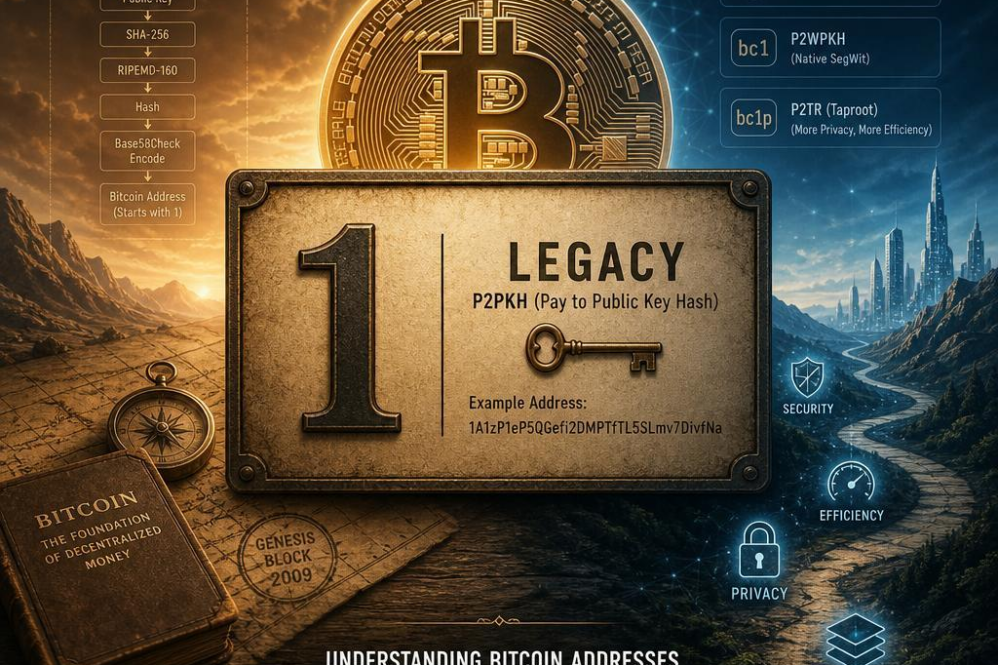
bitcoin Addresses and the Legacy P2PKH Format
bitcoin addresses, much like their counterparts starting with ’3′ and ‘bc1’, each carry their own unique characteristics and ancient meaning. One of the most recognizable types of bitcoin addresses, those beginning with the number ‘1’, are specifically associated with the legacy P2PKH (Pay To Public Key Hash) format, which has been around since bitcoin’s early days.This format operates on the foundation of public and private key cryptography,ensuring that any bitcoin transactions from these addresses require a proof-of-mastery of the private key,thus securing the funds effectively.
When you start dealing with bitcoin addresses on online forums or exchanges, you’ll often encounter discussions on these classic ‘1’ addresses. Historically, these addresses were born out of the need for a more user-friendly method of sending and receiving bitcoin compared to the hexadecimal addresses that preceded them. Despite their age, P2PKH addresses still hold important importance in the bitcoin ecosystem due to their widespread adoption and historical significance.It’s crucial for any bitcoin enthusiast to understand how these addresses work, as they often form the basis for more complex wallet and transaction interactions.To put this into outlook, consider the components involved when using a P2PKH address. Essentially,a bitcoin address starting with ‘1’ acts as a point of entry for receiving bitcoin. Underneath this familiar exterior lies a hashing process that protects the privacy and security of each transaction. When someone sends bitcoin to an address, they’re essentially signing off on a cryptographic message that can only be unlocked by the corresponding private key. This process can be depicted simply in a table to illustrate the key elements of what makes these addresses so secure and unique:
| Element | Description |
|---|---|
| Public Key | Generated from a private key, used for receiving funds. |
| Encrypted Hash | Derived from the public key, forms the address. |
| Private Key | Needed to sign transactions and spend funds. |
Understanding each of these elements helps to underscore the complexity and robustness of the P2PKH format, making it an essential learning point for anyone looking to dive deeper into bitcoin’s technical underpinnings.
The Significance of the ‘1’ Prefix in bitcoin Addresses
bitcoin addresses are familiar entities for cryptocurrency enthusiasts, but there’s a subtlety in their format that often goes unnoticed.For many users, a bitcoin address beginning with ‘1’ stands as the quintessential example of a traditional bitcoin address.These addresses adopt the Pay-to-PubKey-Hash (P2PKH) standard, which essentially means the funds are sent to a public key hashed version. Understanding this format is crucial for grasping the architecture of bitcoin transactions and the security measures in place.
P2PKH addresses originated in the early days of bitcoin when simpler transaction types were in vogue. The ‘1’ prefix signifies the standard address type, indicating a more straightforward transaction mechanism compared to later innovations like SegWit addresses. This older format encodes the recipient’s public key hash with a version byte (typically ‘1’ for bitcoin), a 160-bit hash of the public keyand a checksum. The resulting address is human-readable and easy to validate, but it does not offer enhanced features such as reduced transaction fees or improved performance.
To illustrate the distinction between the P2PKH format and newer address types, let’s look at a brief comparison.
| Address Type | Prefix | Format |
|---|---|---|
| P2PKH | 1 | Standard, simple |
| Bech32 | bc1 | Efficient, uses SegWit |
In this context, recognizing the legacy of the ‘1’ prefix in bitcoin addresses helps demystify the evolving landscape of digital currency transactions, highlighting the progression from basic protocols to more sophisticated ones.
Why Older bitcoin Addresses Are Predominantly P2PKH
bitcoin’s early adoption and subsequent development involved several iterations of address formats, each with its own characteristics and use cases. The older P2PKH (Pay-to-PubKey-Hash) format, recognizable by its address beginning with a ’1′, plays a significant role in the cryptocurrency’s history. This format is not only a relic of bitcoin’s past but also a testament to the ingenuity and foresight of its creators. P2PKH addresses are based on a simplified version of bitcoin’s script,which was designed to be more straightforward and easier to use compared to the complexity that followed.
The P2PKH format employs a hashing mechanism to ensure security and privacy for transactions. Hashing an unencrypted public key with the SHA-256 and RIPEMD-160 algorithms produces a shorter and more manageable reference for transactions, the hash. This hash is then prefixed with a version byte and appended to the end with a checksum, creating the recognizable ‘1’ address format. This process simplifies the transaction verification process, making it efficient and compact for early bitcoin systems with limited computing power and bandwidth. The table below illustrates the key components used in constructing a P2PKH address.
| Component | Description |
|---|---|
| Version byte | Identifies the type of address. |
| Public key hash | Produced by hashing an elliptic curve public key. |
| Checksum | Ensures data integrity and address validity. |
The longevity of P2PKH addresses stems from the robustness of the mechanism behind them, making them a preferred choice for numerous applications, from storing large sums of bitcoin to serving as an anchor for more complex smart contracts. Despite newer address formats like P2SH (Pay-to-Script-Hash) and Bech32 (Pay-to-Witness-Script-Hash) gaining popularity for their enhanced features and shorter length, P2PKH remains a staple in the bitcoin ecosystem, underlining the importance of backward compatibility and security in digital currency systems.
Understanding the Security Implications of P2PKH Addresses
is crucial for anyone handling bitcoin. These addresses, typically beginning with the number ‘1’, have stood the test of time in the bitcoin ecosystem, maintaining their relevance even as newer address formats emerge. P2PKHor Pay-to-Public-Key-Hash, is straightforward in its design, making it easy to understand and implement.However, this does not mean it is without its vulnerabilities.
One major concern with P2PKH addresses is their reliance on static public keys. This means that once a transaction is made from a P2PKH address, the corresponding public key becomes visible in the blockchain. While this does not directly reveal the private key, it could, under certain circumstances, provide attackers with enough information to attempt a brute force attack or other forms of exploitation. Another significant issue is the lack of key rotation, which means that using a single P2PKH address repeatedly increases exposure to potential compromises. Although implementing practices like multi-signature (multisig) transactions can enhance security, it is not a foolproof solution for every situation.
To better illustrate these points, let’s consider a common scenario where a user sends a transaction from a single P2PKH address. The static nature of P2PKH makes it less adaptable to the evolving threat landscape compared to more modern address formats like P2SH (Pay-to-Scripthash) or P2WPKH (Pay-to-Witness-Public-Key-Hash).Below is a simple comparison to highlight the key differences in how these different address types secure funds and operate within the bitcoin network.
| Satus | P2PKH | P2SH | P2WPKH |
|---|---|---|---|
| Security Model | Static Public Key | Script Hash | Witness Public Key Hash |
| Blockchain Exposure | High | Lower due to script obfuscation | Minimal due to witness data segregation |
| Risk of Exploitation | Higher due to static keys | Reduced through scripting obfuscation | Lower with advanced privacy features |
Using and Safeguarding Your Legacy P2PKH Addresses Today
When dealing with P2PKH bitcoin addresses, it’s crucial to understand the basics and how to manage them securely in today’s environment. bitcoin addresses starting with a ‘1’ indicate the Pay-to-Pubkey-Hash (P2PKH) format, which is foundational but comes with its own set of security considerations. First and foremost, always confirm the address you’re dealing with using a tool like the address lookup. This helps in validating the address format and ensuring there’s no typo when receiving funds.
Another critical aspect of using legacy P2PKH addresses is safeguarding your private keys. These private keys are needed to sign transactions and should never be shared or even hinted at on public forums or social media platforms. To protect these keys, consider using a hardware wallet such as the or . These devices are designed to provide an extra layer of security against phishing and malware attacks. ensure that your computer or device where you store these keys is regularly updated and has strong anti-malware protection.
For those who prefer a simpler approach or are limited by hardware,paper wallets can be a viable option. However, creating and securing paper wallets requires careful attention. Keep them in a secure, fireproof location and use a passphrase if your wallet generator supports it. Here’s a simple checklist to follow when handling P2PKH addresses via paper wallets:
- Verify that your wallet generator uses a reputable source such as or .
- Print your wallet on acid-free paper and use a laser printer for better ink permanence.
- Encrypt any backups with a strong passphrase for added security.


