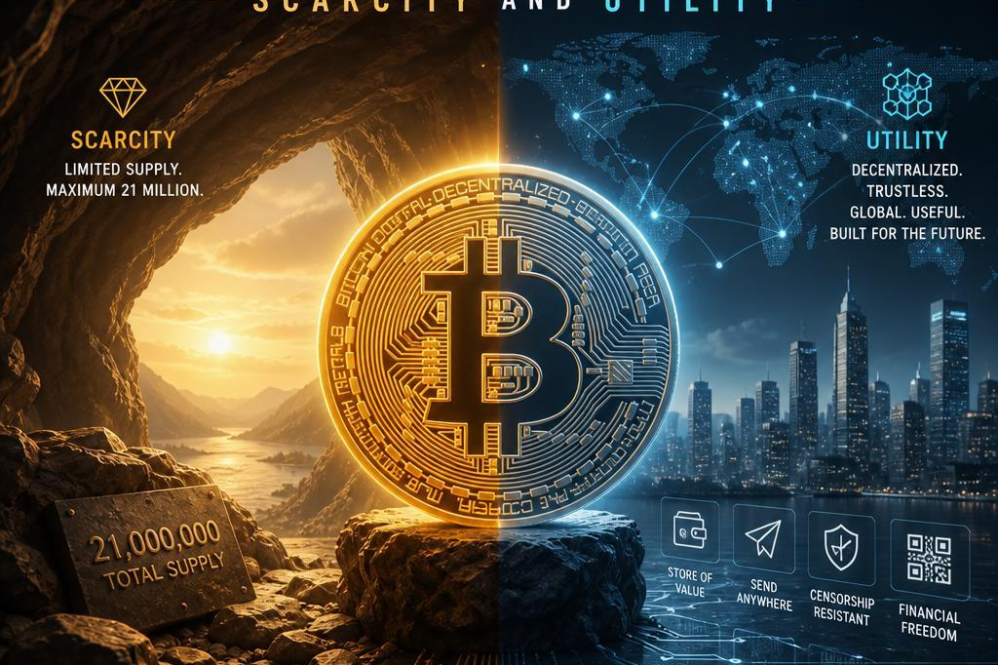
what backs bitcoin’s value? Not a government guarantee, a company’s profits, or a physical commodity held in reserve. bitcoin’s value is backed by its scarcity, security, network effectand utility-the qualities that lead people to use, hold, and trade it. None of those qualities guarantees a particular price,but together they help explain why bitcoin has value to its users.
A Fixed Supply Creates Digital Scarcity
bitcoin’s monetary policy is built into the protocol. No more than 21 million bitcoin can be created. New coins enter circulation through mining rewardsand the rate of issuance falls over time through scheduled halvings.
That does not mean bitcoin must rise in price. Markets do not work that way. Scarcity only matters when people want the thing that is scarce. But bitcoin’s supply is unusually clear: anyone can examine the rules, track issuanceand see that the supply limit is not subject to routine policy decisions.
Its scarcity becomes more meaningful because bitcoin is not simply a digital collectible.It can be divided into very small units, transferred across bordersand held without relying on a bank or payment company.If people continue to value those features, a limited supply can make each unit more economically important. In simple terms, bitcoin’s value depends on voluntary demand meeting a supply that cannot expand to meet it.
Security Without a Central issuer
bitcoin does not depend on a central bank, a company balance sheetor a single database administrator. Instead, self-reliant participants around the world validate transactions according to shared rules. The public ledger records confirmed transactionsand the network is designed to reject attempts to spend the same bitcoin twice.
Ownership is tied to cryptographic keys. If you control the private key associated with bitcoin, you can authorize a transaction. That arrangement gives users a different kind of assurance from a conventional account: rather than trusting one institution to maintain the record,they can verify the network’s rules and transaction history themselves.
Decentralization is an important part of that appeal. No single operator can simply change bitcoin’s supply limit, reverse a valid transactionor decide who may participate in the network. Changes can be proposed, but they only take hold when enough users, node operators, miners, and businesses choose to adopt them. The system is not free of disagreements or tradeoffs, but it is indeed deliberately arduous for one party to rewrite the rules on its own.
That security and independence are part of bitcoin’s utility. they give people a way to hold and transfer a scarce digital asset without placing complete trust in a single intermediary.
Why People Use It
bitcoin can be sent to a compatible address anywhere the network can be reached. It does not rely on the usual chain of correspondent banks, local clearing hoursor approval from a payment processor. The same validation rules apply weather the sender and recipient are in the same city or on opposite sides of the world.
That does not remove every practical obstacle. Exchanges can impose restrictions, governments can regulate its use, taxes may applyand users still need internet access and secure ways to manage their keys. bitcoin is also volatile, which can make it impractical for some everyday payments.Even so, its portability gives it a use case that is not limited to a single country’s financial system.
Direct custody matters, too. A person can hold bitcoin through private keys rather than relying entirely on a bank’s promise or a platform’s account policies.That does not mean bitcoin is anonymous or beyond the reach of law. Transactions are publicly recorded on the blockchain. Censorship resistance means something narrower: there is no single company, bankor government that runs the ledger and can unilaterally stop every valid transaction from being broadcast and confirmed.
For some people, these features are useful only occasionally. For others-particularly where financial access is limited or institutions are less trusted-they may matter much more. That practical usefulness is one reason bitcoin can attract demand beyond short-term speculation.
How to Think About Value and Risk
When evaluating bitcoin, it helps to separate the case for value from the case for price gratitude. The value case rests on a fixed supply, a secure and open network, growing familiarity and liquidityand the ability to move and hold value digitally. Whether those features support a higher market price depends on how much demand exists for them over time.
Network effects are part of the picture.A monetary asset tends to become more useful when more people can access it, more businesses accept itand more services make it easier to buy, sell, storeor transfer. Still, investors should be careful not to confuse trading activity with durable adoption. High volume and public attention can reflect speculation just as easily as long-term use.
bitcoin also differs from a stock or a bond. It does not produce earnings, dividendsor interest on its own, so there is no conventional cash-flow model that can establish a precise fair value. Its market price reflects demand,liquidity,economic conditions,regulation,confidence in the network,and expectations about its future role.
- Potential value drivers: fixed supply, continued demand, liquidity, broader accessand confidence in the network.
- Key risks: sharp price swings, changing regulation, custody errors, fraudand shifts in market sentiment.
A sensible approach starts with those risks. Anyone considering bitcoin should understand how it will be stored, avoid investing more than they can afford to loose, and resist treating past gains as evidence of future returns.
The Bottom Line
bitcoin is valuable because people place value on a scarce digital asset that can be independently verified, held directlyand transferred on an open network. Its supply limit matters,but scarcity alone is not enough.The stronger case rests on the combination of scarcity, security, network adoptionand real-world utility.
That combination may support long-term demand, but it does not make bitcoin a low-risk asset or guarantee future returns.Its price can change quickly when sentiment, liquidity, regulationor expectations shift. Understanding both the strengths and the limits of the bitcoin model is essential before deciding whether it has a place in an investment portfolio.