GSR Capital has finally closed on its investment in tZERO, Overstock.com’s security token trading platform, after months of delays and revisions to the deal.
Instead of buying $30 million of tZERO tokens, as previously agreed, the Hong Kong private equity fund invested just $5 million in tZERO equity, in the traditional form. The finalized transaction valued tZERO’s at $1 billion, less than the $1.5 billion in the initial agreement.
Patrick Byrne, Overstock’s CEO, announced the news Thursday morning during the company’s Q1 earnings call, adding:
“We’re letting them [GSR] out of all previous contracts.”
Makara Capital, a Singapore fund brought into the deal by GSR, is still conducting its due diligence of tZERO, and may yet invest the money it pledged earlier, Overstock said. “We are still working with Makara and feel optimistic (but not certain) that something can be consummated with them (and GSR may join in again at that point),” the company’s Q1 earnings report said.
Despite the sharp reduction in proceeds, tZERO CEO Saum Noursalehi told CoinDesk that the $5 million investment was “a decent offer.” The investment consists of $1 million in U.S. dollars, $1 million worth of Chinese Renminbi, and $3 million worth of “certain securities,” according to Overstock.
Long negotiations
The original deal with GSR, announced last summer, was expected to bring $404 million to tZERO, but was postponed several times and to $100 million in March, and then to in April.
In March, when the deal was postponed for the second time, GSR brought in Makara. The two firms were supposed to co-lead the $100 million investment in tZERO.
As tZERO has not obtained as much external investment as it hoped for, it will for the time being rely on cash from the parent company: earlier plans to sell the Overstock.com online retail business were , too.
“The retail business have quite a bit of capital, they are starting to be cash flow-positive,” Noursalehi told CoinDesk.
To raise additional capital, Overstock sold some of its stock recently, he said — not that it all will go to tZERO, but if it needs money those funds can get “pushed down” to it from the parent company, according to Noursalehi.
This funding served as a “kind of hedge” against the uncertainty in the GSR-Macara deal, he said.
Blockchain progress
On the bright side, tZERO seems to have found a new big client to issue security tokens on its platform.
According to Noursalehi, Dubai-based real estate giant Emaar has signed a letter of intent to issue tokens on tZERO. Emaar owns luxury residential and commercial high-rises, including the world’s tallest building, the Burj Khalifa in Dubai.
Emaar plans to do an initial coin offering (ICO) in March in a partnership with the Swiss startup Lykke AG. Neither Emaar’s media representative nor Lykke responded CoinDesk’s requests by press time.
At first, Emaar will do “some initial small, proof-of-concept issuance to prove it out,” Noursalehi said, although the company is looking into launching a token issuance project as big as $2 billion in the next couple of years. No timeline or other details of the future deal are set now, tZERO’s CEO said, but “we want to get a definitive contract in the next week or two.”
Elio Motors, a car manufacturer that Byrne has previously was working on a token issuance with tZERO, will not be among the first issuers on the platform, Noursalehi said. Elio wants to code a more complicated functionality into their tokens, like allowing token holders to get their ordered cars faster, and working on that will take more time, he explained. By the end of this year, tZERO hopes to get up to 10 tokens traded on its alternative trading system (ATS).
Another partnership was announced during the earnings call: this month, tZERO is planning to complete an integration with another tokenization platform, Securitize. According to Noursalehi, tZERO’s team will conduct due diligence of the tokens issued on Securitize and pick some of them to trade on the ATS.
“Securitize seems to be executing well in the space and providing good quality assets,” Noursalehi said.
Also on Thursday’s earnings call, Overstock gave a demonstration of the previously tZERO crypto trading app, scheduled to go live in June. The app will initially list only bitcoin, ether and, possibly, ravencoin. (The ravencoin blockchain was used by Overstock’s venture arm, Medici Ventures, in a earlier.)
As for the other subsidiaries of Medici, Byrne announced that Medici Land Governance, a startup aiming to put land registries on a blockchain, has signed a contract with the government of Zambia, where it’s already been working on a covering 50,000 houses. The new contract adds “250,000 additional homes (and potentially a million or more) in Lusaka over 10 years,” the Q1 report says.
Going full blockchain?
In the meantime, Overstock is moving some of its own shares to tZERO, a plan it recently notified shareholders about.
These shares, known as “Blockchain Voting Series A Preferred Stock,” were issued in 2016 as the initial proof-of-concept for the future token trading platform.
A new ERC-20 token named already exists on the ethereum blockchain, but no transactions have been recorded yet.
The shares will be live on tZERO in June, the company said on the earnings call.
In the long term, Overstock is planning to issue more tokenized shares. Ultimately the company could go full blockchain, Noursalehi said, concluding:
“Long term down the road, we may ultimately delist from NASDAQ and have all our stock on tZERO. But [before that can happen] it obviously will have to be a much more liquid market than it is today.”
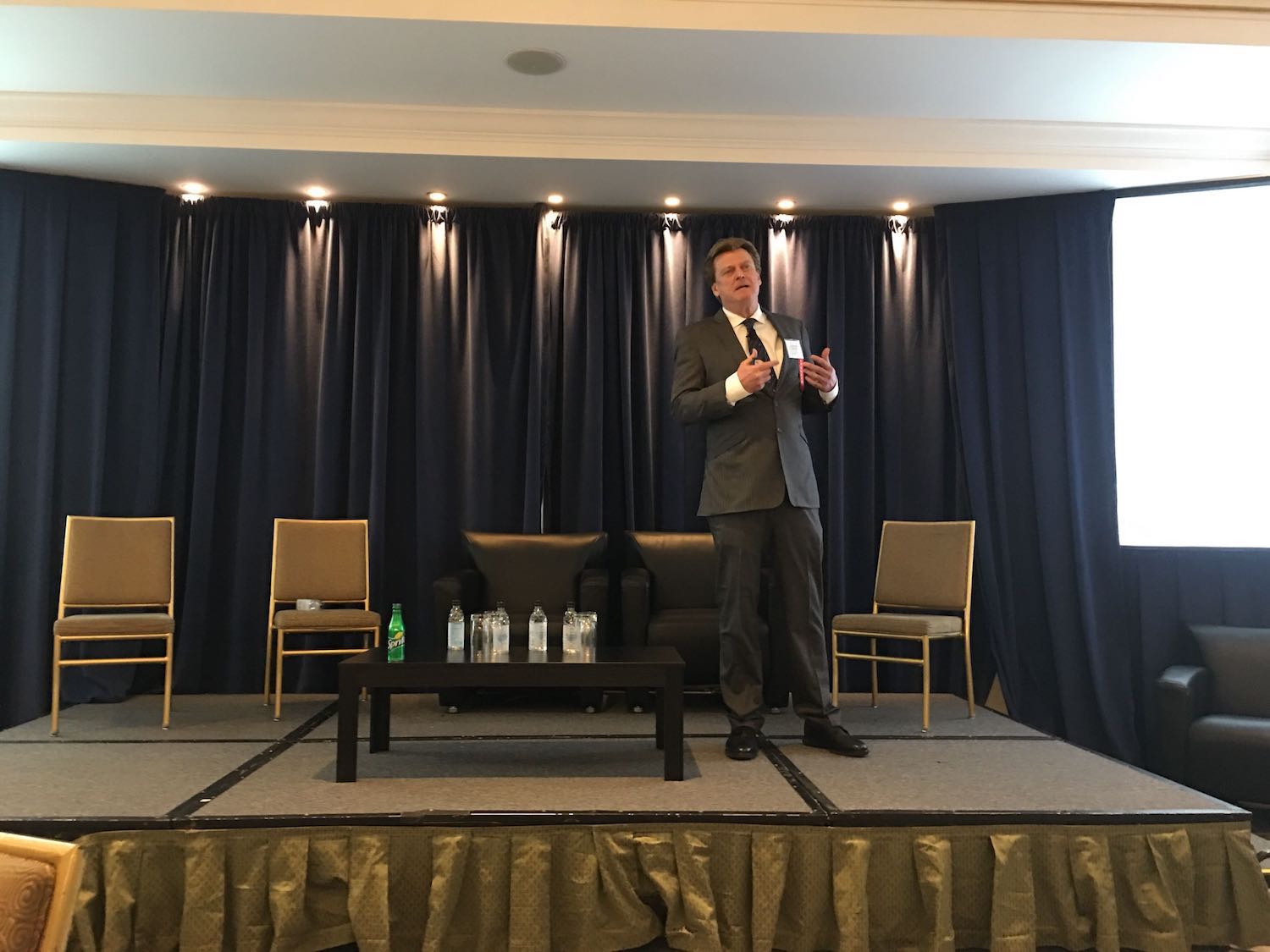
Image of Patrick Byrne by Anna Baydakova for CoinDesk
Published at Thu, 09 May 2019 14:05:12 +0000
![Binance coin [bnb] skyrockets by over 300% in 2019; first coin to break ath ceiling |](https://ohiobitcoin.com/wp-content/uploads/2019/04/whatsapp-icon-square.svg "Binance coin [bnb] skyrockets by over 300% in 2019; first coin to break ath ceiling |")
