October 11, 2026

Capitalizations Index – B ∞/21M

Here’s How Much Public Pensions Are In The Hole By Per U.S. Resident

Here’s how much public pensions are in the hole by per u. S. Resident

Here’s How Much Public Pensions Are In The Hole By Per U.S. Resident

Although some government agencies have demonstrated a desire to deal with the pension crisis, the problem of unfunded liabilities continues to get worse year after year. A new report pegs U.S. public pensions’ unfunded liabilities at nearly $6 trillion as of 2018. That amounts to a whopping $18,300 per U.S. resident.

Public pensions

Using “realistic” assumptions

One of the big issues in the U.S. pension crisis is the fact that many funds are estimating their returns based on unrealistically high assumptions. The American Legislative Exchange Council (ALEC) made a point of emphasizing that its $5.96 trillion estimate for unfunded liabilities was made “using more realistic investment return assumptions” and a “proper, risk-free discount rate.” This is probably why ALEC’s rankings on unfunded pension liabilities differs significantly from others, such as this one from Bloomberg.

Get The Full Seth Klarman Series in PDF

Get the entire 10-part series on Seth Klarman in PDF. Save it to your desktop, read it on your tablet, or email to your colleagues.

Q4 hedge fund letters, conference, scoops etc

As a result, the estimate is much worse than the already-large official amounts reported in state financial documents. According to ALEC, the average state pension is now funded at only 35%, which means unfunded liabilities have risen to $18,300 for every resident of the U.S.

Given that raising taxes is generally the go-to method to increase required contributions, this number makes it clear that state governments just can’t raise taxes enough to make up for their decades-long poor management. Illinois, especially Cook County, demonstrates what happens when officials raise taxes so much that people can’t afford to live there anymore.

States are skipping required payments

ALEC blames state governments directly for this major shortfall, explaining that most state governments are not making their annually required contributions. ARCs include the annual amount needed to cover the “normal cost of future pension obligations accrued in the present, along with amortization of prior unfunded liabilities,” the organization explained.

The organization even said that some states are even skipping payments entirely. For example, a 2017 report found that just 32 states made pension contributions that were enough to cover the accrued unfunded liabilities in fiscal 2015.

ALEC also notes that state workers and pensioners aren’t the only ones affected by the pension crisis. Taxpayers are ultimately footing the bill for government employees’ salaries and pensions, and even non-tax-paying residents are affected when pension costs capture funds that would otherwise go toward essential city services.

For example, I would point out that some Chicago-area suburbs such as Harvey were forced to lay off police officers and/or firefighters when a court ruled that they must pay pension benefits even though they couldn’t afford to do so.

Best and worst states in unfunded liabilities

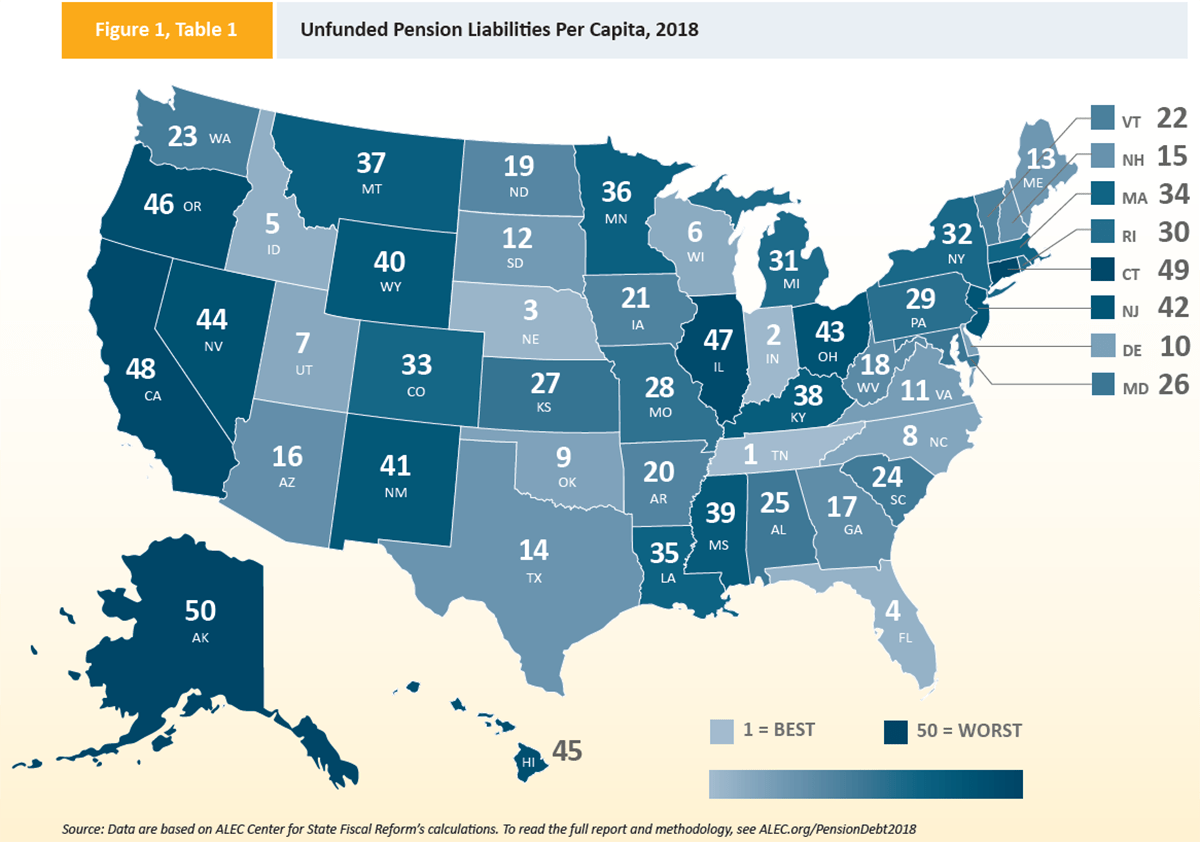
According to ALEC, the states with the least unfunded liabilities per capita are Tennessee, Indiana, Nebraska, Florida and Idaho. The five worst states are Oregon, Illinois, California, Connecticut and Alaska.

Public pensions

ALEC also looked at states’ ability to pay their unfunded pension liabilities based on gross state product. Some of the states are in the same or similar positions to their per capita ranking, although a few changed their positions dramatically. For example, Florida had the fourth-lowest per capita unfunded liabilities, but it ranked tenth in ability to pay those liabilities.

Per capita unfunded liabilities

The organization also looked at which states have made the most progress in fixing their troubled pension systems. Nebraska has made significant progress because not only is it among the top five in per capita unfunded liabilities, but it’s also in the top five most improved. On the other hand, Indiana is closer to the middle of the pack in improvements, but the state is already in second place on a per-capita basis.

Per capita unfunded liabilities

This article first appeared on ValueWalk Premium

The post Here’s How Much Public Pensions Are In The Hole By Per U.S. Resident appeared first on ValueWalk.

Published at Mon, 15 Apr 2019 04:09:08 +0000

Previous Article

The Bigger Picture Behind Bitcoin’s Latest Price Rebound

Next Article

Ethereum (ETH) Price Showing Positive Signs Above 100 SMA

You might be interested in …

Introducing a Programming Language so Simple, It “Fits on a T-shirt”

http://plas2017.cse.buffalo.edu/

Blockstream is introducing Simplicity, a new programming language for blockchain-based smart contracts, intended for inclusion in Blockstream’s sidechains and eventually in bitcoin. The new language was presented by its creator, Russell O’Connor, Infrastructure Tech Developer at Blockstream, at the ACM SIGSAC Workshop on Programming Languages and Analysis for Security (PLAS 2017).

“Simplicity is a blockchain programming language that is so simple, it fits on a t-shirt,” O’Connor told bitcoin Magazine. “It is critical that smart contracts behave in ways that all participants expect, and applying formal verification to Simplicity allows us to achieve that.”

Simplicity is still a Blockstream Research & Development project, but there’s potential for its use in Blockstream products in the future, according to the company’s announcement.

“Simplicity is flexible enough that I anticipate many new, domain-specific, languages will generate Simplicity, and this will give users the freedom to generate smart contracts using the tools that most suit their needs,” added O’Connor.

O’Connor’s paper, titled “Simplicity: A New Language for Blockchains,” presents Simplicity as “a new programming language, designed to be used for cryptocurrencies and blockchain applications, which aims to improve upon existing cryptocurrency languages, such as bitcoin Script and Ethereum’s EVM [virtual machine], while avoiding some of the problems they face.”

bitcoin script is limited by design and unsuitable for complex smart contracts that need more than a small set of simple templates to perform tasks like digital signature verification. Ethereum, on the other hand, includes a more expressive and flexible, Turing-complete programming language, which allows for arbitrarily complex smart-contracts in principle.

But, in practice, Ethereum doesn’t support static analysis to pre-determine the computing resources that a program will require and, thus, filter out too costly contracts and infinite loops. Therefore, pre-paid “gas” fees are lost when an Ethereum program “runs out of gas.” The simpler bitcoin scripting, which supports static analysis, doesn’t present similar issues.

In a post to the bitcoin-dev mailing list, O’Connor proposed Simplicity as an alternative to bitcoin Script, noting that static analysis is important for both node operators and for Simplicity program designers.

“Static analysis is a technique that provides a universal algorithm to determine how much any Simplicity program will cost to run before you stake your money on it,” O’Connor told bitcoin Magazine.

Simplicity can be seen as a more flexible alternative to bitcoin scripting, not Turing-complete but expressive enough to build useful smart contracts for blockchain applications, or as an alternative to Ethereum, which will support static analysis and other desirable features including improved safety, formal semantics, and Merkelized Abstract Syntax Trees (MASTs).

While Simplicity is intended as a low-level language for smart contracts, O’Connor envisages the possibility of compiling programs written in higher-level languages (like Ethereum’s Solidity) to Simplicity.

“Ivy and the Σ-State Authentication Language are existing programming language development efforts that may be suitable for being compiled to Simplicity,” notes O’Connor in the paper. “For the time being, generating Simplicity with our [Haskell] and [Coq] libraries is possible.”

The next step in Simplicity’s development will be a bare-bones SDK (Software Developer Kit) that will include formal semantics and correctness proofs in Coq, a Haskell implementation for constructing Simplicity programs and a C interpreter for Simplicity. Then, the new language will be ready for initial deployment in the Elements project, Blockstream’s open-source codebase for sidechains, so that developers can start experimenting with the code.

But, as O’Connor stated on bitcoin-dev, “Only after extensive vetting would it be suitable to consider Simplicity for inclusion in bitcoin.”

The post Introducing a Programming Language so Simple, It “Fits on a T-shirt” appeared first on Bitcoin Magazine.