June 8, 2026

Capitalizations Index – B ∞/21M

Crypto Trading 101: Stochastic Oscillators and Price Momentum

Crypto trading 101: stochastic oscillators and price momentum

Crypto Trading 101: Stochastic Oscillators and Price Momentum

You may have heard of a lagging or leading indicator before. Maybe your friends have tossed around terms like bullish or bearish divergences, oversold or overbought conditions and what signals you should use to enter or exit the market.

While there are many tools that can assist with this, one often overlooked indicator is called the stochastic oscillator.

Nothing unique to the world of blockchain, the stochastic is a momentum indicator that compares the closing price of the asset with its high-low range over a certain period of time, it’s a handy tool. Even better, it works no matter the volatility, even in the fast-moving market for cryptocurrencies.

First, the particulars require a bit of math:

Slow %K= 100 [Sum of the (C – L14) for the %K Slowing Period / Sum of the (H14 – L14) for the %K Slowing Period]

Slow %D = SMA of Slow %K

Where:

  • C = Latest Close
  • L14 = Lowest low for the last 14 periods
  • H14 = Highest high for the same 14 periods
  • %K Slowing Period = 3.

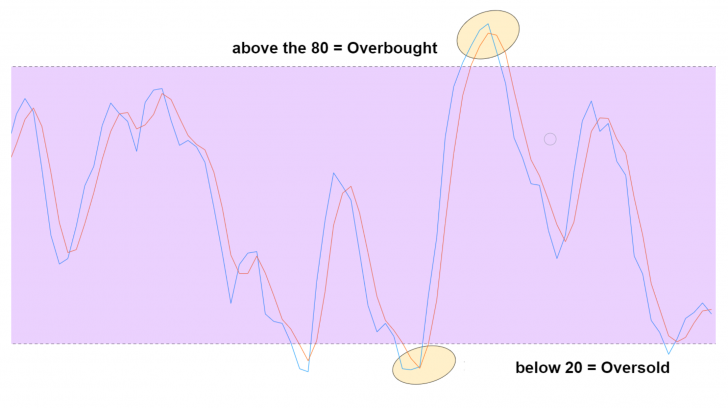
Fortunately, crypto traders need not worry about the calculation part, as the trading platforms and chart softwares process the complex formula and produce a stochastic oscillator, as seen in the chart below.

All you need to know is how to use the oscillator to maximize your efforts.

Reading the Stochastic OscillatorCrypto trading 101: stochastic oscillators and price momentum

To start with, the indicator can range from 0 to 100. The area above 80 represents overbought conditions, and the area below 20 indicates oversold conditions.

So, price rallies usually stall after the stochastic reaches an overbought zone. On the other hand, stochastics reporting oversold conditions are widely considered a sign the bears have reached a point of exhaustion.

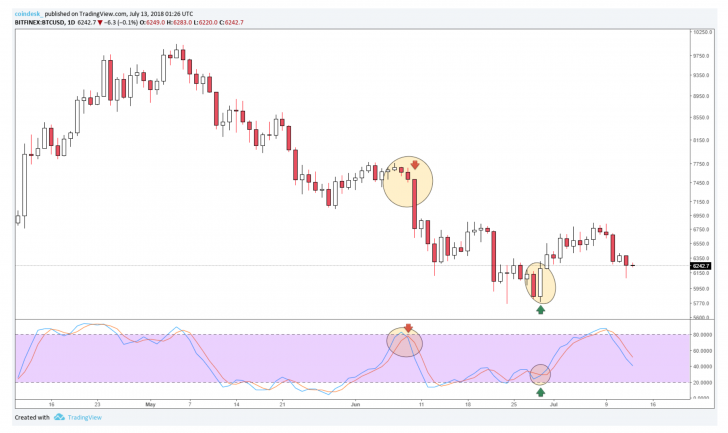
Further, trend reversal signal occurs when the %K line and the %D line cross in the overbought (above 80.00) or oversold (below 20.00) region.

  • Buy signal = %K line crosses %D line from below in the oversold territory.
  • Sell Signal = %K line crosses %D line from above in the overbought territory.
Crypto trading 101: stochastic oscillators and price momentum

The above chart shows, bitcoin dropped 11% after the stochastic generated a sell signal on June 9. Further, it rallied more than 8 percent after the stochastic charted a buy signal on June 29 (green arrow).

Note that stochastic tends to work best in broad trading ranges or slow-moving trends.

Stochastic: a leading indicator

Still, the stochastic is one tool of many.

The difference between a leading indicator such as the stochastic or Relative Strength Index (RSI) and a lagging indicator such as Moving Averages or Bollinger Bands is that the leading indicators precede price movements, while lagging indicators follow price movements.

Their usage also differs during trending and non-trending periods because lagging indicators tend to focus more on the trend and produce fewer buy and sell signals than their leading counterparts.

READ: CoinDesk’s Candlestick Guide can give you the basic building blocks to use this tool.

Charts via Shutterstock

The leader in blockchain news, CoinDesk is a media outlet that strives for the highest journalistic standards and abides by a strict set of editorial policies. CoinDesk is an independent operating subsidiary of Digital Currency Group, which invests in cryptocurrencies and blockchain startups.

Published at Sun, 22 Jul 2018 11:00:33 +0000

Features

Previous Article

Mining Freecoin

Next Article

D.Corp Cypher Sessions #2 feat. 3000 Jools.Cryptic.Equity & D.Corp Ree Jay.Aerows.Filthy Fil

You might be interested in …

Quantstamp (qsp) analysis - will qsp hit $5 this year?

Quantstamp (QSP) Analysis – Will QSP hit $5 this year?

Quantstamp (QSP) Analysis – Will QSP hit $5 this year? Quantstamp (QSP) Analysis – Will QSP hit $5 this year? An analysis seeing if the cryptocurrency Quantstamp is capable of reaching $5. Crypto Playlist: http://bit.ly/cryptoplaylist […]

Scaling Bitcoin Releases This Year’s Program and Announces a New Developer Bootcamp

Scaling Bitcoin Just Released This Year’s Program and a New Developer Bootcamp

Today, Scaling Bitcoin, the international engineering conference focused on bitcoin and blockchain research, released its program for the 2017 edition. The conference, to be held in Stanford, California, in the first weekend of November, will also introduce a new side event this year: Bitcoin Edge, a bootcamp for starting bitcoin developers.

“The program is extremely interesting because it delivers cutting edge research on different blockchain scalability approaches, fungibility, consensus, data propagation, alternative techniques for handling blockchains and many other topics,” said Anton Yemelyanov, chair of the Scaling bitcoin Planning Committee.

Scaling bitcoin Stanford

After events in Montreal, Hong Kong and Milan, the fourth edition of the Scaling bitcoin conference is taking place at Stanford University on November 4 and 5 of this year.

Where the first two editions of Scaling bitcoin were mainly focused on scaling and scalability, the third edition broadened the scope of the conference to include a more diverse set of topics. This trend will continue in Stanford, where talks will range from highly technical topics concerning privacy and fungibility, to fee markets and fee estimation, censorship resistance and more.

bitcoin is the origin of all distributed ledger technology,” said Yemelyanov. “Scaling bitcoin has been fortunate to act as a vehicle for bringing the audience technologies such as Segregated Witness and MimbleWimble, all of which have been adopted or incorporated into various blockchain projects. We hope that other material presented by our participants will be of similar value and help the industry advance the research and development of blockchains.”

Yemelyanov added that another key goal for Scaling bitcoin conferences is to bring engineers and other technical minds together in a physical space where they can discuss their work in person.

“It is through collaboration where a lot of ideas are born and have potential of becoming reality,” he said.

bitcoin Edge Dev++

In addition to the conference itself, Scaling bitcoin is also introducing a two-day technical bootcamp for experienced developers getting into bitcoin: bitcoin Edge.

This nonprofit initiative is an effort to help scale the development capacity of the industry, Yemelyanov explained:

“One of the approaches of helping the industry scale is to scale the much needed development capacity of the industry. There is a clear talent deficit and we are trying to help all industry participants by running a nonprofit workshop that will allow developers to gain complete understanding of primitives that comprise bitcoin and blockchains in general and be able to start working in this field.”

bitcoin Edge will be led by well-known bitcoin developers and academics Anditto Heristyo, Ethan Heilman, John Newbery, Karl-Johan Alm, Nicolas Dorier, Thaddeus Dryja and Jimmy Song. They’ll introduce participants to a range of technical bitcoin-related topics, including Elliptic Curve cryptography, transaction structures, difficulty calculation and adjustments, and much more.

This workshop will take place on the November 2 and 3. For more information on the bitcoin Edge initiative, visit bitcoinedge.org.

See here for the full Scaling bitcoin Stanford program.

The post Scaling Bitcoin Releases This Year’s Program and Announces a New Developer Bootcamp appeared first on Bitcoin Magazine.