July 27, 2026

Capitalizations Index – B ∞/21M

Crypto Startup: JP Morgan Chase Closed our Account with No Explanation

Crypto startup: jp morgan chase closed our account with no explanation

Crypto Startup: JP Morgan Chase Closed our Account with No Explanation

Cryptoraves, a company that is working on the tokenization of social media, had its bank account shut down last month by JP Morgan, not long after news of JPM Coin broke. Eventually, the crypto startup was told that they were working in a “prohibited industry,” but they couldn’t get more details than that.

Account Closed One Day After Launching JPM Coin

Meanwhile, JPM Coin is a blockchain solution, and JP Morgan itself works in digital currencies for some clients.

Nevertheless, the bank told Cryptoraves:

“After a recent review of your account, we have decided to end our relationship with you.”

Jpmorgan chase crypto

Chase failed to explain why it closed the crypto startup’s account. | Source: CryptoRaves/Medium

Cryptoraves so far is a token meant to “boost credibility” on social media. A Twitter user can request free tokens and send them to other Twitter users. The tokens have no actual value, so, therefore, shouldn’t currently run afoul of securities regulations.

Cryptoraves’s Bryan Plasters writes in a blog post:

“We did send two wire transfers to Gemini to buy ETH and LOOM in order to cover future blockchain fees. We suspected that these transactions flagged our account, but the Chase rep would not confirm this. They would not give us a reason for the closure. We called the number in the letter and the agent told us to visit a branch for these details. Visiting our branch resulted in no other details except when our branch rep pressed the agent (yep as the primary course of action, our rep called the same phone number), they said we were operating in an ‘prohibited industry’. I guess JPM’s own blockchain department didn’t get the memo?”

JP Morgan Fires Loyal Customer
Jamie dimon, jpmorgan, crypto

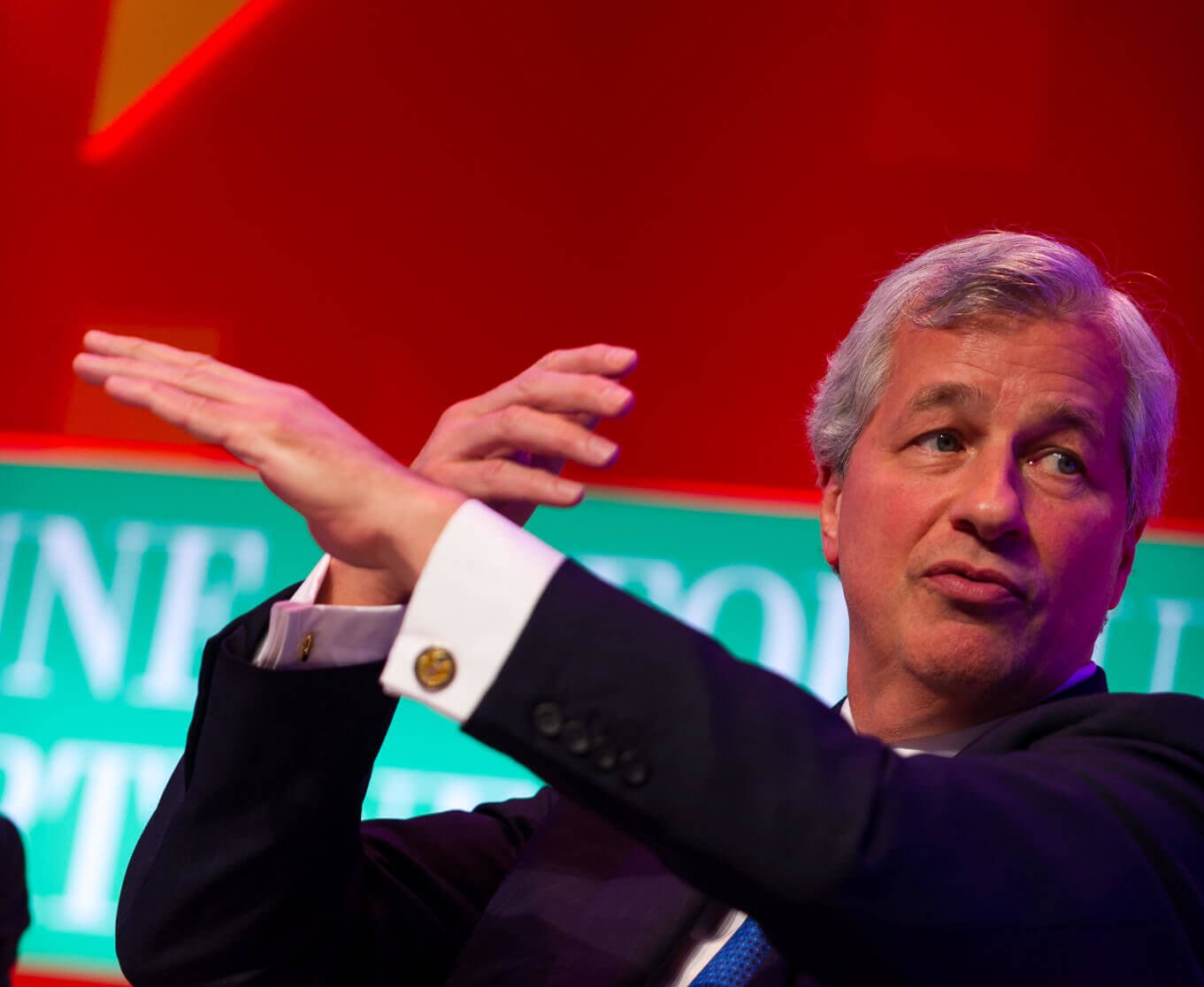
Jamie Dimon: Crypto for me, but not for thee. | Source: Shutterstock

Sadly, the proprietors of Cryptoraves, LLC, had been happy with their long-standing relationship with JP Morgan Chase. They say they’ve been doing business for 15 years there, and that they’ve never had a problem as a result of crypto activities prior to this.

The interesting thing about JP Morgan’s shuttering of their account is the timing. The letter is dated just one day after JP Morgan launched JPM Coin. JPM Coin, of course, is a solution for international payments offered to major clients. It is used to subvert high international fees for a small percentage of JP Morgan’s daily $6 trillion in transfers.

This is, of course, not the first time Chase has closed accounts related to the crypto industry. Every now and then someone comes up for air and reports that the banksters have bullied them out of the regular banking world.

The trend is rather widespread. Bloomberg reported earlier this month that JP Morgan had blacklisted most crypto startups. Sam Bankman-Fried, an expert on the subject, told them:

“It’s not illegal for big banks to bank the crypto industry, but it’s a massive compliance headache that they don’t want to put the resources in to solve.”

Banking with crypto is a problem consistently faced by traders and holders. The simple act of sending a deposit to an exchange can result in account closure.

Published at Wed, 13 Mar 2019 20:30:59 +0000

Previous Article

Blockchain Technology and Digital Governance- Consensus

Next Article

Trezor hits back at Ledger; releases report to counter claims of its wallets being vulnerable to attacks |

You might be interested in …

Op-ed: Bitcoin Is Not a Bubble; It's in an S-Curve and It's Just Getting Started

Op-ed: Bitcoin Is Not a Bubble; It's in an S-Curve and It's Just Getting Started

One of the most intriguing stories underpinning the recent rise of bitcoin prices is how financial institutions will interact with the currency.

The upcoming CBOE futures market is going to open the door for Wall Street giants to participate in the market. That could spell moon or doom for bitcoin, and everyone is speculating on what may happen next.

It is this Wall Street/BTC interaction (phenomenon) that may be driving the unbelievable price spike of the past few days — at least partially.

On the macro scale, however, we may be witnessing a more grand pattern forming; a price-correlated S-curve.

The S-curve is the classic adoption curve applied to the advent of new technologies. As a percentage of the population, adoption looks like a lag phase where the technology is utilized by the innovators of said technology, followed by an early adoption phase led by people who often take risks in order to be the first movers in a space. After the early adopter phase (~16% of the population is now participating), there comes a great “tipping point” where the wide use of the technology seems inevitable. The tipping point gives rise to the “Early Majority” joining in on the fun, followed by the late majority and, finally, the holdouts who allow the top of the S to asymptotically approach total adoption. The curve, as a factor of time and adoption, looks sort of like the following:

Screen_Shot_2017-12-08_at_9.56.44_AM.png

This curve correlates nicely with adoption of some of the greatest technological innovations in our recent history:

Screen_Shot_2017-12-08_at_9.57.15_AM.png

Some important things to note is that this is just U.S. adoption. Much of the world lagged behind the U.S. in the consumer appliance boom of the 1900s. All of these curves, however steep, do follow the same S-curve trend fairly nicely.

So what could that mean for bitcoin? It’s difficult to choose a metric to define bitcoin adoption, and, in fact, there are disputes about if one metric accurately captures it. However, for simplicity I’ll highlight Google searches for bitcoin and Coinbase user count as microcosms of the global adoption trend.

google search

Screen_Shot_2017-12-08_at_9.58.02_AM.png(from CNBC)

This seems to show a very similar pattern to what could be the transitional phase between “innovators” and “Early Adopters.” Just to harken back to the earlier statement though — it’s very difficult to put a number on bitcoin adoption.

So why is this remarkable? bitcoin may be the first “buyable” S-curve. Because this is a capped-supply currency, more users adopting and using it necessitates an increase in price. Whether that correlation is even reflective of the current price action is a practically unanswerable question, and the obvious leaning would be towards there being a speculative additional value. However, with an increase in adoption, there seems to be a floor rising up to catch whatever “bubble burst” might occur, if and when it happens.

https://platform.twitter.com/widgets.js

“Eternal September” is the phrase used to describe September of 1993, when widespread internet adoption began to look inevitable. It occured after AOL began a mailing campaign offering free trials of its internet service, leading to an influx of internet users that has since never ended. Hence “Eternal September.”

https://platform.twitter.com/widgets.js

To compare bitcoin’s adoption to its complement — the internet — this may very well be the “Eternal September” episode for bitcoin.

If the S-curve adoption theory applies to bitcoin, then buckle up. I won’t pretend to be able to predict a spot price, but I will say I think we may be sitting close to another order of magnitude this time next year.

See y’all on the moon.

Corollary: Bulls sound smart in bull markets. We may look back and laugh at this thought, or it may hold true for years to come. Time will tell. ‘Til then, buy bitcoin.

Trading and investing in digital assets like bitcoin and ether is highly speculative and comes with many risks. This analysis is for informational purposes and should not be considered investment advice. Statements and financial information on bitcoin Magazine and BTC Media related sites do not necessarily reflect the opinion of BTC Media and should not be construed as an endorsement or recommendation to buy, sell or hold. Past performance is not necessarily indicative of future results.


The post Op-ed: Bitcoin Is Not a Bubble; It's in an S-Curve and It's Just Getting Started appeared first on Bitcoin Magazine.