
June 11, 2026

Capitalizations Index – B ∞/21M

Bitcoin Price Ducks Below $6,100 as Crypto Market Loses $7 Billion: No Facebook Effect

Bitcoin price ducks below $6,100 as crypto market loses $7 billion: no facebook effect

Bitcoin Price Ducks Below $6,100 as Crypto Market Loses $7 Billion: No Facebook Effect


Bitcoin price ducks below $6,100 as crypto market loses $7 billion: no facebook effect
Advertisement

Many investors and analysts expected the reversal of cryptocurrency advertisement ban by the $576 billion technology giant Facebook to fuel a short-term corrective rally. However, bitcoin and the rest of the cryptocurrency market struggled to sustain momentum.
Bitcoin price ducks below $6,100 as crypto market loses $7 billion: no facebook effect

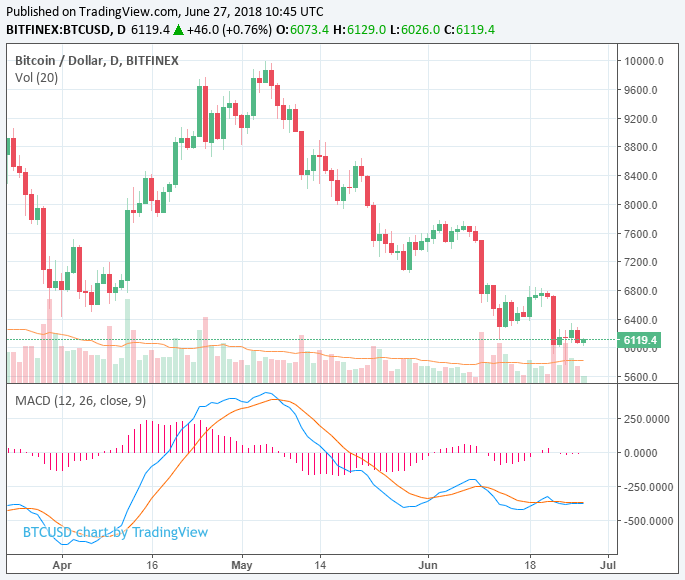
In the past 24 hours, the crypto market lost over $7 billion amidst a minor correction. On June 26, after a speedy recovery by bitcoin from the $5,900 region, the market seemed to be gaining momentum in the short-term.

Tokens such as Ontology (ONT), Theta, and Qtum performed particularly well, recording 20 to 40 percent gains against bitcoin within the past seven days. But, as major cryptocurrencies including bitcoin, Ethereum, Ripple, and bitcoin Cash slowed down, tokens started to lose momentum.

Facebook Had No Effect on Crypto

Unsurprisingly, the reverse ban on cryptocurrency advertisement by Facebook had no impact on the price of BTC and other cryptocurrencies, suggesting that the initial cryptocurrency advertisement ban by Facebook had no impact on the cryptocurrency market in the first place.

At the time, the vast majority of mainstream media outlets and analysts attributed the fall in the market valuation of digital assets to the ban on crypto ads by Facebook that evidently had no effect on the market in any way.
Australia bitcoin tax
Facebook’s turn hasn’t seen any profound impact on cryptocurrency prices.

The decision to unban crypto ads on its platform by Facebook triggered positive conversations about cryptocurrency adoption on various social media platforms and online communities. But, it is important to understand the reasoning behind Facebook in its initial crypto ad ban. In January, Facebook had banned crypto ads because it did not want to be liable for initial coin offerings (ICOs) and potential losses of investors participating in token sales.

Recently, Chicago Board Options Exchange (Cboe) president Chris Concannon, who represents the first major financial institution in the traditional finance market to commit to the cryptocurrency market, said that the US Securities and Exchange Commission (SEC) will likely go after investors that participated in ICOs and sellers of tokens.

“The actual party that offered the unregistered coin, they could have been involved in issuing an unregistered security. Anyone who sold that off could be deemed an unregistered underwriter. If you sold someone an unregistered security you are liable to them if they decide to take them to court.”

It is highly likely that attorneys of Facebook encouraged the platform to eliminate ICO ads because of potential scrutiny by the US SEC and immediately thereafter, Facebook banned crypto ads.

In its recent announcement, Facebook reaffirmed that while crypto ads are permitted, ICO ads are still not allowed.

“Given these restrictions, not everyone who wants to advertise will be able to do so. But we’ll listen to feedback, look at how well this policy works, and continue to study this technology so that, if necessary, we can revise it over time,” Facebook product management director Rob Leathern, said.

Where the Market Goes Next

Considering that the Facebook case will have no impact on the cryptocurrency market in any way in the short-term, the trend of digital assets will solely rely on the state of the market.

Currently, the issue with low volume in the crypto market stands and the volume of bitcoin has actually decreased from $4.5 billion to $3.5 billion, while Ethereum’s volume has dropped to the lower end of $1 billion.

Unless the volume of major digital assets spike up in the next 24 to 48 hours, it is unlikely that the market initiates a large corrective rally and loses more value in the short-term.

Featured image from Shutterstock.

Follow us on Telegram or subscribe to our newsletter here.
Join CCN’s crypto community for $9.99 per month, click here.
Want exclusive analysis and crypto insights from Hacked.com? Click here.
Open Positions at CCN: Full Time and Part Time Journalists Wanted.
Advertisement

Published at Wed, 27 Jun 2018 12:30:44 +0000

bitcoin Price News

Previous Article

Bitcoin Price Ducks Below $6,100 as Crypto Market Loses $7 Billion: No Facebook Effect

Next Article

New York, NY – Intro To Forex & Cryptocurrency Trading & A Life Changing Opportunity

You might be interested in …

Programmer Gets 16 Months Jail Time for Bitcoin Laundering Scam

Yuri Lebedev, an immigrant from Ukraine, was sentenced to 16 months of jail for his role in a bitcoin scam that used an illegal bitcoin exchange, Coin.mx, for laundering money for a global hacking ring.


No matter how smart or lucky a criminal is, they usually end up facing the long arm of the law. The latest perpetrator to face justice is Yuri Lebedev, a Florida programmer who had emigrated to the US from Ukraine as an exchange student when he was 16. Now he’s being sentenced to 16 months in jail for his role in a bitcoin scam featuring the illegal exchange, Coin.mx.

Using Technology for Criminal Enterprise

Yuri Lebedev is 39, married, and the father of three children. He’s also the tech guru behind Coin.mx, an illegal bitcoin exchange that authorities say laundered money for a global hacking network. The court found that Yuri Lebedev did not actually launder any funds himself or be personally involved in any hacking, but he was found guilty of setting up and maintaining the illegal exchange.

The group behind Coin.mx targeted financial and publishing firms, such as JPMorgan and Dow Jones & Co., to steal customer data. They then targeted millions of victims to spam “pump and dump” penny stock schemes. The cryptocurrency they received for their attacks was then laundered through the Coin.mx exchange. Yuri Lebedev had set up an array of servers to process the transactions, which were disguised to banks as restaurant delivery charges and online purchases of collectible items in order to be converted into cash. The actual operator of Coin.mx was Anthony Murgio, who was sentenced to 5 1/2 years of prison. The man behind the hacking scheme itself is Gery Shalon, an Israeli citizen, who was recently released from jail after agreeing to pay of fine of $403 million USD.

Shining Opportunity Squandered

As for Yuri Lebedev, he explained his part in the scheme as wanting to create “cutting edge technology” and build something “that would make me exceptional.” He added that he “got carried away.” However, he is lucky in that he did not get the full ten years that he was facing.

It’s a sad twist as Yuri Lebedev had done a lot to improve his lot in life. He was born in Russia and raised in Ukraine. He was abandoned by his alcoholic father when he was 8 and raised by his mother, who was a scientist. He came to the US as an exchange student when he was 16. He graduated from Valdosta State University with degrees in physics and computer science, and he then went on to gain a Masters of Science and Physics from Florida State University. As one could see, Yuri Lebedev is an extremely bright individual and actually didn’t need to turn to crime for money.

An interesting twist on the federal case is that the judge ruled that Bitcoin is money. US District Judge Alison Nathan ruled:

Bitcoins are funds within the plain meaning of that term. Bitcoins can be accepted as a payment for goods and services or bought directly from an exchange with a bank account. They therefore function as pecuniary resources and are used as a medium of exchange and a means of payment.

Do you think that Yuri Lebedev squandered his opportunity by being part of a bitcoin scam? Does such laundering schemes hinder the wider acceptance of cryptocurrency? Let us know in the comments below.


Images courtesy of Pixabay, Flickr, and Public Domain Pictures.

The post Programmer Gets 16 Months Jail Time for Bitcoin Laundering Scam appeared first on Bitcoinist.com.

Zaif-Hack: Täter vermutlich aus Europa

BTC-ECHO Zaif-Hack: Täter vermutlich aus Europa Im September stahlen Hacker Kryptowährungen im Wert von 59 Million US-Dollar von der japanischen Krypto-Börse Zaif. Die Ermittler vermuten nun, dass die Täter aus Europa stammen. Wie BTC-ECHO berichtete, […]

A decentralized exchange for the cryptocurrency community

Crypto New Media A decentralized exchange for the cryptocurrency community Crypto New Media Press EOSex: A decentralized exchange for the cryptocurrency community Introduction The trade for eos by eos and for the eos individuals. The […]