
June 11, 2026

Capitalizations Index – B ∞/21M

Bitcoin Market Dominance is Actually Over 80%, New Research Finds

Bitcoin market dominance is actually over 80%, new research finds

Bitcoin Market Dominance is Actually Over 80%, New Research Finds

Bitcoin market dominance is actually over 80%, new research finds

bitcoin market dominance or BTC’s percentage of the total market cap may not be the best way to get an accurate picture of the market, according to new research.


Market Share vs Market Dominance

There are certain bitcoin metrics that we all understand; the price, the circulating supply, the market cap. And then there’s market dominance, which is BTC’s percentage of the total market cap of all cryptocurrencies. But what if we’ve all been wrong on this last one?

When considering bitcoin’s ‘Market Dominance’, we generally go to the measure used by CoinMarketCap. But whilst comparing BTC to the total market cap certainly gives us market share, maybe ‘dominance’ should include other factors?

That was the theory John-Paul Thorbjornsen investigated, after feeling the current 50% ‘dominance’ score didn’t give a true representation. A better reflection of bitcoin’s dominance, he suggested, might include some measure of liquidity, or daily trading volume.

Pareto Distribution and Power Law

His research revolved around the Pareto principle or 80/20 rule. This states that 80% of the effects come from 20% of the causes. Or in this case that 20% of cryptocurrencies should dominate 80% of the market. This principle often occurs in nature where the rule of equilibrium abounds. As a free market, cryptocurrency trading could well follow this pattern, which is a form of Power Law.
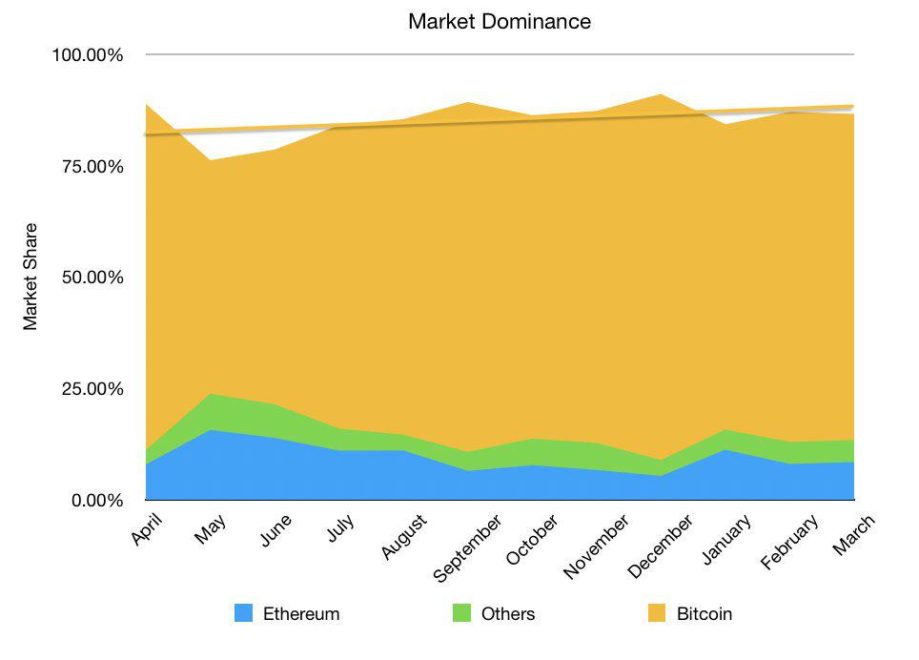
Bitcoin dominance

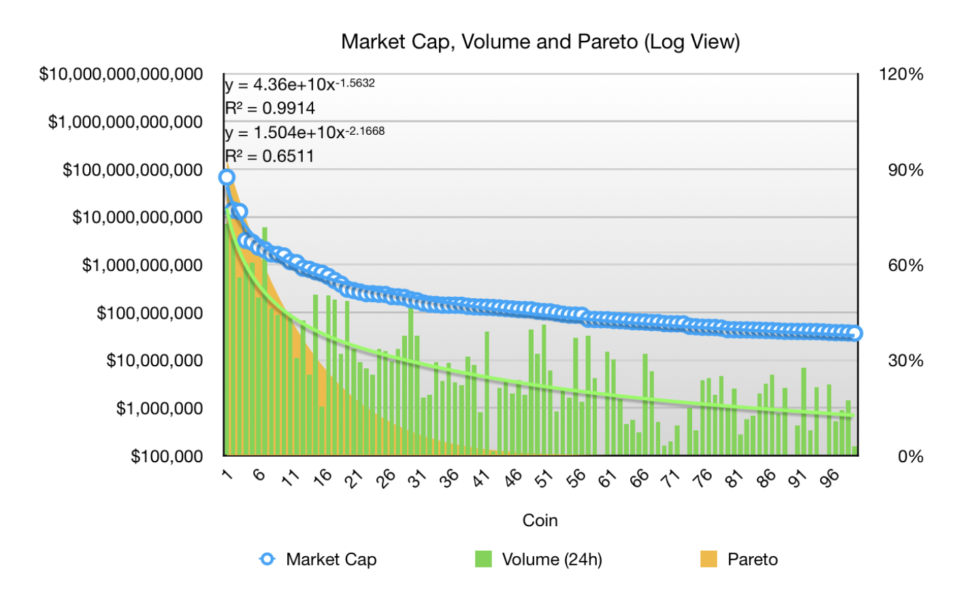
Thorbjornsen compared the top 100 cryptocurrencies by market cap on a logarithmic scale. He found that while there was some form of Power Law, volumes did not correlate well. Some coins had less than 0.1% of market cap in daily volume, indicating a trapped market or artificial market cap.
Bitcoin market dominance is actually over 80%, new research finds

Volume-Weighted Market Dominance

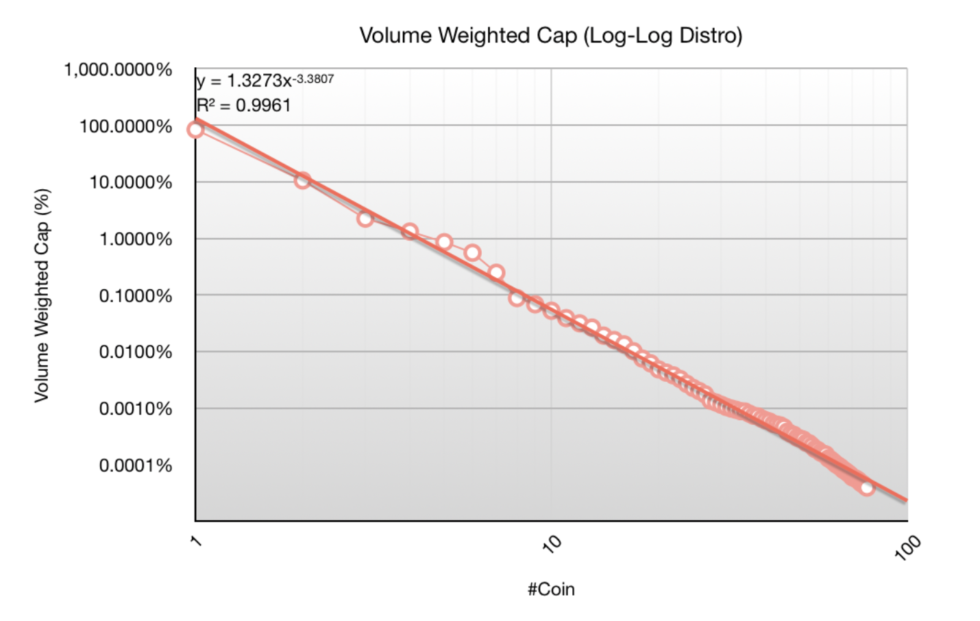
When Thorbjornsen multiplied the volume by the market cap (Volume-Weighted Cap), he found a much higher correlation. Removing the bottom third of the coins (to correct for ‘Page 1 Effect’), strongly suggested that this was indeed a Power Law distribution.
Bitcoin market dominance is actually over 80%, new research finds

Calculating a new measure of bitcoin Dominance using this metric, showed a level consistently over 80%. In fact, considering only the top 5 cryptocurrencies, bitcoin (the 20%) dominates over 85% of the market. This fits the Pareto distribution hypothesis originally suggested.

The King Is Dead, Long Live The King

So should we all forget about CoinMarketCap’s ‘market dominance’ metric?

Well no, although it might be better renamed ‘market (cap) share.’ As a metric, it can be useful. In Bitcoinist’s latest article on the subject, lower bitcoin market dominance index has actually historically coincided with a higher bitcoin price.

But in the future, when talking about true market dominance, it would probably be wise to consider the volume-weighted cap as a more accurate measure. Particularly when the liquidity and volume of some altcoins are almost non-existent.

Does this new way to measure market dominance paint a more accurate picture? Let us know below!


Images courtesy of Shutterstock, medium.com/@jpthor

The post Bitcoin Market Dominance is Actually Over 80%, New Research Finds appeared first on Bitcoinist.com.

source: https://bitcoinist.com/bitcoin-dominance-new-80/

TheBitcoinNews.com is here for you 24/7 to keep you informed on everything crypto. Like what we do? Tip us some Satoshi with the exciting new Lightning Network Tippin.me tool!

Published at Fri, 22 Mar 2019 16:00:08 +0000

Previous Article

Streamex’s Platform Addresses Current Needs of Traders, the Focused Crypto Exchange That Democratizes Trading

Next Article

Bitcoin Market Dominance is Actually Over 80%, New Research Finds

You might be interested in …

BTC-ECHO Wochenrückblick KW 20/18

BTC-ECHO BTC-ECHO Wochenrückblick KW 20/18 In der Kalenderwoche 20 stand die Kryptowelt – trotz ernüchternder Preise – nicht still. Im BTC-ECHO Wochenrückblick bespricht unser Redakteur Alex die wichtigsten Themen. Consensus Die Consensus-Konferenz von CoinDesk fand […]

Op Ed: Three Legal Pitfalls to Avoid in Blockchain Smart Contracts

Op Ed: Three Legal Pitfalls to Avoid in Blockchain Smart Contracts

Increasing improvements to blockchain technology which allows for the transfer of ownership without the use of a centralized third party (such as a bank) has resulted in the mass availability of blockchain “smart contracts.” A smart contract is a prewritten software program that automatically performs each party’s obligation in an “if-then” format, while taking advantage of blockchain’s decentralized verification system. Uber-secure cryptocurrencies, such as bitcoin, use the same type of verification systems.

A simple example is this: If Party A pays a certain amount and the payment is verified, then the title to Party B’s property is automatically released to Party A and can be automatically updated with correct ownership information.

These smart contracts are extremely tempting. They could easily increase the efficiency of your business, as well as save money that previously went to third parties. Smart contracts are becoming more popular in segments such as real estate, healthcare and securities, primarily due to these potential gains in efficiency and cost.

However, this silver bullet of efficiency and lower cost doesn’t come without potential problems. First, will a court even consider a computer program to be a binding contract? Second, if disputes arise, where can the parties sue? Last, do the parties have to go to court, or is the less-expensive option of arbitration available?

Offer/Acceptance: Is It Even a Binding Contract?

Typically, contracts are binding and enforceable under the law if the required legal process is followed. One side makes an offer, the other side accepts that offer, and there is some sort of consideration underlying the transaction. With a smart contract, however, the parties aren’t necessarily making and accepting offers they are consenting to a mutually agreeable computer program that outlines the if-then conditions regarding the transaction between the parties. In the eyes of a court, this by itself may not create a binding agreement. If the agreement is not binding, it may be tough to recover damages down the road.

To rectify this issue, the smart contract should include a clause detailing the agreement between the parties; for example, that this contract is regarding the sale of real estate, and that Party A agrees to exchange the deed for the property (or the use of an apartment for a night, or the title to a car, or whatever the contract is for) for the specific sum that shall be provided by Party B.

Without this clause, the program is merely a set of conditions. With this clause, the rest of the program becomes the conditions to this already-specified agreement and is much more likely to be enforced. Simple, but extremely helpful.

Jurisdiction: Is the Area of Jurisdiction Clearly Defined?

There is a difficult jurisdictional issue on the horizon for blockchain technology. With the blockchain’s decentralized transaction system, where the contract actually became final and binding is a question the courts have yet to answer.

Theoretically, a court could find that a party could sue wherever validation of the transaction took place. With potentially thousands or even millions of peers validating transactions all over the country, parties could be sued in random places anywhere in the entire United States.

The solution for this problem is a forum selection clause. A forum selection clause says that the parties agree to resolve any disputes in one particular jurisdiction. Though it is occasionally a spot of contention between the parties if each party wants their own city as the jurisdiction selected, this clause lowers the risk of being sued at any time anywhere in the country.

Dispute Resolution: Does It Have a Clear Dispute Resolution Mechanism in Place?

Last, if the contract is silent, the parties are automatically required to resolve any issues in state or federal court. This can be an expensive and lengthy process. If the parties agree and add a dispute resolution clause, the parties could resolve their disputes in front of an arbitrator instead.

Though arbitration has been vilified recently as the tool of big business, the contract could state that both parties must agree to the arbitrator beforehand or that a neutral third party such as the American Arbitration Association could make the choice. This would eliminate any potential bias on the part of the arbitrator, as it would be the neutral third party, not either of the invested parties, choosing the arbitrator.

Further, the parties could ensure that the arbitrator had some knowledge and experience with blockchain technology. Most judges today may not have even heard of this technology, much less conversant in the ins-and-outs of program complexities. Including a dispute resolution clause requiring that the arbitrator have some blockchain experience may be a benefit to both sides.

Conclusion

Smart contracts may be the future of transactions. However, the technology is in its infancy and has not been thoroughly examined by state or federal courts. There are a number of potential issues, such as offer/acceptance, jurisdiction and dispute resolution. Thus, while this technology may be extremely useful for certain transactions now, it should still be considered best practice to hire a lawyer for important or complex contracts, such as the sale of IP or complex services.


This is a guest post by Gregg D. Jacobson,an attorney in the Commercial Litigation and Construction practices at Chamberlain Hrdlicka (Atlanta). The views expressed are his own and do not necessarily reflect those of BTC Media or bitcoin Magazine. This article is for informational purposes only and does not intend to give legal advice.

The post Op Ed: Three Legal Pitfalls to Avoid in Blockchain Smart Contracts appeared first on Bitcoin Magazine.