July 18, 2026

Capitalizations Index – B ∞/21M

Bitcoin Eyes Test of Key Price Hurdle in First Since November

Bitcoin eyes test of key price hurdle in first since november

Bitcoin Eyes Test of Key Price Hurdle in First Since November

bitcoin (BTC) could test a key resistance line for the first time in nearly two months.

The widely followed 50-day simple moving average (SMA) line is currently located at $3,940 – $100 above BTC’s current price of $3,840 – according to Bitstamp data.

The crucial SMA line was last put to test on Nov. 8. Back then, the SMA was located at $6,450 and was serving as a stiff resistance.

On Nov. 14, BTC nosedived below $6,000, putting the bears back into the driver’s seat.  As a result, the gap between the 50-day SMA line and price widened sharply in the following two weeks. Notably, on Nov. 25, the 50-day MA line was located at least $2500 above price.

That spread, however, has narrowed sharply in the last two weeks, indicating waning bearish pressures. Further, price chart analysis indicates that the bulls have won control, at least for the short-term.

BTC, therefore, could test and possibly break above the 50-day SMA line of $3,940 in the next day or two.

Daily chart
Bitcoin eyes test of key price hurdle in first since november

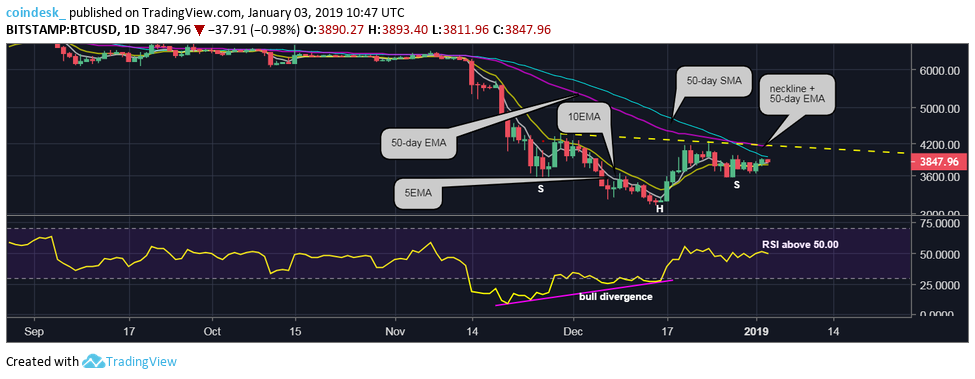
As seen above, BTC ran into offers near the 50-day SMA earlier today. Notably, at 00:05 UTC, BTC was trading $40 short of the 50-day SMA.

Despite the pullback from intraday highs near $3,900, the outlook remains bullish, as the positive divergence of the relative strength index (RSI), confirmed on Dec. 18, is still valid.

Further, 5- and 10-day exponential moving averages (EMAs) are beginning to curl upwards. The RSI is also biased bullish above 50.00.

The 50-day SMA is indeed trending south, indicating a bearish setup. The long-term averages, however, are lagging indicators. As a result, the price action always supersedes the long-term moving average lines.

It is worth noting that a break above the 50-day SMA, if confirmed, would open the doors to $4,170 – neckline of the inverse head-and-shoulders pattern. The 50-day exponential moving average (EMA) is also located just below the neckline hurdle. So, $4,170 is the level to beat for the bulls.

6-hour chart
Bitcoin eyes test of key price hurdle in first since november

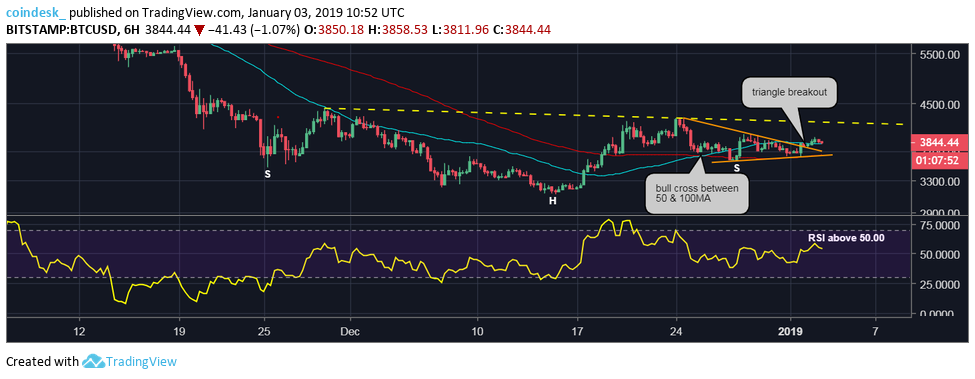
The triangle breakout seen in the 6-hour chart indicates that the rally from the December low of $3,122 has resumed.

The RSI is printing bullish levels above 50.00. Meanwhile, the stacking order of the 50-candle MA above the 100-candle MA is also a classic bull indicator.

View

  • BTC could rise above the 50-day SMA of $3,940 and extend the rally to $3,170 in the short-term.
  • A UTC close above $4,170 (neckline hurdle + 50-day EMA) would confirm an inverse head-and-shoulders bullish reversal and open up upside toward the psychological hurdle of $5,000.
  • The bullish case would weaken if prices drop below the support at $3,566 (Dec. 27 low).

Disclosure: The author holds no cryptocurrency assets at the time of writing.

Bitcoin image via Shutterstock; charts by Trading View

Published at Thu, 03 Jan 2019 11:00:21 +0000
Previous Article

Welcome to the reGenesis of Bitcoin Magazine!

Next Article

Monero Becomes Exclusive Cryptocurrency at Fortnite’s Merch Store

You might be interested in …

Scaling Bitcoin Announces This Year’s Program and a New Developer Bootcamp

Scaling Bitcoin Just Released This Year’s Program and a New Developer Bootcamp

Today, Scaling Bitcoin, the international engineering conference focused on bitcoin and blockchain research, released its program for the 2017 edition. The conference, to be held in Stanford, California, in the first weekend of November, will also introduce a new side event this year: Bitcoin Edge, a bootcamp for starting bitcoin developers.

“The program is extremely interesting because it delivers cutting edge research on different blockchain scalability approaches, fungibility, consensus, data propagation, alternative techniques for handling blockchains and many other topics,” said Anton Yemelyanov, chair of the Scaling bitcoin Planning Committee.

Scaling bitcoin Stanford

After events in Montreal, Hong Kong and Milan, the fourth edition of the Scaling bitcoin conference is taking place at Stanford University on November 4 and 5 of this year.

Where the first two editions of Scaling bitcoin were mainly focused on scaling and scalability, the third edition broadened the scope of the conference to include a more diverse set of topics. This trend will continue in Stanford, where talks will range from highly technical topics concerning privacy and fungibility, to fee markets and fee estimation, censorship resistance and more.

bitcoin is the origin of all distributed ledger technology,” said Yemelyanov. “Scaling bitcoin has been fortunate to act as a vehicle for bringing the audience technologies such as Segregated Witness and MimbleWimble, all of which have been adopted or incorporated into various blockchain projects. We hope that other material presented by our participants will be of similar value and help the industry advance the research and development of blockchains.”

Yemelyanov added that another key goal for Scaling bitcoin conferences is to bring engineers and other technical minds together in a physical space where they can discuss their work in person.

“It is through collaboration where a lot of ideas are born and have potential of becoming reality,” he said.

bitcoin Edge Dev++

In addition to the conference itself, Scaling bitcoin is also introducing a two-day technical bootcamp for experienced developers getting into bitcoin: bitcoin Edge.

This nonprofit initiative is an effort to help scale the development capacity of the industry, Yemelyanov explained:

“One of the approaches of helping the industry scale is to scale the much needed development capacity of the industry. There is a clear talent deficit and we are trying to help all industry participants by running a nonprofit workshop that will allow developers to gain complete understanding of primitives that comprise bitcoin and blockchains in general and be able to start working in this field.”

bitcoin Edge will be led by well-known bitcoin developers and academics Anditto Heristyo, Ethan Heilman, John Newbery, Karl-Johan Alm, Nicolas Dorier, Thaddeus Dryja and Jimmy Song. They’ll introduce participants to a range of technical bitcoin-related topics, including Elliptic Curve cryptography, transaction structures, difficulty calculation and adjustments, and much more.

This workshop will take place on the November 2 and 3. For more information on the bitcoin Edge initiative, visit bitcoinedge.org.

See here for the full Scaling bitcoin Stanford program.

The post Scaling Bitcoin Announces This Year’s Program and a New Developer Bootcamp appeared first on Bitcoin Magazine.

Hackers from North Korea Attempt to Steal Bitcoin

Hackers from North Korea have attempted to infiltrate several cryptocurrency exchanges in South Korea, and some entities are saying that this action should serve as a wake-up call.


One can definitely say that the country of North Korea is not a highly desirable tourist destination. The ruling military dictatorship, currently under the control of Kim Jong-un, has kept the country isolated from the rest of the world for decades. While we sometimes laugh at the absurd news that the official North Korean news agency reports, such as finding unicorns and how Kim Jong-un excels at everything humanly possible, the reality is that North Korea is a dangerous state. It has kidnapped people off the beaches of Japan and sends assassins into South Korea. It’s recent intercontinental ballistic missile (ICBM) testing has led to severe UN sanctions, and its ongoing nuclear program is definitely worrisome. Hackers from North Korea have long been active in seeking to cause mischief, and their current targets are a number of bitcoin exchanges in South Korea.

North Korea Desperately Needs Money

It should come as no surprise that North Korean hackers are looking to get their grubby mitts on some bitcoin. CNBC recently reported on this nefarious activity. A report from FireEye states that hackers from North Korea (who are extremely likely to be agents of that rogue state) have targeted the personal email accounts of those working at various bitcoin exchanges in South Korea using tax-themed lures and deploying malware. So far, three exchanges are known to have been targeted, and there is a possibility of four wallets being targeted on the Yapizon exchange as well.

North Korea is desperate for funds. The UN sanctions have really hurt their already-fragile economy as the sanctions impacted a full third of their exports (such as coal, seafood, iron ore, and iron). However, such sanctions were only the beginning as the United States has put additional sanctions upon North Korea, to which Kim Jong-un has loudly railed against. This has led to even China’s central banks cutting off ties with North Korea so as to not fall under penalty of the US sanctions. In short, North Korea is looking at any possible way to gain funds, and it appears that trying to steal bitcoin is one such method of getting needed capital.

Is This a Wake-up Call?

Of course, the news of hackers from North Korea looking to score some bitcoin has led to the usual hyperventilating from news agencies. CNBC openly wondered if these attempted thefts were a wake-up call to finally get governments and financial agencies to begin regulating digital currencies. CNBC cited University of Georgia Professor Jeffrey Dorfman, who said:

The ability of regimes like Kim Jong Un’s North Korea to mine or steal cryptocurrencies such as bitcoin is a new reason to be cautious in treating these commodities as currencies. While rogue states have practiced counterfeiting even longer than they have been computer hacking, counterfeiters are easier to catch. Once a cryptocurrency is stolen, it is virtually impossible to stop the new owner from spending it, and doing so in untraceable ways.

Are bitcoin and other digital currencies used for bad things? Of course they are. But you can say the same for gold, silver, hard currency, and so on. It’s not exactly earth-shattering to realize that bad people spend currency on bad things. However, it’s far harder to launder digital currency than the media and world governments would have you believe, as can be seen in the case in mid-July where $60 million of ether was pilfered. It would nice not to deal with all the hand-wringing whenever a bad person is associated with cryptocurrency. As for North Korea and Kim Jong-un, you can bet that they’ll continue to attempt to hack their way into different cryptocurrency exchanges. The US sanctions are not going away any time soon.

What do you think about North Korean hackers targeting bitcoin exchanges? Is this a wake-up call or not? Let us know in the comments below.


Images courtesy of Wikimedia Commons and Flickr.

The post Hackers from North Korea Attempt to Steal Bitcoin appeared first on Bitcoinist.com.