October 10, 2026

Capitalizations Index – B ∞/21M

Bitcoin Economic Activity Now 30% Higher Than At $20K Price

Bitcoin economic activity now 30% higher than at $20k price

Bitcoin Economic Activity Now 30% Higher Than At $20K Price

While bitcoin transactions per day have hit a fresh 2019 high, a “better indicator” measuring transaction outputs reveals that economic activity on the BTC blockchain is currently at a record high.


Another New bitcoin Daily Transaction High for 2019

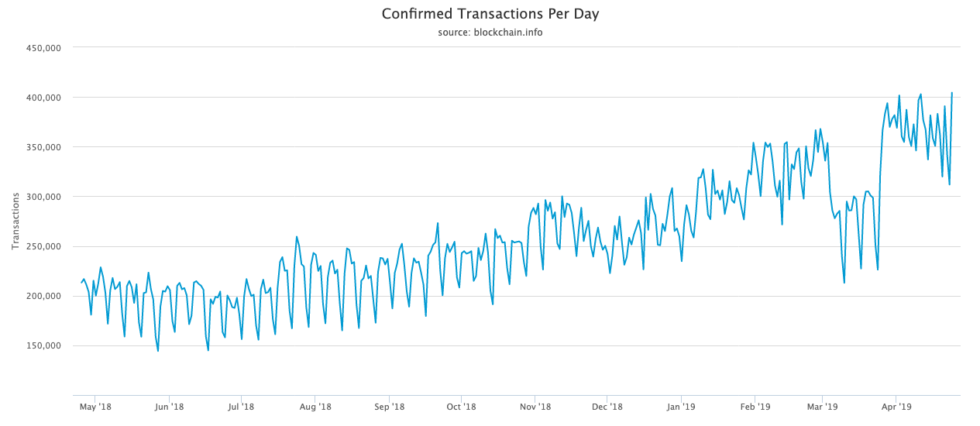
It took less tha a month for the bitcoin blockchain to set another new high for this year with over 404,000 daily confirmed transactions, according to Blockchain.com.

At the end of March, Bitcoinist reported that the number of confirmed bitcoin transactions per day hit a new 2019 high to nearly 400,000.
Bitcoin economic activity now 30% higher than at $20k price

This is the highest network activity since BTC price 00 was well above $10,000 USD in early January 2018.

At the same time, transaction fees today are roughly five times lower (in satoshis per byte) than they were at the beginning of 2018, the latest data shows.

Thus, block space optimization via SegWit is proving to be a successful scaling strategy for the meantime despite the network now processing more transactions on average.

‘Transactions’ Do Not Paint The Whole Picture

Meanwhile, a new resource tracking the number of bitcoin transaction outputs per day could provide a more accurate picture of economic activity.

An output essentially contains instructions for sending bitcoins. Its value is the number of satoshis (1 BTC = 100,000,000 satoshi) that this output will be worth when claimed.

Looking at the number of outputs per day, therefore, may serve as a better indicator of overall economic activity since one confirmed transaction can contain many outputs from multiple entities.

In other words, the number of total outputs is more indicative of actual economic activity. So only looking at the number of transactions misses an important part of the picture.

For example, large players such as exchanges use a process called “batching.” This essentially combines multiple outputs into one batch or transaction to reduce overall transaction fees.

A Better Indicator Presents an Even Better Picture

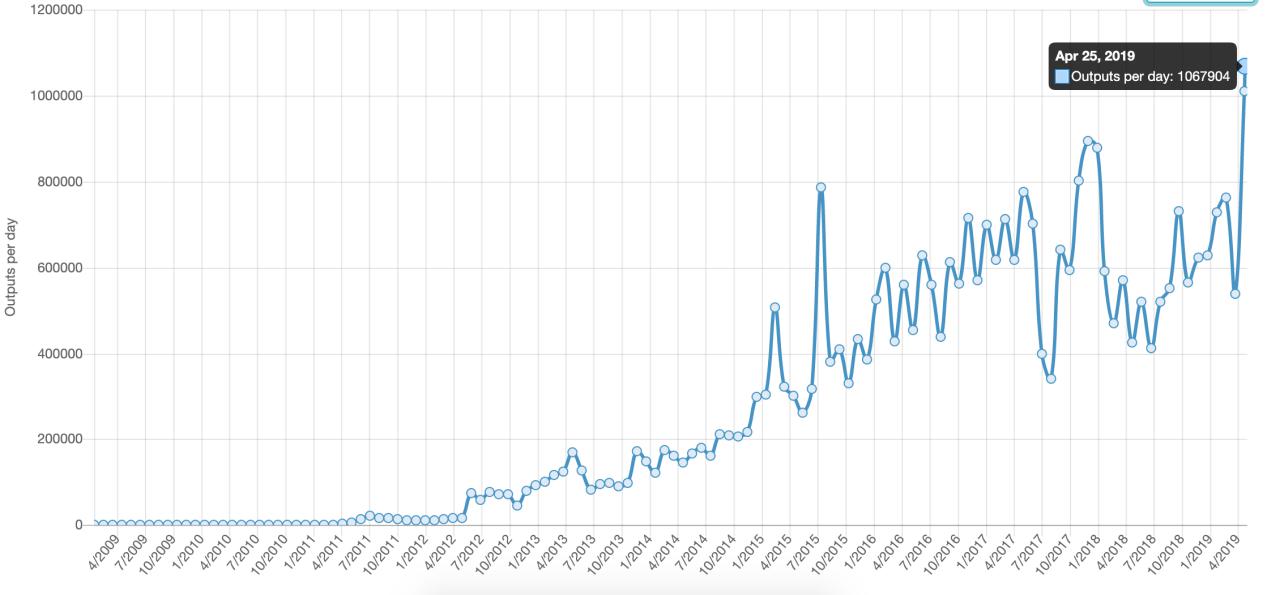
Looking at the outputs per day presents an even more optimistic picture of bitcoin network activity. It currently stands at 1,067,904 outputs per day, the highest in bitcoin’s history. This is also about 2.8 outputs per confirmed transaction.
Bitcoin economic activity now 30% higher than at $20k price

Despite today’s price of bitcoin being roughly 70 percent lower than in December 2017, the number of daily outputs is actually about 30 percent higher than during its historic bull-run to $20,000.

What’s more, other key network activity indicators such as hash rate is also five time higher than in late 2017.

So what does this all mean?

For one, bitcoin is fundamentally a lot stronger and more secure than it was at its price peak.

Secondly, it also suggests that real network growth simply could not keep up with the hype and runaway price in 2017.

Thirdly, the price ‘crash’ of 2018 was simply a return to the mean as network fundamentals caught up.

Fortunately, the bitcoin network is in much better shape today displaying healthy growth. It is more secure and more active compared to 2017 as it now settles trillions in value per year. This also doesn’t even include the growing off-chain activity such as that on the Lightning Network.

Therefore, while bitcoin is no stranger to volatility, it’s probably a good bet that bitcoin can only go up from here.

Will bitcoin price eventually catch up to bitcoin’s fundamentals? Share your thoughts below!


Images via Shutterstock, outputs.today, blockchain.com

The Rundown

Published at Thu, 25 Apr 2019 08:30:48 +0000

Previous Article

Bitcoin Trading Program Released with Sophisticated Technology

Next Article

Bitcoin, Ether, and XRP Weekly Market Update: April 25, 2019

You might be interested in …

De-briefing Ethereum’s Parity Predicament: What’s Next?

De-briefing Ethereum’s Parity Predicament: What’s Next?

After an unidentified actor “accidentally” triggered a series of bugs that destroyed approximately $150 million worth of digital currency, the world waits for a substantive answer — is this vulnerability an anomaly? An “I told you so”? Or a humbling opportunity to secure the Ethereum network?

What Happened?

On November 6, “Devops199,” an alleged amateur programmer, set off a chain of bugs on Parity, a popular digital wallet for Ethereum. These bugs affected multisignature, or “multisig,” accounts — “wallets” that require multiple users to sign off with their keys before funds can be transferred.. The place these wallets connect to is known as a “library” contract.

  1. According to Parity, an attempt to fix a vulnerability that allowed hackers to steal $32 million from multisignature wallets in July of 2017 inadvertently created a second vulnerability in the library contract. This allowed Devops199 gain sole ownership of the library that every multisignature wallet used for their code.

  2. After Devops199 realized what had happened, he “killed” (deleted) the code. Unfortunately, this locked all funds into multisignature wallets permanently, with no way to access them.

  3. Because of the functionality of the current blockchain, $150 million worth of ether (ETH), the tradable currency that fuels the Ethereum platform, is now effectively destroyed and inaccessible to anyone.

Among the victims of this bug are several recently successful ICOs that chose to store their funds in a Parity wallet because of its multisig option and compatibility with various hardware wallets.

Parity’s Response (So Far)

On November 7, tweets on Parity’s official Twitter account acknowledged the vulnerability and confirmed that the funds affected are frozen and can’t be moved anywhere.

A day later, on November 8, Parity de-briefed the bug, explaining that it was indeed possible to turn the Parity Wallet Library contract into a regular multisig wallet and become the owner of it, which is exactly what Devops199 did. Parity now has a tool to check if a user/wallet has been affected by the vulnerability.

Parity’s History of Hacks

This isn’t the first time Parity has fallen victim to a security exploit. Parity’s multisignature contracts were previously the target of three thefts totalling 150,000 ether in July of 2017 (the second-largest hack after the DAO fiasco). And losses could have been exponentially higher. However, the “White Hat Group,” a collection of hackers and activists, was able to intervene and drain the majority of other wallets before they could be compromised as well.

Future multi-sig wallets created in all versions of Parity Wallet have no known exploits.
 – Official Parity website post following the July 19 hack

Jeff Coleman, an expert in blockchain technologies and currently a researcher and advisor with L4 Ventures, described Parity’s response to the July 19, 2017, attack as having been “worrying, to say the least.”

Coleman told bitcoin Magazine that his primary concerns centered around Parity’s inadequate response and its tendency to downplay the significance of the compromise, choosing instead to blame a large number of external causes:

They blamed observers for not finding the bug before it was exploited; they blamed lack of incentivization for observers; and they blamed the Solidity language for not blocking access by default to the functions the [Parity team] failed to protect.

He further noted that Parity seemed to be blaming the complexity of the well-audited wallet (which they still believed to be secure) from which they had originally modified their code. And also that Parity didn’t take responsibility for their own inadequate quality control and audit procedures.

S.O.S.?

Developers in the community are desperately trying to find a fix to the Parity predicament. Coleman believes that “from a technological perspective, there is nothing short of a hard fork [a non-backward-compatible change to the Ethereum protocol] to restore the destroyed funds.”

After the DAO hack in 2016, the Ethereum Foundation had already accepted a hard fork to restore lost funds, with the common understanding that this was a sort of “mulligan” — a one-time fix for a young, developing blockchain. This scenario, nevertheless, divided the Ethereum blockchain into two parts and created Ethereum Classic, the original Ethereum blockchain, backed by a community that vehemently opposes editing transaction history to restore lost funds.

Using hard forks as interventions to “correct” worst-case scenarios like this is highly controversial, especially since blockchains are meant to be immutable. So, it’s difficult to convince the Ethereum community to use a hard fork to rescue one team from a mistake. While many acknowledge sympathy for smaller accounts storing personal ETH, sentiment is not as sympathetic for the 300,000 ETH that belonged to the Polkadot Project, project associated with the Parity team.

Arseny Reutov, an application security researcher for blockchain security firm positive.com, affirmed this community sentiment, while acknowledging that hard forks can be solutions. However, he agrees that Ethereum cannot simply hard fork any time there is a problem on the network. He believes blockchains should expect “more and more high profile thefts and incidents,” and that the problem lies in the infant Ethereum platform itself — specifically, in the native Solidity programming language.

If a Hard Fork Isn’t the Answer, Then What Is?

Both Coleman and Reutov believe that the key to gaining the community support necessary to restore funds is to combine the Parity situation with similar situations in which funds have been lost due to various kinds of mistakes. As an example, Coleman referenced those detailed in EIP 156: “Reclaiming of ether in common classes of stuck accounts.”

Coleman also pointed out that in any of these instances, it must be “completely unambiguous who the original owners of the assets were.” The necessary changes could then be made and packaged together in an “already planned hard fork, such as the upcoming Constantinople fork.”

Even so, restoring funds is problematic. Ethereum core developers must discern which mistake-affected funds will be returned to users. Will all funds be returned or only a select few — or will this be a ~500,000 ETH learning experience?

The post De-briefing Ethereum’s Parity Predicament: What’s Next? appeared first on Bitcoin Magazine.

What is tokencard?

What is TokenCard?

What is TokenCard? Shared by: https://coincheckup.com from the Tokencard website