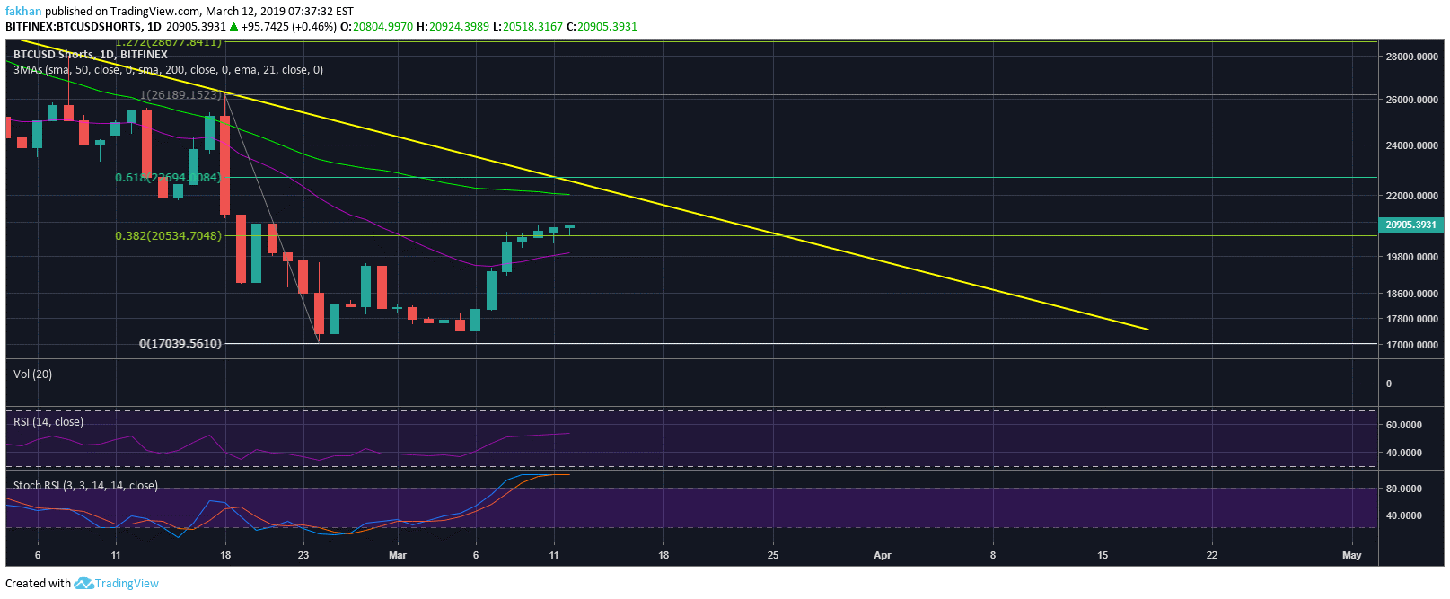
Bitcoin (BTC) More Likely To Plunge Below $3,000 Than To Form Golden Cross
() is more likely to crash hard below $3,000 than to form a golden cross that many expect it to. Throughout the course of this bear trend, we have seen orchestrated attempts to misguide the masses so they are forced to walk into the trap. When started to decline from its all-time high, the masses were made to believe that this was just a normal pullback and that () is still going to $50,000 long term. Similarly, when the price started to rise in February, 2018, FOMO was injected back into the market which trapped a lot of other people who did not know they are going to be bled slowly to their own death in the months ahead. After that, the $6,000 support was sold to the masses as the ‘unbreakable’ level because it happened to be the average price to mine one ().
Make no mistake, during this whole time, the financial gurus and the media outlets that sold you the idea that the price could not fall below $6,000 knew full well that markets are irrational more often than they are rational. This means that no matter how overbought the price is, it can always get more overbought and no matter how oversold the price is, it can always get more oversold. In other words, there is no such thing as believing that the price will stop around $6,000 because it is reasonable to do so. Certainly, the majority of people in this market who are new to investing and are not to be blamed for this. You can blame the media outlets or ‘financial gurus’ but they are not going to change. They have vested interests and they are going to keep playing this game.
Now that it has been a long time that the market has run out of FOMO, we are seeing debates around the upcoming golden cross that could form on the daily chart for /USD when the 50 day moving average crosses above the 200 day moving average. Now, there is no reason to be greedy and say that you are only going to start buying once the price starts falling below $3,000 because if you are really interested in /USD long term, you may miss a rally towards $6,000 while you wait for the bottom. The probability of such a move is extremely low but it is still a possibility.
The point is, while we do not believe () has bottomed, we should be mindful of the fact that the price has dropped more than 80% and is very close to a bottom even if it hasn’t bottomed. The daily chart for shows that the number of margined shorts is expected to rise short term till it hits the trend lien resistance. After that, we may see a sharp decline to the downside which would coincide with a strong move to the upside in /USD before the final corrective wave to the downside begins.
In December 2017, an interesting rumor : According to “sources familiar with the matter,” the messaging app , very popular among crypto-enthusiasts for its strong encryption and privacy features, would launch its own blockchain platform and cryptocurrency.
On January 8, 2018, TechCrunch that several unnamed sources had confirmed the news and quoted a secret Telegram white paper. According to TechCrunch, “the potential for a cryptocurrency inside a widely adopted messaging app is enormous.”
Of course, a leaked executive summary of the white paper is now available. The document has been by Cryptovest, and its authenticity has been independently by TNW. The 23-page executive summary often refers to an unreleased technical white paper which, according to TechCrunch, has 132 pages.
“This paper outlines a vision for a new cryptocurrency and an ecosystem capable of meeting the
needs of hundreds of millions of consumers, including 200 million Telegram users,” reads the white paper. “Launching in 2018, this cryptocurrency will be based on a multi-blockchain proof-of-stake system — TON (Telegram Open Network, after 2021 The Open Network) — designed to host a new generation of cryptocurrencies and decentralized applications.”
Scaling and Adoption
According to Telegram, while cryptocurrencies and other blockchain-based technologies have the potential to make the world more secure and self-governed, no consensus-backed currency has been able to appeal to the mass market and reach mainstream adoption. Despite the utility of bitcoin and Ethereum, “there is no current standard cryptocurrency used for the regular exchange of value in the daily lives of ordinary people.” This is what the TON project wants to change. According to Telegram, the world needs an electronic “decentralized counterpart to everyday money — a truly mass-market cryptocurrency.”
Scaling transaction throughput to the tens of thousands of transactions per second supported by major credit card networks such as Visa and Mastercard is an important requirement for a mass-market cryptocurrency. While bitcoin and Ethereum developers are working toward achieving higher throughput, the Telegram white paper notes that bitcoin and Ethereum are currently limited to a maximum of only seven transactions per second for bitcoin and 15 transactions per second for Ethereum, resulting in insufficient speeds and higher transaction costs. The white paper does not seem to take second-layer protocols into account, however.
Existing cryptocurrencies face other roadblocks as well, according to Telegram. For example, they are still too complicated for average merchants and consumers, the demand for crypto-assets comes mainly from investors rather than consumers, and there’s no critical mass for the ecosystem to grow and “eventually become adopted by hundreds of millions of users.”
“Telegram will use its expertise in encrypted distributed data storage to create TON, a fast and
inherently scalable multi-blockchain architecture,” states the white paper. “TON can be regarded as a decentralized supercomputer and value transfer system. By combining minimum transaction time with maximum security, TON can become a VISA/Mastercard alternative for the new decentralized economy.”
The Tech Specs
The TON blockchain will consist of a master chain and (eventually) a huge number (2**92) of accompanying blockchains (shards) that can dynamically split and merge to accommodate changes in load and achieve optimal throughput. TON will use a proof-of-stake approach based on a variant of the protocol and instant to partition the workload among shards. Network protocols for storage, TOR-like privacy and micropayments will be released after the TON blockchain core.
Of course, TON will be fully integrated in the Telegram messaging network. According to the white paper, this will permit leveraging Telegram’s massive user base and developed ecosystem to provide a clear path to cryptocurrencies for millions of people, with light wallets implemented in Telegram applications. The white paper notes that 84 percent of blockchain-based projects have an active Telegram community, more than all other chat applications combined, which makes Telegram the “cryptocurrency world’s preferred messaging app.”
According to the roadmap in the white paper, a Minimal Viable Test Network for TON will be launched in Q2 2018. Then, after a testing phase and a security audit, a stable version of TON and a Telegram wallet will be deployed in Q4 2018.
Funding with Grams
The TON coins will be called Grams. To fund TON, Telegram will launch a token sale in Q1 2018. Initially, 44 percent of the total supply (2.2 billion) of Grams will be sold at a price that will start at $0.10 per Gram and gradually increase, with each Gram priced one billionth higher than the previous one, reaching $1 per Gram once 2.2 billion tokens have been sold. Based on these projections, it seems that Telegram’s token sale could easily become the biggest in history.
Of the total supply of Grams, 52 percent will be retained by the TON Reserve “to protect the nascent cryptocurrency from speculative trading and to maintain flexibility at the early stages of the evolution of the system,” and the remaining 4 percent will be reserved for the development team.
According to current plans, the token sale will use a (SAFT), to be converted 1:1 to native TON Grams after the deployment of the TON Blockchain.
Telegram wants to serve as a launch pad for TON, but it plans eventually to transfer ownership and governance of the TON system to a non-profit TON Foundation. “By 2021, the initial TON vision and architecture will have been implemented and deployed,” states the white paper. “TON will then let go of the ‘Telegram’ element in its name and become ‘The Open Network.’ From then on, the continuous evolution of the TON Blockchain will be maintained by the TON Foundation.”
The TON Killer App: A Privacy-Focused User Base
TON’s killer app is Telegram’s ability to leverage the enthusiasm of millions of cryptocurrency fans among the app’s 200 million users. At the same time, however, it’s worth noting that the greater population doesn’t really care much about encryption or cryptocurrencies. Many other messaging apps, such as Facebook’s Messenger and Whatsapp, are much more popular than Telegram.
Telegram is independent, self-funded and privacy-focused. The popularity of Telegram among cryptocurrency enthusiasts can be explained by the fact that the messaging app was founded “by libertarians to preserve freedom through encryption.” These features make it more attractive than other platforms, like Messenger or Whatsapp, to users who feel strongly about privacy protection.
It’s then interesting to speculate about possible moves of Facebook toward developing a cryptocurrency integrated with its social network and messaging platform.
In , Facebook co-founder and CEO Mark Zuckerberg notes that, contrary to the once widespread belief that technology could be a decentralizing force that puts more power in people’s hands, it now appears that technology’s net effect is that of centralizing power in the hands of large corporations and governments.
“There are important counter-trends to this — like encryption and cryptocurrency — that take power from centralized systems and put it back into people’s hands,” says Zuckerberg. “But they come with the risk of being harder to control. I’m interested to go deeper and study the positive and negative aspects of these technologies and how best to use them in our services.”
In as speech by FBI Director Christopher Wray on January 9, 2018, to the International Conference on Cyber Security, he highlighted his concerns over encryption, pointing out that last year, 7,800 devices were rendered inaccessible to law enforcement.
“This problem impacts our investigations across the board — human trafficking, counterterrorism, counterintelligence, gangs, organized crime, child exploitation and cyber,” he stated.
He called on the private sector to find ways that would allow them to “respond to lawfully issued court orders, in a way that is consistent with both the rule of law and strong cybersecurity.” It is these sorts of access measures that Zuckerberg will probably be considering.
While it doesn’t seem plausible that Facebook could become a staunch champion of privacy like Telegram, it will definitely be interesting to watch Facebook’s moves in the cryptocurrency space.
bitcoin [BTC] proponent attacks JPM Coin; says “it should be prevented” JP Morgan, the largest bank in American, had launched its own cryptocurrency JPM Coin a few weeks back. The announcement was met with a […]
Blockchain based Payments Blockchain based Payments for a New Financial World One of Blockchain's promises is to enable fast, secure, low-cost internatinal payment processing services through the use of decentralised and distributed ledgers that provide cryptographically […]