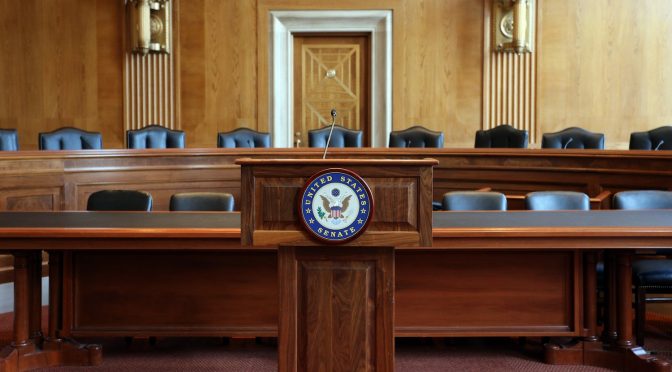
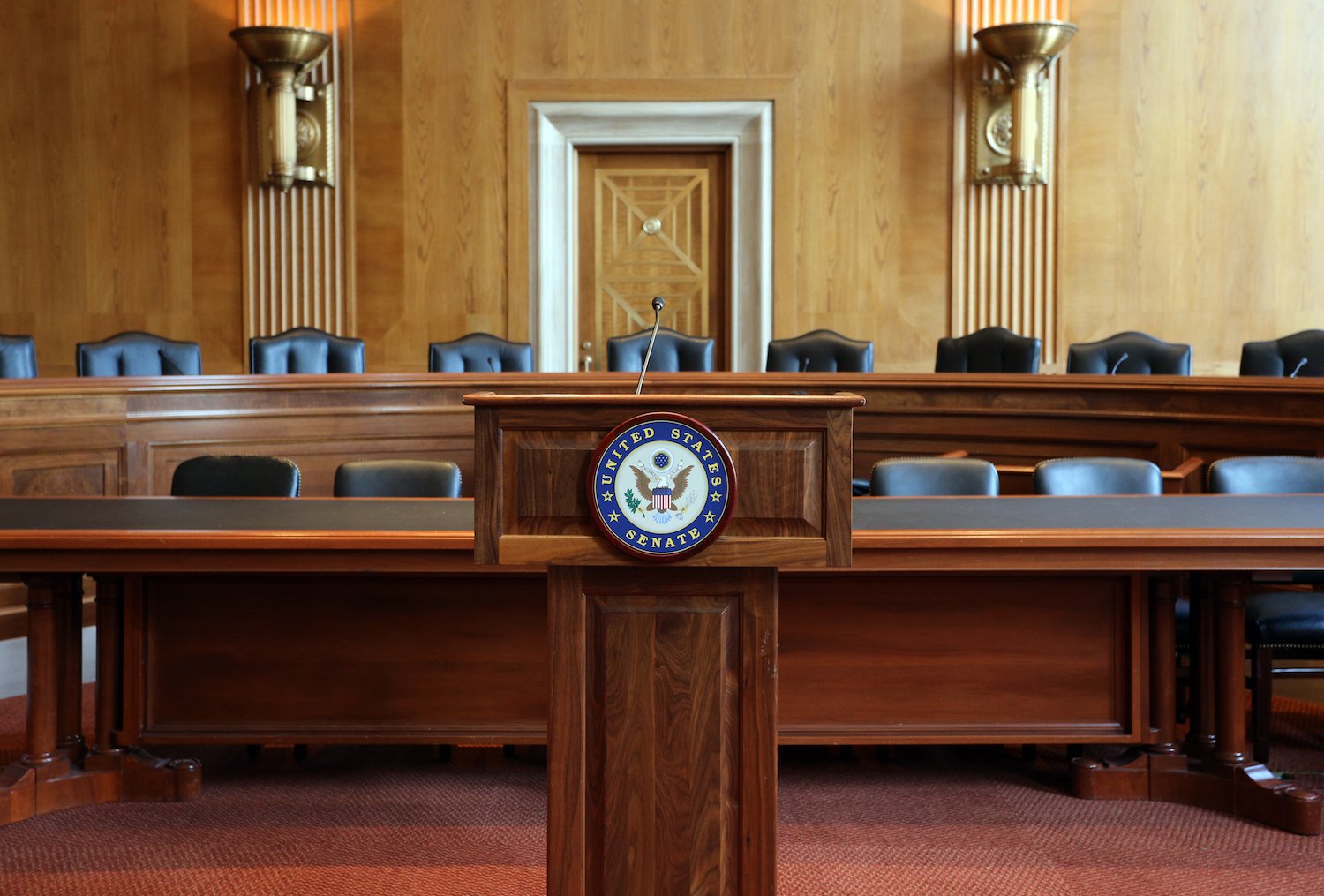
Congress is set to hold what may be the most consequential hearing in years on the subject of cryptocurrency, with the heads of the two main U.S. financial market regulators in the hot seat.
J. Christopher Giancarlo, chairman of the Commodity Futures Trading Commission, and Jay Clayton, his counterpart at the Securities and Exchange Commission (SEC), on Capitol Hill tomorrow. And the process of fielding questions from the Senate Banking Committee is likely to yield one or two notable moments given recent developments in the space – including those involving the agencies themselves.
In recent months, the two agencies have, between them, against alleged scams, , of bitcoin futures, to investors and, perhaps more broadly, come to terms with a rapidly-evolving environment that has, in the words of their leaders, tested the limits of their reach.
Ahead of the hearing, copies of both Clayton’s and Giancarlo’s testimony have been released. While largely an overview of their respective agencies’ work to date, both leaders suggested that they would support, in some way, new avenues of regulation that could lead to an expansion of oversight by the U.S. government into the cryptocurrency market.
Yet such an undertaking would, in their view, require an act of Congress – as well as close involvement with the relevant agencies.
Clayton commented in his written remarks that he is “open” to working with U.S. lawmakers, in addition to state regulators, on the question of new rules for trading sites.
He remarked:
“As Chairman Giancarlo and I stated recently, we are open to exploring with Congress, as well as with our federal and state colleagues, whether increased federal regulation of cryptocurrency trading platforms is necessary or appropriate. We also are supportive of regulatory and policy efforts to bring clarity and fairness to this space.”
Giancarlo’s nudging toward possible changes was slightly more detailed, highlighting what he called “shortcomings’ in the system by which each state issues money transmission licenses to businesses.
“As the Senate Banking Committee, the Senate Agriculture Committee and other Congressional policy-makers consider the current state of regulatory oversight of cash or ‘spot’ transactions in virtual currencies and trading platforms, consideration should be given to shortcomings of the current approach of state-by-state money transmitter licensure that leaves gaps in protection for virtual currency traders and investors,” he wrote.
Potential new rules governing cryptocurrency exchanges should, he went on to explain, “be carefully tailored to the risks posed by relevant trading activity and enhancing efforts to prosecute fraud and manipulation.”
“Overall, a rationalized federal framework may be more effective and efficient in ensuring the integrity of the underlying market,” he went on to write.
Fireworks ahead?
What kind of event can industry-watchers expect?
The written testimony only offers a piece of what might be raised during the question-and-answer phase of the hearing. Given the significant public interest in the topic – as well as a soundbite-heavy political environment – it’s tough to what could come up.
According to Jerry Brito, executive director of the non-profit advocacy group Coin Center, two of the prevailing news narratives of the past year – initial coin offerings (ICOs) and derivatives products like futures – are likely to dominate the discussion.
“There’s been a frenzy of ICOs,” Brito noted, including “a lot of crazy scams and weird stuff” alongside serious projects and significant money invested. “This is what sparked the hearing,” he added.
Brito said that Coin Center has met individually with staff of more than half a dozen committee members and participated in a group briefing Friday for staff of all committee members. The room was packed, he said.
Token talk
Another issue that may come up in the hearing is the regulatory treatment of token sales, particularly when the token being sold to raise funds for a project is supposed to be useful on the network that will eventually be built.
Lewis Cohen, a partner at the law firm of Hogan Lovells in New York, said he agreed with Clayton’s comment in the that ICOs should be regulated as securities when they emphasize the potential for investor profits (for example, from selling tokens in the secondary market). Just because the tokens may have utility does not exempt the offering from investor protections.
But likewise, he said, the regulatory community needs to be careful not to assume that just because a token is the object of an investment scheme that it is necessarily a security itself.
It would “make little sense,” Cohen said, if once a functional network like Filecoin is fully up and running its users had to go to a broker-dealer to buy tokens to store data in a decentralized manner on the platform.
Nikhilesh De and Marc Hochstein contributed reporting.
Image Credit:
The leader in blockchain news, CoinDesk is an independent media outlet that strives for the highest journalistic standards and abides by a . Have breaking news or a story tip to send to our journalists? Contact us at news@coindesk.com.
Published at Mon, 05 Feb 2018 22:05:51 +0000
Features[wpr5_ebay kw=”bitcoin” num=”1″ ebcat=”” cid=”5338043562″ lang=”en-US” country=”0″ sort=”bestmatch”]