President Trump’s , via Twitter, that the U.S. would not be imposing new tariffs on China on March 1st sent the markets wild in Beijing and New York, but where does this development leave his side-war with Huawei?
On Sunday, Huawei blew the roof off the first day of the Mobile World Congress in Barcelona with the launch of its $2600 folding smartphone. This announcement coming the same day that President Trump tweeted what amounted to a truce in the ongoing trade war with China. The world’s media went crazy over the new 5G Huawei Mate X, and the after Trump’s tweet. Both events caused a global stir for very different reasons, but the connection between one of tech’s biggest and fastest growing players and the 45th president of the United States runs deeper than it might seem at first glance from the outside.
The Battle for 5G
At its heart, the Trump-Huawei could be seen as the battle for 5G. The next stage in the development of telecommunications technology is currently being won by Huawei and by default the Chinese. President Trump is not a big fan of this, as was evidenced by his tweet last week where he called out U.S. companies for falling behind in the race for mobile infrastructure supremacy.
I want 5G, and even 6G, technology in the United States as soon as possible. It is far more powerful, faster, and smarter than the current standard. American companies must step up their efforts, or get left behind. There is no reason that we should be lagging behind on………
— Donald J. Trump (@realDonaldTrump)
Ignore the fact that there is no such thing as 6G tech. Not only does the president not like the fact that a Chinese company is leading the way with this technology, but he is also taking aggressive action to prevent other friendly countries from allowing Huawei to play a role in the implementation of such technology in their own countries.
The pretext for this is that Huawei is somehow acting as a deep-cover spy for the Chinese government. By allowing Huawei to play a key role in the new mobile infrastructure of friendly nations, Trump and people within his administration believe that they could be inviting spying from China. While this may sound like fanciful conspiracy theory, many countries that Trump has pressured, have indeed banned Huawei from playing a role in the development of 5G in their countries. Australia, New Zealand, and Japan have all banned the use of Huawei infrastructure, with many EU countries debating whether to do the same.
Making it Personal
The attacks on Huawei by the U.S. have not stopped at trying to force it out of the development of 5G in friendly nations.
The U.S. has also made the fight personal by requesting the arrest of one of Huawei’s Chief Financial Officer Meng Wanzhou, the daughter of the company’s founder. The arrest of Meng Wanzhou is perhaps the most high-profile of a number of major events in the US-Huawei war that has run in parallel to the wider ongoing trade war between the U.S. and China.
A Timeline of the US-Huawei war
Dec. 1: At the request of the U.S., Meng Wanzhou by Canadian authorities during a stopover in Montreal. The request is made in relation to an accusation that Huawei violated sanctions on Iran by selling equipment to that country through a shell company.
Dec. 6: China of Meng, stating that she broke no U.S. or Canadian laws.
Dec. 8-9: China summons the ambassadors of Canada and the U.S. to meet with its officials where they again demand the release of Meng, if the request is not met.
Dec. 10: Two Canadians are detained in China in what is believed to be a tit-for-tat response to Meng’s arrest.
Dec. 11: Meng is . She must wear an ankle monitor and surrender her passports. President Trump says that he may intervene if it will help the ongoing trade war.
Jan. 16: Meng’s father, Ren Zhengfei, tells foreign reporters that Huawei obeys the law, including export restrictions, wherever it operates.
Jan. 22: China demands that the U.S. withdraws the arrest warrant for Meng.
Jan. 24: Huawei announces that it will launch its foldable fifth-generation smartphone at the Mobile World Congress in Barcelona.
Jan. 28: The U.S. State Department unseals its charges against Meng and Huawei. It alleges not only violation of sanctions but also the theft of trade secrets.
Jan. 29: China says that it will defend its companies and urges the U.S. to stop its persecution of Huawei.
Feb. 25: Huawei . Trump tweets a thawing in the trade war with China and the markets go crazy.
A New Beginning?
It is probably just a coincidence that about a thaw in the ongoing trade war on the same day that Huawei launched the Mate X, but it is clear that Huawei has been used as a proxy for China in this whole operation. Now that things seem to be improving between the governments of the two countries, it will be interesting to see whether Meng and Huawei also benefit from this development.
Huawei CEO Richard Yu displays the new Huawei Mate X foldable 5G smartphone at the Mobile World Congress, in Barcelona, Spain, Sunday, Feb. 24, 2019. | Source: AP Photo/Manu Fernandez
While Meng has almost certainly not enjoyed been under house-arrest, the fortunes of Huawei have gone from strength to strength in recent years. Not only are its mobile phones becoming more and more popular on the global market amongst everyday users, but its tech also plays a key role in the underlying infrastructure of many countries all over the world.
Huawei: a Powerhouse not Afraid of a Fight
Despite the provocations that have come its way, the reactions by the Huawei leadership to the charges against it by the U.S. have not been those of a company that is afraid of a fight. Even with his daughter under house arrest and facing extradition, Huawei founder Ren Zhengfei has been bullish in his public statements, telling the BBC:
There is no way the U.S. can crush us.
And while President Trump clearly doesn’t like the fact that Huawei leads the way when it comes to 5G technology, his connected tweet on the matter also accepted that U.S. companies have to win this fight through competition, not sanctions.
….something that is so obviously the future. I want the United States to win through competition, not by blocking out currently more advanced technologies. We must always be the leader in everything we do, especially when it comes to the very exciting world of technology!
— Donald J. Trump (@realDonaldTrump)
Too Big to Fail
The rise of Huawei over the last few years has been remarkable. Perhaps what worries the U.S. so much is just how big the company has become in Europe, particularly when it comes to mobile infrastructure.
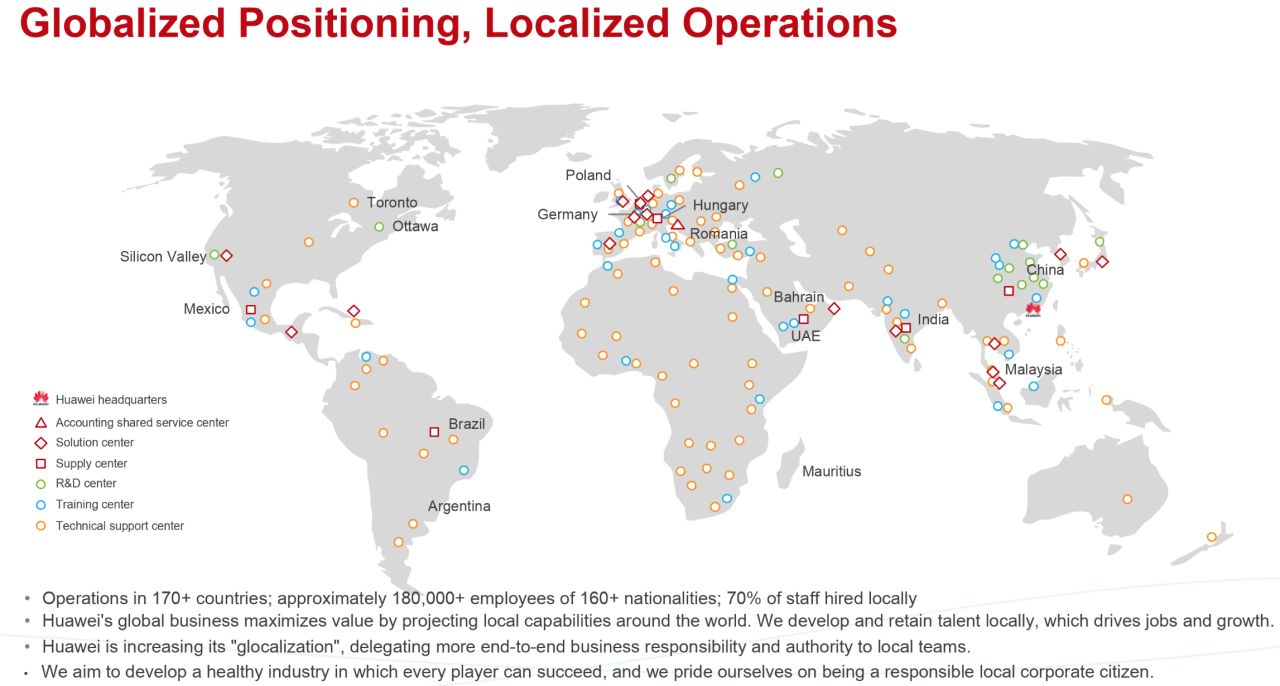
Huawei’s global reach is substantial. | Source: Huawei
In some European countries, Huawei accounts for 50-8 percent of existing mobile infrastructure. These figures will only increase as the company drives the move towards 5G. The U.S. clearly understands how significant this could be, especially when the relationship between Huawei and the Chinese government seems so close.
It is quite ironic that the U.S. government seems to want to reduce the power of one of China’s largest tech companies when at home the and their founders could be called strained at best.
The truth is that $2600 folding smartphones aside, Huawei has become too integral to the for it to simply disappear.
Published at Tue, 26 Feb 2019 11:50:09 +0000

![Tron [trx] ceo justin sun says partnership with tether [usdt] is vital for the ecosystem |](https://ohiobitcoin.com/storage/2019/04/whatsapp-icon-square.svg "Tron [trx] ceo justin sun says partnership with tether [usdt] is vital for the ecosystem |")