
June 27, 2026

Capitalizations Index – B ∞/21M

Uber Co-Founder, E*Trade Vet Launch Zero-Fee Cryptocurrency Trading Platform

Uber co-founder, e*trade vet launch zero-fee cryptocurrency trading platform

Uber Co-Founder, E*Trade Vet Launch Zero-Fee Cryptocurrency Trading Platform


Uber co-founder, e*trade vet launch zero-fee cryptocurrency trading platform
Advertisement

An Uber co-founder and an E*Trade veteran have teamed up to launch commission-free cryptocurrency trading service that, if successful, could see the firm challenge Coinbase, Robinhood, and a growing number of other competitors to become the venue of choice for retail investors.

The platform, named Voyager, aims to capitalize on the fragmentation in the global cryptocurrency spot market. Rather than operating as a traditional centralized exchange, Voyager will serve as a routing engine for other exchanges, helping investors buy and sell 15 cryptocurrencies at the best available prices without having to open dozens of accounts and shop around before making a trade. The news was first reported by Fortune.

Like Robinhood, the widely-popular stock trading app that began rolling out cryptocurrency trading earlier this year, Voyager will not charge commission on these trades. Rather, CEO Stephen Ehrlich said in an interview with Fortune, the firm will profit from the spread between the price quoted to traders and the price at which the underlying trade is actually settled.

“We saw an opportunity to build a dynamic smart order router that can take advantage of the marketplace and also offer customers no commissions,” said Ehrlich, a former executive at electronic brokerage firm E*Trade and the founder of Lightspeed Financial. “Sometimes you go to trade on a certain exchange, but there’s no liquidity there.”

One of Ehrlich’s co-founders, Oscar Salazar, co-founded Uber and served as the ride-hailing app’s first chief technology officer. At Voyager, he is helping oversee the development of the routing engine as the platform’s lead tech advisor.
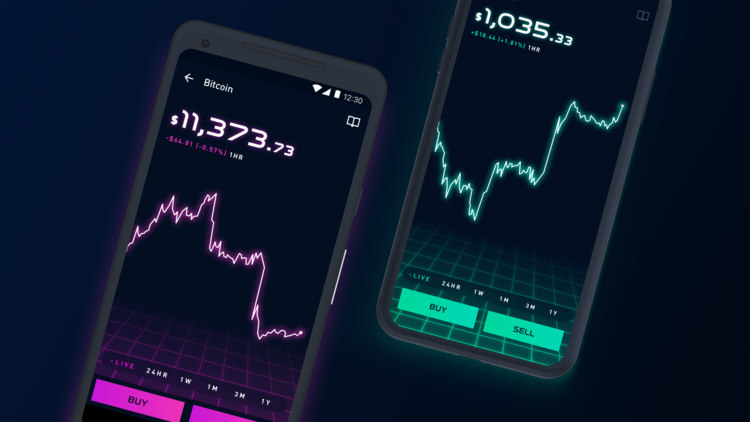
Robinhood
Voyager joins robinhood crypto in seeking to bring zero-fee cryptocurrency trading to the u. S. Retail market. | source: robinhood

The platform recently entered beta testing, and the firm is racing to acquire as many state-level licenses as possible before its formal launch in October. At present, Voyager has approval to operate in about five states, with many pending applications in states like New York, whose complicated regulatory framework has led many exchanges to skip it altogether.

Voyager aims to officially launch with support for at least 15 cryptocurrencies, primarily large-cap cryptocurrencies with high trading volumes. That’s more than either Coinbase (four) or Robinhood (five) currently support, though both platforms have signaled their intent to list more assets. Consequently, it’s not clear how much of an advantage Voyager will have in this department once it goes live.

In other respects, Voyager has its work cut out for itself. Though Coinbase charges commission on trades, it already has a large user base as well as industry prestige. Robinhood — and to a lesser extent, Square, whose Cash App supports bitcoin trading — is newer to the cryptocurrency trading space, but it also has a large built-in user base by virtue of its core stock brokerage platform, as well as a head start on regulatory approval. Ehrlich, though, is not concerned that the firm will be the new kid on the block in an increasingly-crowded market.

“We don’t think crypto has been adopted yet by the masses in the United States,” he concluded. “I believe the market space itself is extremely large…We think the opportunity for both retail and institutional is vast, and we want to be part of that, and help the industry grow, and be good citizens to the industry, and help people get more knowledgeable in crypto assets.”

Featured Image from Shutterstock

Follow us on Telegram or subscribe to our newsletter here.
Join CCN’s crypto community for $9.99 per month, click here.
Want exclusive analysis and crypto insights from Hacked.com? Click here.
Open Positions at CCN: Full Time and Part Time Journalists Wanted.

Advertisement


Published at Thu, 26 Jul 2018 13:54:54 +0000

Exchanges

Previous Article

Penjelasan Tentang CoinPulse.io (New Exchanger)

Next Article

ZoZoCoin su kien tai SaiGon

You might be interested in …

Bitcoin Miners Miss the First BIP 148 “Deadline”

Bitcoin Miners Miss the First BIP 148 “Deadline”

bitcoin miners at large have missed the first BIP 148 “deadline” to prevent a “split” in bitcoin’s blockchain.

As bitcoin’s scaling dispute appears to be heading for a climax, the next couple of weeks could prove pivotal. One scaling solution in particular, Bitcoin Improvement Proposal 148 (“BIP 148”), is scheduled to trigger activation of Segregated Witness (SegWit) on August 1, 00:00 UTC. As a User Activated Soft Fork (UASF), all users that run a BIP 148 node will then start rejecting any and all blocks that do not signal support for SegWit by the “deadline” — or, perhaps more accurately, “ultimatum” — set by BIP 148 users.

BIP 148 and SegWit are backward-compatible protocol upgrades, which means that non-upgraded nodes will still accept SegWit-signaling and SegWit-utilizing blocks. Therefore, if a majority of hash power in one way or another adopts SegWit before August 1, all current bitcoin nodes would follow the same blockchain.

However, if only a minority of miners activates SegWit through BIP 148, bitcoin’s blockchain and currency would “split” in two. This would result in two types of “bitcoin”: one that activated BIP 148 and one that did not, while even more types of “bitcoin” could emerge as a result. A split between BIP148-nodes and non-BIP148 nodes would last at least until a majority of hash power joins the BIP 148 chain, or until the BIP 148 chain is abandoned by all users and miners for good.

Miners essentially have three options to avoid such a split. This first option was to lock in SegWit before August 1 through the activation mechanism proposed by Bitcoin Core and implemented in many nodes on the network. This required 95 percent of hash power to signal support for the upgrade within a two-week difficulty period. Specifically, such a difficulty period consists of 2,016 of these sequential blocks, which means that a minimum of 1,916 blocks must signal support. Or, in other words, if more than 100 blocks — at least 101 of them — do not signal support for SegWit within a single difficulty period that ends before August 1, this BIP 148 deadline is missed.

Ignoring extreme statistical deviations or other unexpected events, the final difficulty period to end before August 1 started on Friday (UTC). And out of the first day and a half worth of blocks within this difficulty period, only about half of them signaled support for Segregated Witness. This means that the threshold of 101 blocks not signaling support has now been reached.

With two more BIP 148 deadlines ahead, the first one was probably also the most likely to be missed. Its threshold was the hardest of the three to achieve as it required the highest level of hash rate to succeed. Additionally, a large majority of miners (by hash power) indicates that they will activate SegWit through BIP 91 instead. This is the next BIP 148 deadline.

This next deadline will be on July 29. This is the last day that BIP 91 can activate in time to be compatible with BIP 148. In order to do so, 80 percent of hash power must have signaled support for SegWit2x within 2 1/3 days. As such, miners should at the very latest start signaling support for BIP 91 on the 26th of July. Though like the now-missed BIP141 deadline, which is technically not until August 31, the BIP 91 deadline could actually be either missed or met before July 29 as well.

If this next BIP 91 deadline is missed too, miners will have one more chance to avoid a “split.” A majority of hash power would have to activate SegWit through BIP 148 itself by August 1, 00:00 UTC. Alternatively, a majority of hash power could switch to the BIP 148 chain even after August 1 to reunite both chains, but this will likely cause significant disruption on the bitcoin network(s), and potentially a loss of funds for users not aware of the risks.

For more information on how to keep your bitcoins safe during a potential coin-split, click here.

The post Bitcoin Miners Miss the First BIP 148 “Deadline” appeared first on Bitcoin Magazine.

Science! What is the rarest precious metal?

SCIENCE! What is the Rarest Precious Metal?

SCIENCE! What is the Rarest Precious Metal? Links to LEARN more: Tweets by tweetsauce http://www.Facebook./com/VsauceGaming Vsauce Tshirts: http://www.districtlines.com/vsauce music by: http://www.Soundcloud.com/JakeChudnow Periodic Videos on YouTube: http://www.youtube.com/periodicvideos Behind the scenes with me at the University of […]