March 28, 2026

Capitalizations Index – B ∞/21M

Tim Draper Bets On The Price of Bitcoin With Argentina President

Tim draper bets on the price of bitcoin with argentina president

Tim Draper Bets On The Price of Bitcoin With Argentina President

Tim draper bets on the price of bitcoin with argentina president

Serial investor and bitcoin bull Tim Draper has taken his advocacy of the cryptocurrency a step further – by making a bet with the president of Argentina.


Draper Lures Macri With Money For Nothing

As local news outlet La Nación reported March 22, Draper sees bitcoin as the ideal tool to combat Argentina’s economic woes.

He met with president Mauricio Macri last Wednesday, ahead of a Fintech and Blockchain summit organized by his dedicated Argentine fund, Draper Cygnus.

The 60-year-old remains in the spotlight after hitting mainstream media headlines for a different kind of bitcoin plug last week.

“We talked about bitcoin and the devaluation of the peso, and I proposed a bet,” the publication quotes him as telling the audience of the summit.

[I]f the peso is valued more than bitcoin, I double the investment I am making in the country; and if bitcoin acquires more value than the peso… that would be a perfect solution because there is no confidence in the currency.

Not Just Venezuela

As Bitcoinist has mentioned, Argentina has faced currency problems and its associated effects, such as ‘brain drain,’ for several years.

As much attention focuses on Venezuela as a crucible of economic collapse and bitcoin as a rescue package, Argentina has given increasing hints that its utility in the face of its own adversity cannot be ignored.

From official warnings over using bitcoin several years ago, real-world use cases began appearing in 2019.

For Draper, Argentina is ripe for disruption using Blockchain technology and bitcoin itself. Speaking to La Nación, the millionaire gave his vision for how corporations could look like within the context of a suitable regulatory landscape from Buenos Aires.

“…[T]hrough blockchain, you build a contract, and with bitcoin, you can make sure that you are making the premium payments and you can make sure that someone who makes a claim receives their payment immediately,” he explained.

That can go for social security, for health insurance for all these things that governments historically have provided. Now governments have a better tool to provide all this and have a tool that can go beyond borders, which would stop being tribes to become a great world giving us services.

Big bitcoin Trades

Consumer appetite already appears to be in place. According to data from Coin Dance, last week was Argentina’s seventh-largest in terms of trade volume on P2P cryptocurrency exchange Localbitcoins.

With almost 8 million pesos ($214,000) changing hands, the figure is only marginally behind the all-time high set in early December of 9.4 million ($226,000).

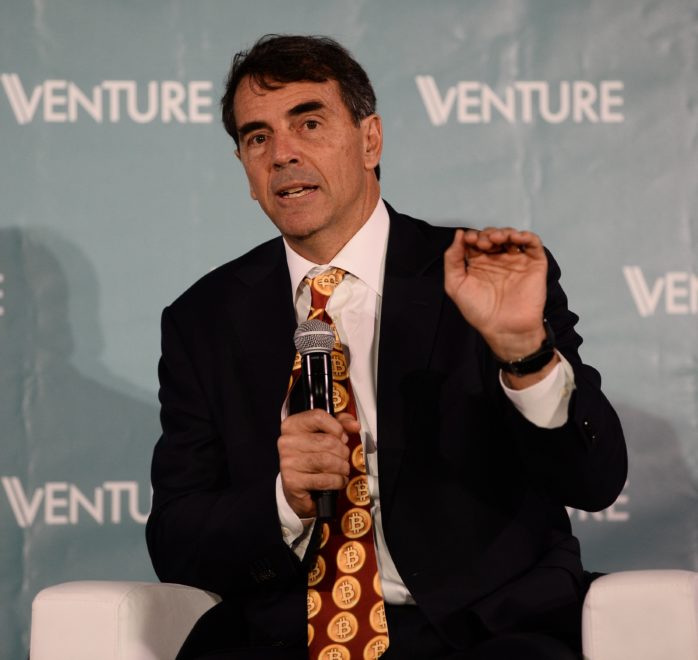
Draper meanwhile is perhaps an unlikely advocate for political lobbying, having already surprised TV audiences last week when he appeared in an HBO documentary about Theranos wearing a bitcoin tie.

The trademark garment, which has made various appearances in media interviews by Draper, nonetheless earned him a new, albeit mixed, following in both formal and social media.

It is, however, unknown whether or not Draper was wearing the tie during his meeting with president Macri.

What do you think about Tim Draper’s Bitcoin bet with Mauricio Macri? Let us know in the comments below!


Images courtesy of Shutterstock

Published at Mon, 25 Mar 2019 15:12:23 +0000

Previous Article

Tim Draper Bets On The Price of Bitcoin With Argentina President

Next Article

Dow Trembles after Mueller Report Shockingly Vindicates Trump

You might be interested in …

How Bulletproofs Could Make Bitcoin Privacy Less Costly

bulletproofs

Bulletproofs, presented in a paper titled “Bulletproofs: Short Proofs for Confidential Transactions and More,” describe a new zero-knowledge proof system. The proposal uses on-chain scaling for privacy and suggests a new, faster and more compact way to verify privacy-enhancing Confidential Transactions (CTs). Specifically, Bulletproofs can decrease the size of these verifications for these types of transactions drastically. Furthermore, the authors of the paper — Stanford University’s Applied Cryptography Group, overseen by professor Dan Boneh — have already managed to create a practical implementation for Bulletproofs.

This is how it works.

Currently, all transaction information — such as wallet addresses and especially the sent amount of bitcoins — are visible on the bitcoin blockchain. This affects the privacy of all users. If we wish to pay wages via the bitcoin network, for example, this means that every salary will be visible on the blockchain network. This, in turn, could mean that someone (like your landlord) could look up how much money you’re making to try and increase your rent accordingly.

Confidential Transactions are much needed to bring any type of blockchain to a higher level of privacy. Confidential Transactions combine and utilize several cryptographic tricks so that only the sender and the receiver of a transaction are aware of the amount transacted. These cryptographic tricks let users obfuscate the amounts they are transacting while still allowing onlookers to perform math on the obfuscated amounts. Basically, anyone can still check that the sum of sent bitcoins is greater than the sum of received bitcoins.

Confidential Transactions are realized with “zero-knowledge proofs.” These proofs are best described as a method for proving to another party that a Confidential Transaction is valid without conveying any information about the Confidential Transaction itself.

However, as stated in the Bulletproofs paper: “Current proposals for CT zero-knowledge proofs have either been prohibitively large or required a trusted setup. Neither is desirable.”

First of all, if we have to prove multiple range proofs, which is the case for multisignature transactions, the complexity and size will scale in a linear fashion. For example, if the size of a single proof is 2 kB, two proofs are 4 kB, three proofs are 6 kB and so on.

Additionally, zero-knowledge proofs typically require a trusted setup: they must be initialized by some trusted authority. However, the security properties of the bitcoin system don’t apply to that authority because in practice it means that the authority could produce fake “proofs.” These fake proofs could lead to uncontrolled and undetectable inflation.

Bulletproofs could solve these problems.

According to the paper, “In any distributed system where proofs are transmitted over a network or stored for a long time, short proofs reduce overall cost.”

Bulletproofs are claimed to be able to reduce the cryptographic proof significantly: from 8 kB to 734 bytes, though this depends on what the transaction looks like. Moreover, when dealing with multiple proofs, the size increases with just a few percent instead of this linear scaling. And in addition, Bulletproofs do not require a trusted setup.

Andrew Poelstra, contributor to the research paper and mathematician at Blockstream, believes that Bulletproofs are very practical: “We have already implemented a first version in the bitcoin crypto library libsec256k1, which can verify proofs three and a half times faster than the verifier for the classic rangeproofs. It is a drop-in replacement for classic rangeproofs that does not affect other aspects of the system and is therefore very easy to integrate.”

Until now, Confidential Transactions were just a theoretical concept because they were so heavy to implement. With Bulletproofs, the implementation of Confidential Transactions on bitcoin suddenly becomes more likely.

The post How Bulletproofs Could Make Bitcoin Privacy Less Costly appeared first on Bitcoin Magazine.