While bitcoin advocates point to politically fraught Venezuela as a prime example of crypto adoption, they often overlook the more business-friendly hub a bit farther south. Since Argentina has a sordid history of , plus an inflation rate that hit in 2018, bitcoin isn’t a hard sell these days.
“I was raised with my father telling me never trust the Argentine peso and my story was the story many Argentinians had,” Santiago Siri, founder of the blockchain startup Democracy Earth Foundation and investor in several Argentinian crypto startups, told CoinDesk.
Indeed, Argentinian usage of the peer-to-peer exchange hit an all-time high of $9.4 million in weekly volume in December 2018. Despite broader market dips, this growth has continued to surge in 2019 at a rate that dwarfs anything witnessed during the 2017 token boom, when the peak was $5.7 million. That figure would currently represent a slow week in Argentina’s 2019 P2P market.
None of this is to say that Argentinian companies haven’t felt the strain of crypto volatility, but local demand and interest remains steady. Plus, a recent influx of has infused Buenos Aires with underbanked communities that need financial tools and remittance services.
“The sector is growing, it’s growing very well. It’s providing a lot of jobs,” Siri said. “People are using these technologies for real survival needs and finding themselves in a better world than if they had to trust the government.”
All things considered, market dips have hardly decreased demand for bitcoin-related products and services in Argentina. To the contrary, bitcoin exchange CMO Manuel Beaudroit of Bitex told CoinDesk his company has seen increasing demand in 2019 for bitcoin-related services from Argentinian banks and brokerage firms.
As revealed exclusively to CoinDesk, Bitex will court such institutional customers across the region by launching bitcoin custody services in March.
Beaudroit said:
“They are interested in offering their clients the ability to do cross-border payments and remittances with Bitex’s services.”
The bitcoin startup recently helped facilitate a purchase of pesticides and agricultural products by the government of , settling in bitcoin. With 250 institutional customers already facilitating the majority of the exchange’s $500,000 daily volume, Beaudroit said Bitex is posed to expand services across Latin America. The platform is already live in Paraguay and Uruguay.
This builds on Argentina’s unique role in Latin American commerce. Brazil is so large that its startups often focus purely on the domestic market, Siri said, while Mexico generally loses top-tier talent to northern migration.
Meanwhile, the cryptocurrency mining company Bitpatagonia, located in the chilly southern tip of the continent, closed its first deal in early February to house 1,000 miners from Miami, according to Bitpatagonia co-founder Walter Salama. Latinos around the world are turning to Argentina as a hub where bitcoin-savvy startups can bring user-led insights to the global ecosystem.
Lightning lessons
Since they are generally focused on retail use cases, a bitcoin scaling solution called the has captured the attention of Argentinian users.
The Buenos Aires-based bitcoin wallet startup Muun will be launching Lightning-enabled payments in March, followed by the launch of an iOS app.
“Our main strategy revolves around the lightning network,” Muun founder Dario Sneidermanis told CoinDesk. “This is going to be the year of launching all those products.”
The bootstrapped startup with 10 employees has at least four people devoted entirely to Lightning, although the entire team works with this scaling solution in some aspect. In order to learn more about how nearly 1,000 Android downloads translates to real transactions, Muun COO Florencia Ravenna spent several weeks this winter conducting market research in Barrio 31, one of the largest slums in Argentina.
“Merchants are the key to these types of experiments,” Ravenna told CoinDesk. “If you want people to be able to spend bitcoin, you need to work with merchants.”
One way that Ravenna found merchants in Barrio 31 have been able to work with bitcoin without relying on custody services or payment processors is by adding a markup for products paid for with crypto. This way, merchants can hedge against volatility and liquidity challenges. Underbanked Barrio 31 residents also used bitcoin for remittances as well.
“I was surprised by how interested people were in learning new solutions,” she said.
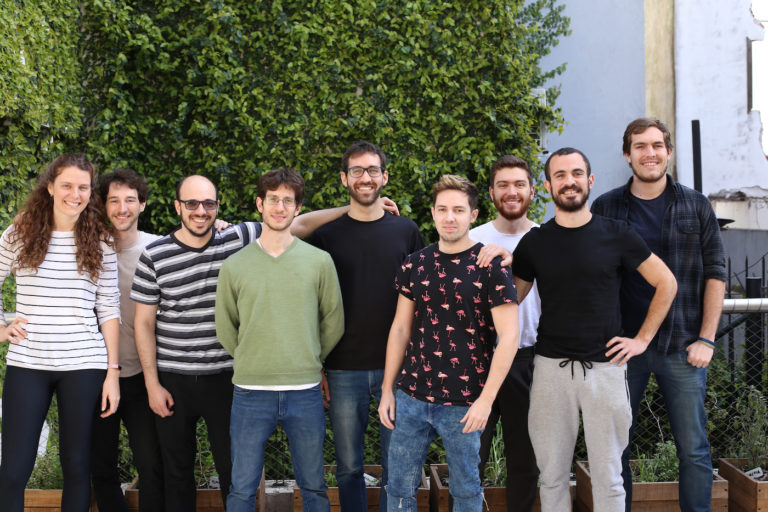
Muun staffers in Buenos Aires. (Courtesy photo)
Global ties
Beyond local demand, another reason Argentinian startups are thriving in this bear market is they’ve mastered the art of leveraging global networks.
For example, the digital notary startup Signatura has operated with just $450,000 in venture capital since it was founded in 2015. Now, with 3,000 monthly users and 5 percent of its customers paying in bitcoin, Signatura CEO Gonzalo Blouson told CoinDesk the startup is raising another modest round of $400,000 to expand its services across Latin America.
“We have a couple of investors [abroad] that have invested in the company using bitcoin,” Blouson said. “And are also looking for local VCs.”
Unlike the previous dot-com boom, in 2019 Argentinians are equipped with the digital infrastructure for remote work and fundraising. Such was the case with RSK Labs and RIF Labs, two blockchain startups that recently merged to form IOV Labs, which raised 22,000 bitcoins in 2018. IOV Labs CEO Diego Gutiérrez told CoinDesk most of the company’s funding and half of their contributors now come from abroad.
Likewise, the Buenos Aires-based CEO of the arbitration startup Kleros, Federico Ast, told CoinDesk in previous years it was difficult for crypto entrepreneurs to fundraise from Silicon Valley if the project hailed from a country like Argentina, with a history of banks defaulting on debts.
These days, he said, many Argentinians work remotely and garner direct investments from abroad. Along those lines, the stablecoin startup MakerDAO has up to seven Buenos Aires-based workers contributing to the project.
“In Argentina, we’ve had more than 100 years of really high inflation, so we are always looking for solutions,” Nadia Alvarez, MakerDAO’s business development associate for Latin America, told CoinDesk. “And it’s easier to do something here than in Venezuela.”
Through partnerships with companies like the crypto exchange startup , among several others, Alvarez has developed fiat on-ramps for unbanked stablecoin users with almost any Latin American currency.
Since more firms feel comfortable investing bitcoin in startups with small but growing user bases in inflation-riddled Latin America, the history of banking hardships has actually turned into an opportunity.
Speaking to over a decade of experience working with Argentinian startups, Democracy Earth’s Siri added:
“The pace of innovation that we’re seeing, for the context of Latin America, has no precedent.”
image via Shutterstock
Published at Tue, 26 Feb 2019 10:00:51 +0000

