August 15, 2026

Capitalizations Index – B ∞/21M

Stock Market Looks Recession-Proof, So What’s Holding Back the Dow?

Stock market looks recession-proof, so what’s holding back the dow?

Stock Market Looks Recession-Proof, So What’s Holding Back the Dow?

Stock market looks recession-proof, so what’s holding back the dow?

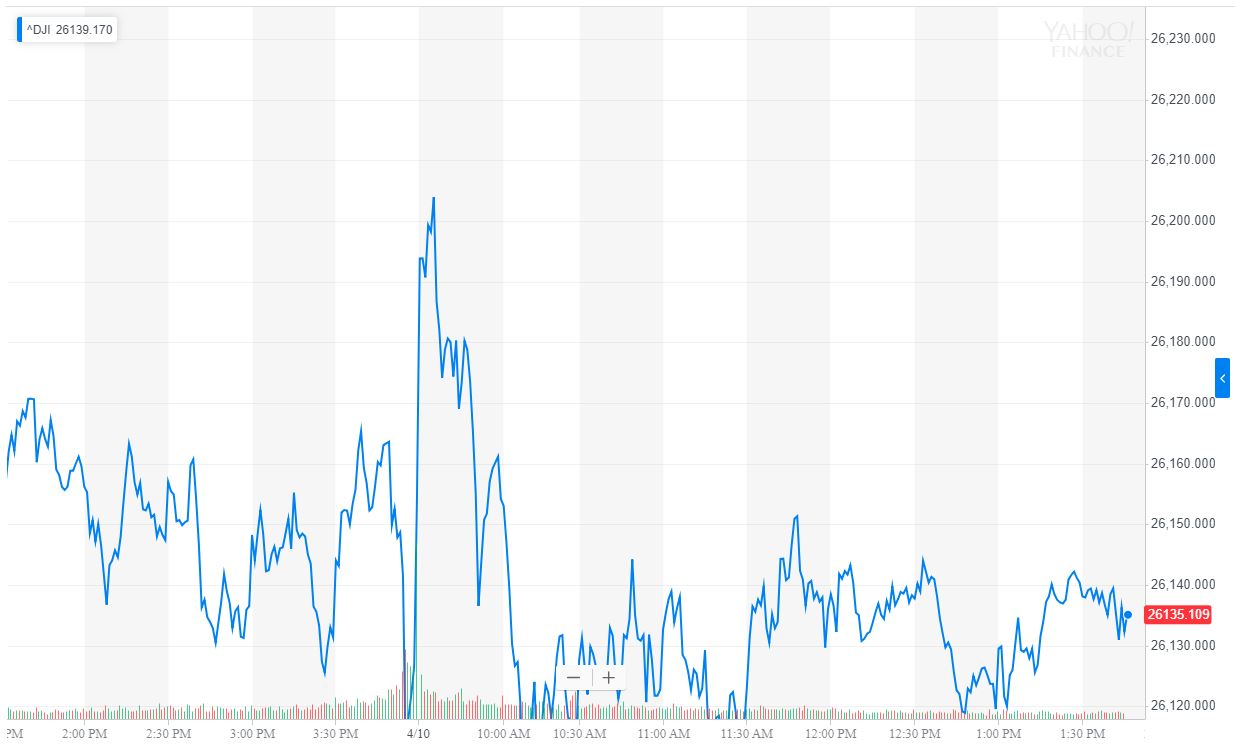
The Dow Jones Industrial Average held relatively steady on Wednesday. According to Goldman Sachs, the US stock market recovery is unlikely to run into a recession anytime soon. If that’s the case, what’s holding back the Dow?

Strategists Spar over Recession Risk and Dow Danger

The Dow teetered back and forth throughout the morning session. | Source: Yahoo Finance

On Wednesday, the International Monetary Fund (IMF) slashed its outlook of the global economic growth rate from 3.5 to 3.3 percent, citing various factors including a decline in business confidence and the uncertainty in the U.S.-China trade talks.

Guggenheim Partners added to the bearish outlook by dropping the shocking claim that the chance of a recession occurring in the next two years doubled in 2019 despite the overall optimism in the equities market and the Dow Jones still near its all-time high.

If a recession is to occur in the next 24 months, the research team at Guggenheim Partners led by Chief Investment Officer Scott Minerd said that it could last longer than a conventional correction.

“The next recession will not be as severe as the last one, but it could be more prolonged than usual because policymakers at home and abroad have limited tools to fight the downturn,” the team said.

Goldman Sachs: Recession Odds Plunge to 10%

The U.S. should escape a recession in the near-term, which gives the Dow and its peers more room to run. | Source: Shutterstock

But, the decision of the Federal Reserve to hold rates steady until the end of 2019 alleviated most of the pressure on the U.S. market and the possibility of a recession in the medium-term.

Goldman Sachs analysts stated that the Fed’s dovish shift succeeded in decreasing downside risks. If the Fed remains patient, growth should continue throughout 2019, further reducing the risk of a full-fledged recession.

Suggesting that the risk of a recession over the next 12 months remains at around 10 percent, Goldman Sachs economists wrote:

“The Fed’s dovish shift was likely designed to decrease downside risks, and our findings suggest that this has largely worked as planned. As the lingering effects of the Q4 tightening gradually fade away, the Fed may eventually be willing to revisit the need for patience, as indicated in the January minutes.”

The economists added that U.S. growth momentum has improved considerably in recent months.

“Our analysis also suggests that downside risk will likely be contained in the near-term, barring another large tightening in the FCI. In addition to the reversal of much of the Q4 FCI tightening, US growth momentum has improved and global growth appears to be stabilizing,” the economists said.

If a Recession is Not Likely, What’s Holding Dow Back?

At over 26,000 points, the Dow is already in a strong position, having recovered by more than 4,000 points since December 2018.

However, one prevailing concern is that stocks may be too expensive to be compelling for retail investors during a phase in which there are no clear stimuli to push equities prices even higher.

A comprehensive trade deal with the U.S. and China, which could also lead to an overall recovery in the eurozone, may act as a catalyst that pushes the Dow further in the medium-term.

For now, either strong earnings from big players or a catalyst like a trade deal that would drastically reduce geopolitical risks could be needed to move the U.S. equities market much further up from the current level.

Published at Wed, 10 Apr 2019 18:05:39 +0000

Previous Article

Coinbase Introduces Security Measures to Safeguard Users’ Login Credentials

Next Article

Beware: Bitcoin Might Blindly Chase the Dow into the Next Financial Crisis

You might be interested in …

Japanese Company Will Launch New Bitcoin Mining Operation With 7 nm Chips

GMO Internet Group Launches Massive Bitcoin Mining Operation With 7 nm Chips

GMO Internet Group, a Japanese provider of a full spectrum of internet services for both the consumer and enterprise markets, is launching a new bitcoin mining business utilizing next-generation 7 nanometer (7 nm) semiconductor chips. “[We] believe this new business has high potential for increasing corporate value in the future,” states the company.

Headquartered in Tokyo, GMO IG comprises more than 60 companies in 10 countries. GMO IG’s size and financial muscle, as well as the novel technologies it wants to leverage, will make it a serious entrant in the bitcoin mining industry, and one that could have a disruptive impact.

“We will operate a next-generation mining center utilizing renewable energy and cutting-edge semiconductor chips in Northern Europe,” GMO stated, emphasizing that they will invest in R&D and manufacturing of hardware including the next-generation mining chip. “We will use cutting-edge 7 nm process technology for chips to be used in the mining process, and jointly work on its research and development and manufacturing with our alliance partner having semiconductor design technology.”

The International Technology Roadmap for Semiconductors defines 7 nm semiconductor chip technology as the next technology iteration following 10 nm technology, which, in turn, follows the 14-16 nm technology that currently represents the state-of the-art hardware in the bitcoin mining industry. Commercial production of 7 nm chips is still in the development stage with GlobalFoundries, IBM, Intel, Samsung and Taiwan Semiconductor Manufacturing Company (TSMC) competing for market leadership.

According to a recent article in Android Authority, TSMC seems to be in the pole position in this race, having already showcased a preliminary 7 nm SRAM chip — not yet a full system on a chip (SoC) but an important milestone. Intel is said to be planning the upgrade of a manufacturing plant in Arizona to start building 7 nm SoCs. Samsung and GlobalFoundries are also striving to catch up.

According to Quartz, 7 nm technology would be four times more energy efficient than the current bitcoin mining industry standard. Therefore, once 7 nm chips are in use, all other miners will have to upgrade to stay in the game.

“It’s clearly the next generation of miners,” Diego Gutierrez, CEO of mining software developer RSK Labs, told Quartz. “The other [mining chip makers] will surely follow and create their own 7 nm chips if they are not already doing it. As [chip manufacturers] get the new technology, everybody can access it.”

“We believe that cryptocurrencies will develop into ‘new universal currencies’ available for use by anyone from any country or region to freely exchange ‘value,’ creating a new borderless economic zone,” notes GMO IG. “[bitcoin] can be regarded as a distributed system whose credibility is secured by mutual monitoring by network participants, as opposed to legal currencies which are a centralized system whose credibility is secured by the issuer. And management of a distributed system such as [bitcoin] requires a mining process.”

The entry in the bitcoin mining sector of these new Japanese players with relatively deep pockets is likely to be welcomed by those concerned about China’s dominance of the mining industry. For example, Chinese mining operator and hardware manufacturer Bitmain plays a dominant role in the $70 billion bitcoin economy. Its mining pools, Antpool, BTC.com and ConnectBTC, account for around 30 percent of all the processing power on the global bitcoin network, while the company is also the market leader for specialized mining hardware, including ASIC chips.

In related news, another large Japanese company, DMM, announced the launch of its own Virtual Currency Division, scheduled to begin operation of a virtual currency mining business “DMM Mining Farm” in October 2017. According to the company, which hasn’t released further information, DMM will operate one of the 10 largest mining farms in the world before the end of 2018.

The post Japanese Company Will Launch New Bitcoin Mining Operation With 7 nm Chips appeared first on Bitcoin Magazine.