
Another year is coming, filled with fresh optimism and newfound determination to make 2019 the year when cryptocurrencies take over. Having gotten their calls badly wrong for 2018, so-called experts will be hesitant to make bullish price predictions for 2019. That’s probably for the best since there are far more interesting things to focus on than price action. Here are seven trends that should dominate the cryptosphere over the next 12 months.
Also read:
2018 Didn’t Play Out the Way it Was Promised
 This time last year, all kinds of bold predictions were being issued for what 2018 would hold for the crypto space. In the event, the biggest trend of the year was one which few futurologists foresaw – stablecoins. 2018 will go down as the year the markets went south and ICOs died off, leaving a new wave of digital assets to shine – dollar-pegged stablecoins.
Love, hate or tolerate them, there’s no denying that stablecoins were a recurring motif this year. Whether they will continue to dominate in 2019 depends to a large extent on how conventional crypto assets perform. Should the current bear market persist, or bite deeper still, stablecoins will remain ubiquitous. If more favorable market conditions return, however, stablecoins will be forced to take a back seat, leaving the following trends to joust it out in 2019.
New Privacy Protocols Will Gain Traction
 With the Mimblewimble-powered cranking into life, the stage is set for 2019 to be the most private year in crypto in a long time. The last few years of encroaching blockchain surveillance have stripped away a lot of the anonymity that cryptocurrency users once took for granted, but the fight back has begun. It’ll take more than a single privacy protocol to restore the imbalance of course, so it’s just as well there’s a host of privacy-minded tools set to come onstream.
Aside from the Mimblewimble coins, there’s the prospect of bitcoin Core getting Schnorr signatures next year, which could open the door to privacy tech such as Coinjoin at some point. Before then, we’ll be seeing a lot of other pro-privacy platforms, apps and protocols gaining traction. , a privacy-focused BTC wallet, will hoover up new users, while Ethereum may get its own take on confidential transactions courtesy of protocol. Stablecoins could get private too should – zero-knowledge DAI transactions – become a thing. Pro-privacy projects like Dust and Loki should also make progress, while new projects such as , a privacy coin and accompanying DEX, are in the works.
STOs Will Replace ICOs
2018 was meant to be the until it wasn’t. That prediction can be rolled over to 2019, however, when it might just come true provided the technical and regulatory hurdles can be cleared by enough applicants. What’s beyond dispute is that 2018 killed the ICO, and no one is tipping the crowdfunded utility token model to rise again. The increased legal and compliance costs of holding an ICO, which now average around $1 million, have put paid to the vast majority of initial coin offerings.
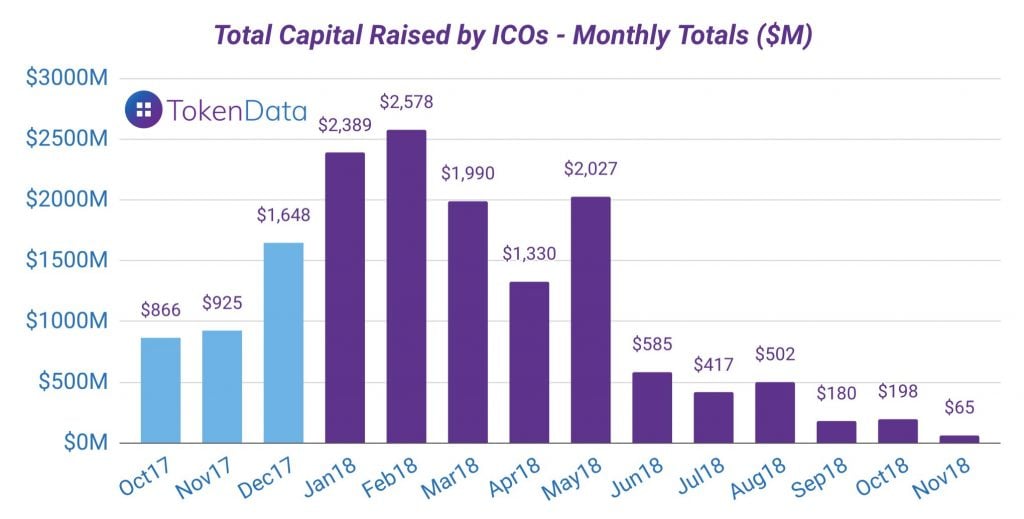 The ICO market died off dramatically in 2018.
head analyst Jose Macedo believes the security token offering (STO) will become the standard model most crypto-based projects deploy. “While utility tokens are far from dead, what the industry has now realized is that few of these token economic models actually made sense in terms of long-term value capture,” he explains. “As a result, we’re seeing a lot of projects come to us looking for help in either launching their STOs or restructuring their ICOs as STOs,” adds Macedo. He continues:
We’re also seeing a lot more STO infrastructure be built out in terms of quality legal, token sale platforms, book-building firms, exchanges etc … As of right now, we have about $1B worth of STOs partnered with us looking to launch in 2019.
 While security token projects are poised to launch in proactive territories like Malta and Gibraltar, where regulatory frameworks have been drawn up, slower progress is expected in the U.S., where fundraising options are limited. There, the SEC will likely deem most ICOs to be issuing securities. American crypto-based projects are no closer to being granted Reg A+ approval to launch an STO, despite some, such as Gab, having filed the paperwork over a year ago.
Decentralized Credit Networks Will Take Off
made huge strides this year in terms of infrastructure development. The tools necessary to facilitate collateralized loans, social credit and open finance have been fine-tuned and proven to work. 2019 will be when they scale up and start to serve the sort of users they were envisioned for – global citizens who’ve been excluded by the current financial system.
 Crypto debt markets and credit networks will be bolstered by the growth of projects like , , , and Maker DAO. Maker’s system of multi-asset over-collateralization will be emulated, having proven its robustness through extreme market volatility this year. Multi-collateral dai will see a wide range of applications in 2019, as the number of users grows with the number of assets that can be collateralized. 2018 was all about ETH, but in 2019 Maker will accept BTC, ERC20s and other crypto and non-crypto assets.
Other Trends to Expect in 2019
It’s possible that 2019 could be the year when one or more dapps finally sees mass adoption, but don’t count on it. It may also prove to be the year when the first viral blockchain game arrives. At the very least, crypto collectibles and virtual reality projects will attract fresh investment, with non-fungible tokens (NFTs) tethering them to public blockchains to facilitate the trading of digital assets. Once Decentraland’s virtual world launches in 2019, a meeting ground for all kinds of crypto games and projects will be established.
 The bitcoin Cash community will continue to find new ways to spend and receive peer-to-peer cash, while the BTC brigade will have optimism that 2019 will finally be the year when the Lightning Network proves its suitability for something more than purchasing stickers. Custodial services for institutional investors will improve, bringing new money into the crypto space (but probably not propelling crypto assets to new highs). NYSE’s Bakkt will launch, bringing physical BTC futures contracts, and there’s an outside bet the SEC might approve a bitcoin ETF.
Stripped of much of the greed that characterized the dawn of 2018, and with 12 months of robust infrastructure work completed, 2019 is shaping up to be an exciting time for cryptocurrency users from all tribes, countries and continents.
What other trends do you expect to see in 2019? Let us know in the comments section below.
Images courtesy of Shutterstock and Tokendata.
Need to calculate your bitcoin holdings? Check our section.
The post appeared first on .