SEC Investor Conference to Hold Session on Bitcoin and ICOs
Advertisement
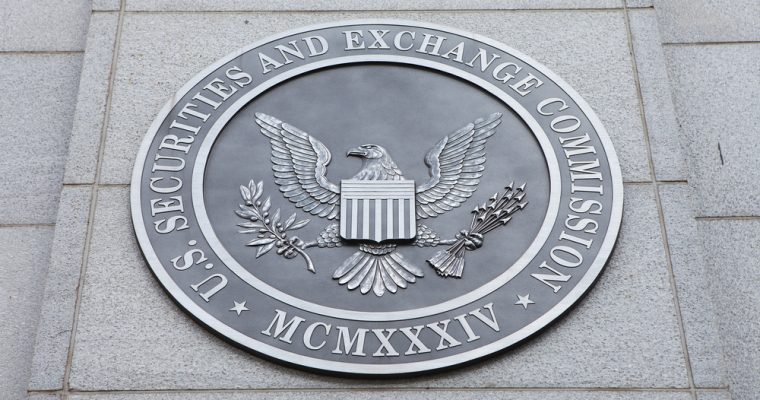
The US Securities and Exchange Commission are holding the SEC Investor Conference in Atlanta this year on June 13 at Georgia State University.
There will be a town hall event followed by break-out events wherein attendants can meet with members of the SEC for a more informal discussion on issues regarding regulation in the world of fintech, mutual funds, fraud prevention, and cryptocurrency.
A page on the official SEC website advertises as follows:
“Meet the people who help make Wall Street work for Main Street. All five SEC Commissioners are coming to Atlanta to meet with you: young people, the military, urban and rural, those saving for retirement, and seniors—the diverse, the dynamic people of the southeast region.”
All five SEC commissioners will be in attendance including Chairman Jay Clayton, who had earlier this year about cryptocurrencies and ICOs at Princeton University on April 5. When asked if he thought ICOs were inherently fraudulent Clayton said “absolutely not”, stating that his hope was the regulation introduced by the SEC would have a positive impact on the cryptocurrency space by stamping out bad actors and allowing legitimate projects to thrive.
Many members of the cryptocurrency community have been concerned recently that the SEC is gearing up to classify cryptocurrencies like bitcoin and Ethereum as securities, meaning that the tokens represented an underlying asset as opposed to being utility tokens. The security classification would have disastrous effects on the market with strict regulations on taxes and even who can or cannot legally own and invest in crypto.
However, Clayton set some minds at ease by that the SEC were really looking at, not bitcoin. Meanwhile, the Ethereum co-founder has stated that he is “” that Ethereum does not qualify as a security.
The confusion over how to classify crypto-tokens and on the processes involved in ICO investment, in general, are the reason discussions like the one being held in June are necessary, and the SEC bitcoin and ICO session may help to clarify the government’s stance on some of the pressing legal issues being widely discussed in the cryptocurrency community.
“There’s no such thing as a safe hard fork,” lead developer Thomas Voegtlin corrected an audience member at the conference in Paris last weekend. “I would recommend to have replay protection, of course,” he added.
Community support for SegWit2x, the bitcoin spearheaded by Barry Silbert’s, was virtually absent in Paris. Whenever the “2x” part of the was discussed in the French capital, speakers and visitors overwhelmingly considered it a risk to defend against — not a proposal to help succeed.
Electrum users, for example, will not blindly follow hash power in case of a chain-split, Voegtlin explained throughout his talk; instead, they’ll be able to choose which side of such a split they want to be on. And importantly, the lightweight wallet will implement security measures to prevent users from accidentally spending funds on both chains: “replay protection” that seems unlikely to be implemented on a protocol level if SegWit2x does fork off.
“We are ready,” Voegtlin said. “If [SegWit2x] doesn’t include replay protection, the fork detection we have in Electrum will be useful.”
the successful conference format, the French bitcoin community hosted the first edition of Breaking bitcoin two blocks from the Eiffel Tower last weekend. bitcoin developers, academics and other technical-minded Bitcoiners gathered for a diverse program, but with the common denominator being bitcoin’s security.
“For the past two years, the bitcoin community has been obsessing with scale and scalability,” Kevin Loaec, managing director at and co-organizer of the event, told bitcoin Magazine. “But I’m not so worried about scale, I’m worried about mining centralization, a lack of privacy and fungibility … these kinds of things. As an industry we need to recognize there are more challenges than just scalability; hopefully this conference reflects that.”
Whereas the first Scaling bitcoin conference two years ago was a very specific reaction to a looming block size limit increase hard fork — then put forth by — this wasn’t necessarily the motivation behind Breaking bitcoin. Yet, once again, a controversial hard fork is looming on the horizon. This time imbedded in the BTC1 implementation developed by co-founder Jeff Garzik, the New York Agreement’s SegWit2x is scheduled to increase bitcoin’s “base block size limit” to two megabytes by November — an incompatible protocol change that could split the bitcoin network in two.
And it did not take much to recognize how unpopular the proposal was in Paris. Perhaps most vividly, Italian bitcoin startup led a protest campaign by distributing NO2X stickers; the Twitter hashtag was proudly added as a piece of flair to the by now well-known Make bitcoin Great Again and UASF hats. And voices critical of the project — like Voegtlin and his call for replay protection — could consistently count on rounds of applause. From a technical perspective, the proposal is often considered — quite frankly — to be reckless.
“Unfortunately, SegWit2x […] was designed to effectively be as disruptive to the minority chain,” engineer and author James Hilliard said on stage during the miner panel.
SegWit2x: The Arguments
Arguments against the 2x hard fork are diverse.
Perhaps its biggest problem, SegWit2x currently lacks basic safety measures to prevent unsuspecting users from losing funds. This includes, most importantly, the aforementioned replay protection, but a new address format would be similarly helpful.
Additionally, the three-month lead time for this specific hard fork is considered extremely short — assuming the goal is to prevent a chain-split in the first place. “If you ask any of the developers, they will typically want to see 18 months or two years lead time, for something with as wide an impact on all the software and hardware out there as a hard fork,” co-founder and inventor Dr. Adam Back noted during a Q&A session.
And if the chain does split into different networks and currencies — one following the current bitcoin protocol and one adopting the hard fork — the question becomes which of the two gets to use the name “bitcoin.” So far, proponents of the SegWit2x hard fork have shown no willingness to pick a new name.
This branding issue, contributor and co-founder Eric Lombrozo pointed out, provides yet another point of controversy.
“My personal opinion is that whomever is proposing the change, the onus is on them to demonstrate widespread support,” Lombrozo said during his talk on protocol changes. “The people that want to keep status quo don’t need to show anything. It’s the people who want to change the stuff that actually need to demonstrate there is widespread support.”
And for now, not everyone is convinced that SegWit2x does indeed have this level of support — or anything close to it. While several large mining pools, as well as a significant number of companies, have signed on to the New York Agreement, this agreement was itself drafted without any feedback from bitcoin’s technical community nor — even more important — a reliable gauge of user sentiment.
And while some bitcoin companies claim to represent their customers, this is — once again — not taken for granted by everyone.
“One debate I want to draw attention to,” venture capitalist Alyse Killeen pointed out, “is the debate whether businesses speak for their users. I think this is probably a debate you would only see now in this space because it’s pretty well established that businesses outside of this space do not speak for users, but it’s a debate we still have in our community. Of course they don’t.”
NO2X
If Breaking bitcoin in Paris can be considered at all representative of SegWit2x’s community support — which, it should be noted, is not necessarily the case — the proposal will face an uphill battle to be widely accepted in November.
Indeed, some signatories of the agreement are not so sure about the hard fork anymore: and have publicly backed out of the agreement. And, during a mining panel in Paris, CIO Alex Petrov ever so slightly opened the door to potentially withdrawing support as well, if both the original and the 2x chain manage to survive.
In fact, it’s not just that contentious hard forks are considered a threat to be defended against by bitcoin’s technical community. It goes beyond that.
In the words of bitcoin developer Jimmy Song, at the conclusion of his opening talk of the event:
“What doesn’t kill bitcoin makes it stronger. And conferences like this prove that we’re getting better at this. We’re getting immunized to all these hard forks, and it’s creating a better bitcoin as a result, and that’s a very good thing. We’re securing against a lot of these attacks, and figuring out ways to mitigate these threats.”
The Bristol & Bath blockchain and cryptocurrency seminar Have you heard about blockchain or cryptocurrency and want to understand more? According to a recent survey 1 in 5 UK adults who have never owned cryptocurrencies […]