
Michael J. Casey is the chairman of CoinDesk’s advisory board and a senior advisor for blockchain research at MIT’s Digital Currency Initiative.
The following article originally appeared in , a custom-curated newsletter delivered every Sunday exclusively to our subscribers.
___________
With offering a reminder that faces challenges in its long roadmap to migrate from a proof-of-work (POW) consensus algorithm to proof-of-stake (POS), it’s easy to miss the fact that elsewhere in crypto-land, POS is already a thing.
A little-discussed ramification is that POS will drive new business and financial models for cryptocurrencies, which will, in turn, give rise to a new regulatory and security challenges.
Viewed through the prism of traditional finance, a consensus model in which owners of cryptocurrency earn block rewards when they stake, or deposit, their holdings to “vote” on ledger validation starts to look a bit like an interest-earning function. And when third parties, such as those that are starting to provide “staking as a service,” do this on behalf of coin-holders who trust them to provide custody and exchange functions, it starts to look like banking.
That assessment would rightly alarm crypto traditionalists. And it’s one reason why some warn against these attempts to improve on the POW model on which bitcoin [BTC] is founded, arguing that POS will diminish security and incentivize centralization.
But although the , proof of work faces real challenges both in terms of computational efficiency and in its public perception as an environmental threat.
As such, it’s hard to imagine there won’t be continued and growing support for chains using proof of stake and its cousin, delegated proof of stake (DPoS), which draws from notions of representative democracy to increase efficiency at the cost of some centralization.
Already, out of the 19 leading blockchain projects reviewed on , three – Cardano, Dash and Qtum — are using proof of stake and another three – EOS, Lisk and Tron – use DPOS. Four of those six are among the top 15 ranked cryptocurrencies cited by , collectively accounting for $6 billion in coin value as of Friday afternoon.
If we added ethereum to that group, along with Tezos, another prominent blockchain project using a variation of POS, the total market cap of these leading POS chains would run to $18.8 billion.
That’s still less than a third of bitcoin [BTC]’s total $64 billion valuation. Nonetheless, this universe of future and current POS chains can’t be ignored. We need to think hard about what POS means for the evolution of a crypto-based financial system.
A business waiting to happen
I hadn’t given this much thought until I read an in which she assessed aspects of a new report from the European Securities and Markets Authority (ESMA) on regulating crypto assets.
that while ESMA is recommending that crypto exchanges now employ systems of segregated accounts, in the future there will also be a need for “exchanges to explicitly inform clients whether their funds are used for staking purposes” and to “get specific consent.”
It got me thinking of how unavoidably appealing staking-as-a-service is for all the exchanges managing people’s trading in POS coins. There are no clear signs that any are actually doing this with crypto tokens in their custody – and if that is happening without users’ consent, it needs to stop. But the idea of helping their clients earn revenue on their otherwise dormant coins, and charging a fee for doing so, is surely an attractive one for both sides.
A bitcoin [BTC] utopia in which “everyone is their own bank,” with complete control over their private keys, may well be desirable from a decentralization and security perspective. But millions have shown that they are happy to have an insured third party handle custody for them rather than have sole control over their assets. The success of Coinbase and other such custodial exchanges and wallet providers speaks to this.
Now, add to that the prospect of having that exchange or dedicated custodian manage staking rewards on people’s behalf and it’s easy to see many people going for it.
There’s a fiat equivalent: most of the world’s savings in dollars, euros, yen and all other traditional currencies sit in either interest-bearing bank accounts or are pooled into funds whose portfolios are managed by third parties. People find it both convenient and more effective to pool their monetary power with others and have an outsider invest it for them.
Back to the future
But, hang on a second. Aren’t we just recreating the old banking world with all of its attached system and counterparty risks? Maybe, yes.
As , if we can envisage staking-as-a-service becoming so popular that pretty much all coins permanently reside with the most trusted of these custodians, constantly earning rewards, then we can also imagine those entities issuing tradable, interest-bearing depositary receipts based on the coins held with them.
Given the unlikelihood that all users’ coins will be withdrawn from that institution at the same time, those receipts would trade at par, which could mean they’re treated as a unit of exchange equivalent to the value of the underlying deposited coins, essentially allowing for off-chain monetary creation.
“Congratulations!” writes Bunin, “We’ve come full circle to reinventing fractional banking! You now have an asset AND a financial instrument that’s a claim on that asset.”
Anyone who’s studied the history of banking, specifically of bank runs, of systemic risk and all the panics that have led to repeated crises in our financial system, and who’s also watched how governments have stepped into the crypto space in the name of protecting consumers, will know that this scenario will inevitably invite another layer of regulation. And for a host of reasons, including for keeping the cost of entry down for breakthrough startups, that can be problematic.
Now’s the time to try to get ahead of this. As with many other ideas that try to wrestle control over security risks away from regulators and put it into users’ hands via blockchain-inspired governance, the way forward may lie in innovators developing decentralized solutions.
Not unlike the work going into decentralized exchanges and atomic swaps that protect users from the counterparty risks with centralized exchanges, so too can developers look at decentralized systems for pooling assets employed in staking services.
One way to think about it is illustrated by a run by their own decentralized applications, so that smaller players can participate in EOS’s lucrative reward system for delegated block producers.
Another way to add protection to the system might be to somehow apply custody arrangements in staking service agreements, so that clients retain ultimate control while service providers are still empowered to execute staked votes.
staking-as-a-service is already taking off, with the early players earning steep margins. She notes a natural trajectory by which new competitors will enter the market and narrow the spread, making this more attractive for the wider market.
The time to figure out what this means for the crypto financial system is now.
Ethereum image via CoinDesk archives.
Published at Mon, 21 Jan 2019 05:00:09 +0000


 Figure 1: BTC-USD, 3 Day Candles, Bitfinex, Macro Bull Trend
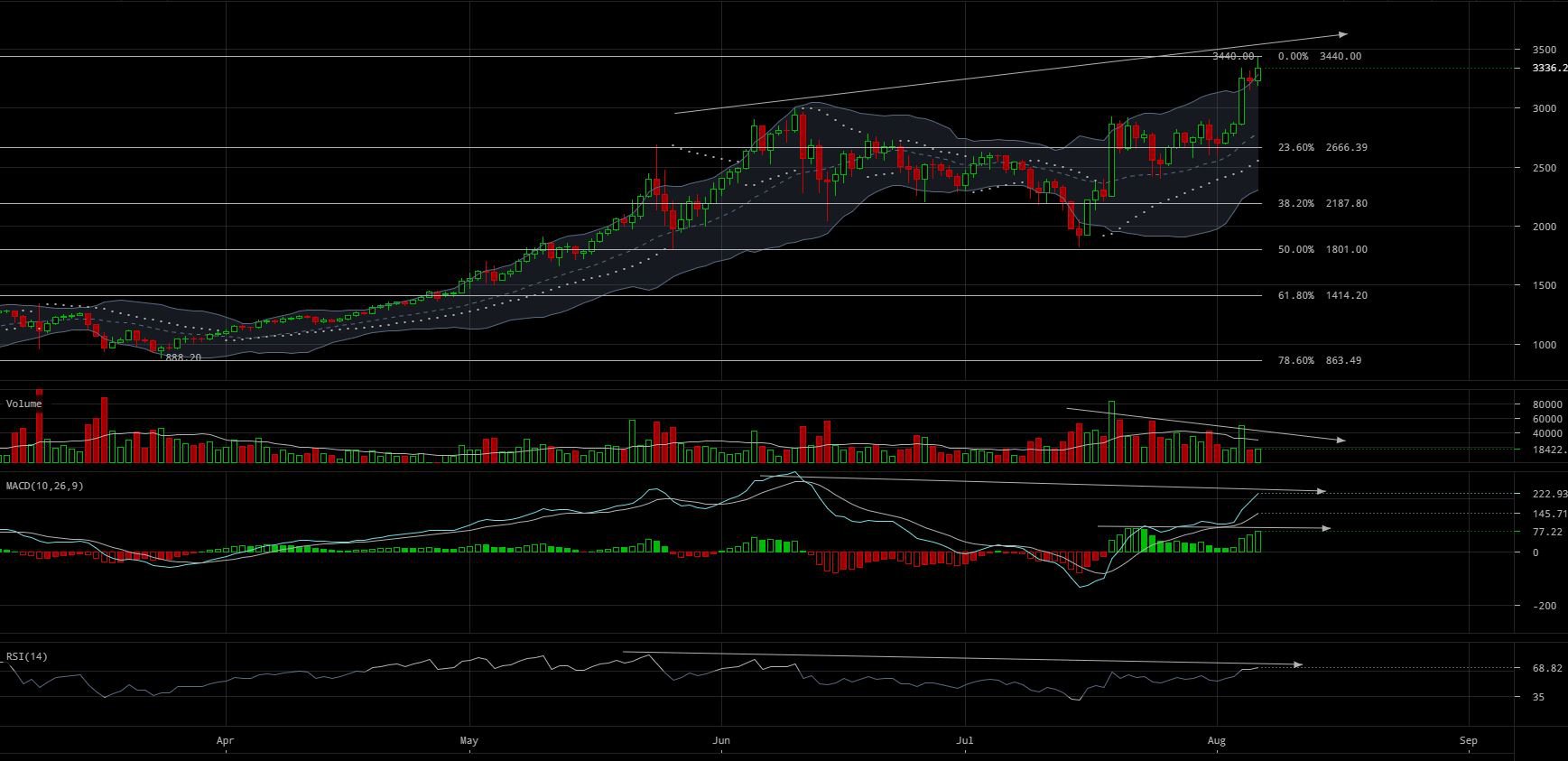 Figure 2: BTC-USD, 1 Day Candles, Bitfinex, Macro Bull Trend, Zoomed In
 Figure 3: BTC-USD, 6 Hour Candles, Bitfinex, Current ATH
 Figure 4: BTC-USD, 1 Day Candles, Bitfinex, Bollinger Band Trend