June 30, 2026

Capitalizations Index – B ∞/21M

Only Five Bitcoin Mining Devices Released in 2018 Are Profitable This December

bitcoin News
Only Five bitcoin Mining Devices Released in 2018 Are Profitable This December
Only five bitcoin mining devices released in 2018 are profitable this december

There has been a slew of bitcoin mining rigs announced during the last 12 months that claim to process more terahash per second while consuming less energy. However, with cryptocurrency prices so low, lots of newly launched machines are not profitable and many of them haven’t even shipped yet.

Also read: Federal Agents Told This Silk Road Moderator to Fake His Own Death  

The Five Profitable Mining Rigs

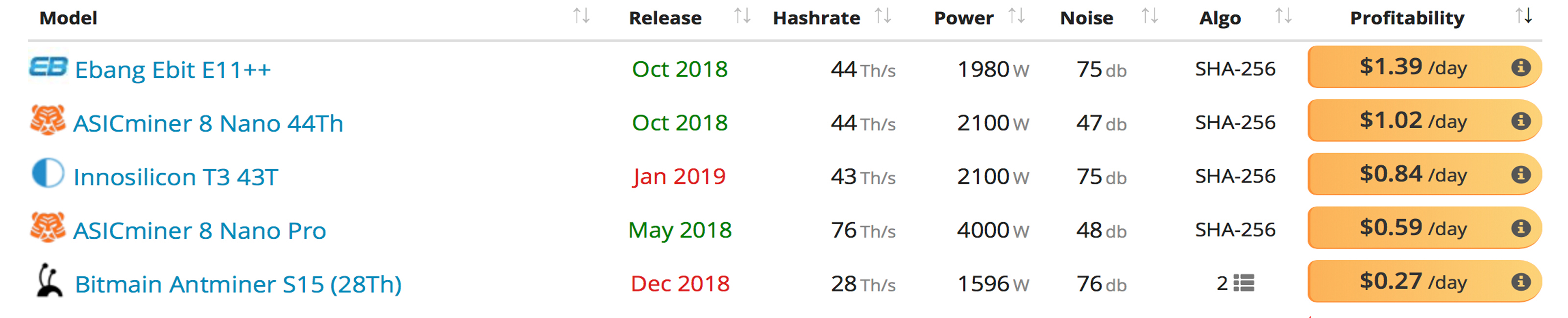
Digital asset prices have seen better days as cryptocurrency markets throughout the entire 2018 calendar year have been riding a long bearish trend. Many coins with the SHA-256 mining algorithm such as bitcoin cash (BCH), bitcoin core (BTC), and peercoin (PPC) have lost considerable value. Because cryptocurrency prices are so low, many mining devices announced this year are failing to bring a profit and some machines cannot be purchased on the open market. According to real-time statistics from Asicminervalue.com at the time of publication, only five mining devices make a profit and two machines are not yet available on the market. The data website uses a combination of electrical costs, current network difficulty, block reward, and exchange rates to figure out whether or not certain ASIC machines are profitable.
Only five bitcoin mining devices released in 2018 are profitable this december

Machines With Significant Terrahash Pull Small Profits

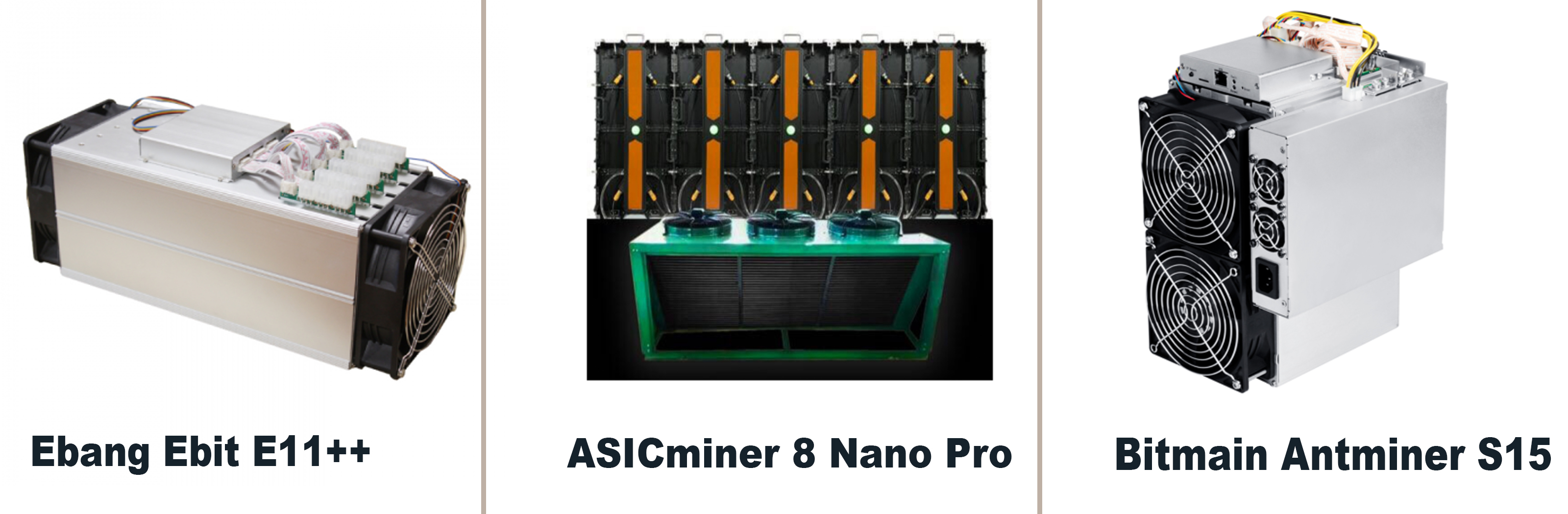
The most profitable machines on Monday, Dec. 10, 2018, three weeks before the new year, are manufactured by the corporations Ebang, Asicminer, Innosilicon, and Bitmain. The Ebang Ebit E11++ is currently the most profitable mining device on the market with 44 terrahash per second (TH/s) and it consumes 1,980W. The Ebang mining rig priced at $2,500 makes about $1.39 per day profit with current BTC prices. The E11++ is currently available on the open market from two companies but one vendor is only taking pre-order right now. The Asicminer 8 Nano is another machine that processes 44TH/s but pulls 2,100W from the wall. The machine created by Asicminer was launched in October and pulls a profitability of about $1.02 per day, at the time of writing. The company’s 8 Nano is available for purchase through the Canadian dealer Mining Cave for $2,045.
Only five bitcoin mining devices released in 2018 are profitable this december

Then there’s the new Innosilicon T3 model, which also claims to boast roughly 43TH/s but the rig is not available to the public just yet. The T3 will be released in January 2019, according to the company, at a price of $2,500 per machine. With current market statistics, this gives the T3 a profitability of about $0.84 per day for a machine you cannot obtain. The next most profitable miner, Asicminer 8 Nano Pro, is obtainable according to Asicminervalue. The Nano Pro claims to process a whopping 76TH/s but consumes over 4,000W in electricity. These metrics make the $11,600 machine only profitable by $0.59 per day. Lastly, Bitmain contends the Antminer S15 machine produces about 28TH/s, pulling 1,596W from the wall, giving the device a profitability of $0.27 every 24 hours.
Only five bitcoin mining devices released in 2018 are profitable this december

Operating at a Loss

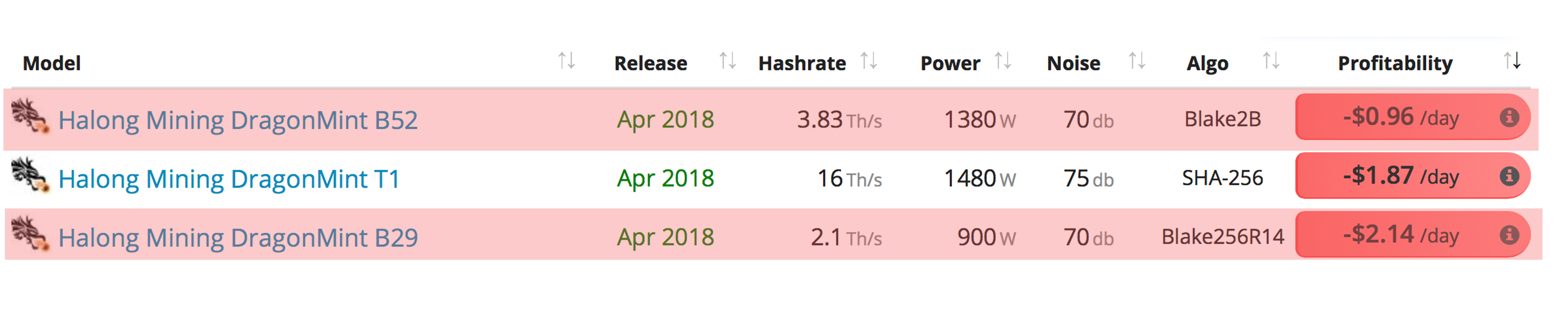
Many other machines that were announced this year are not showing profits and consume more energy cost if the companies continue to operate them. GMO’s B2 and B3, which boast 24-33TH/s, can lose between $1.90-4.98 per day at current BTC prices. The infamous Halong Mining Dragonmint T1 model sees a loss of around $1.87 per day.
Only five bitcoin mining devices released in 2018 are profitable this december

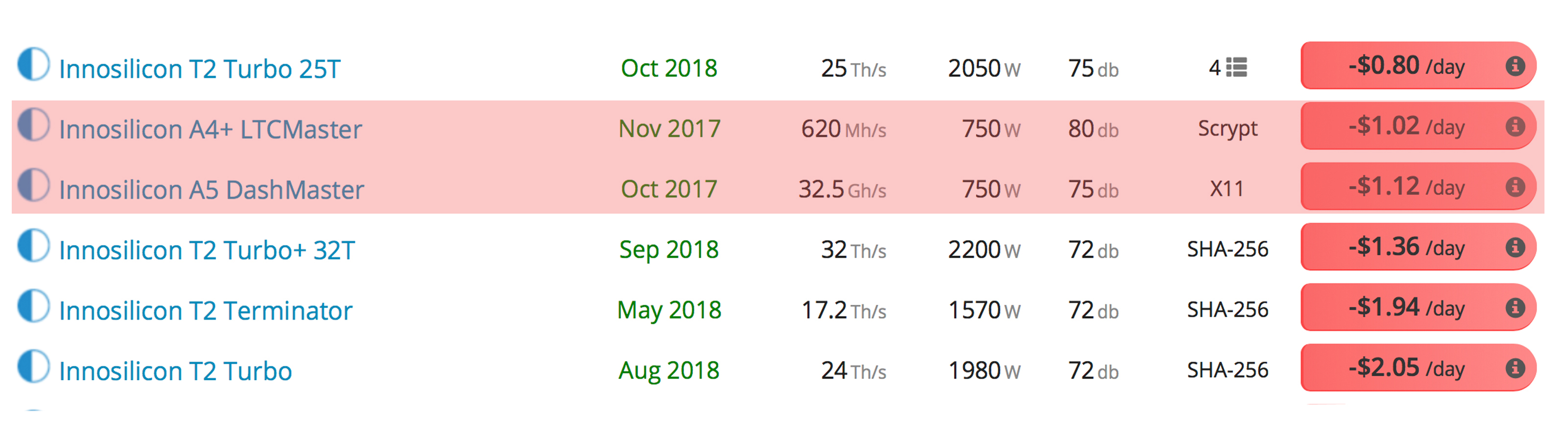
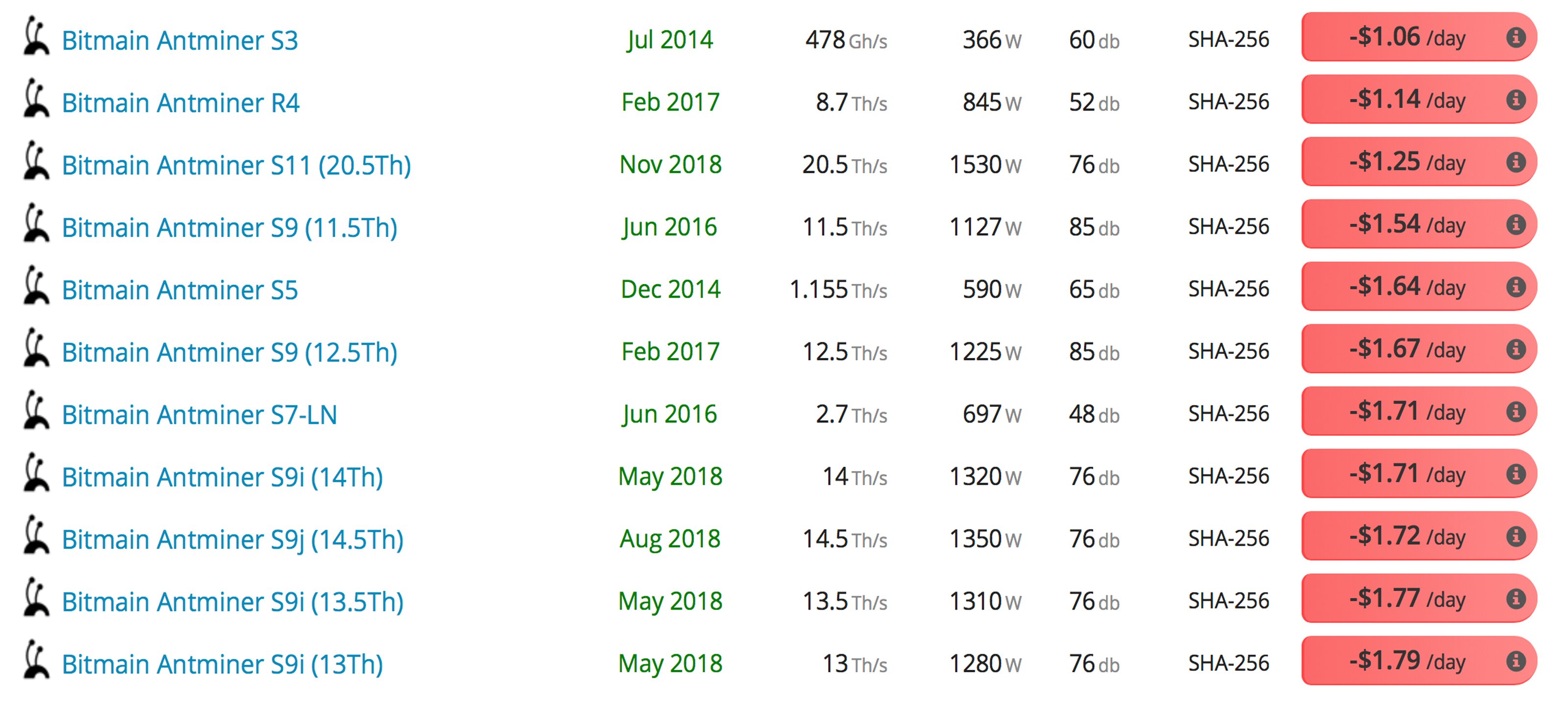
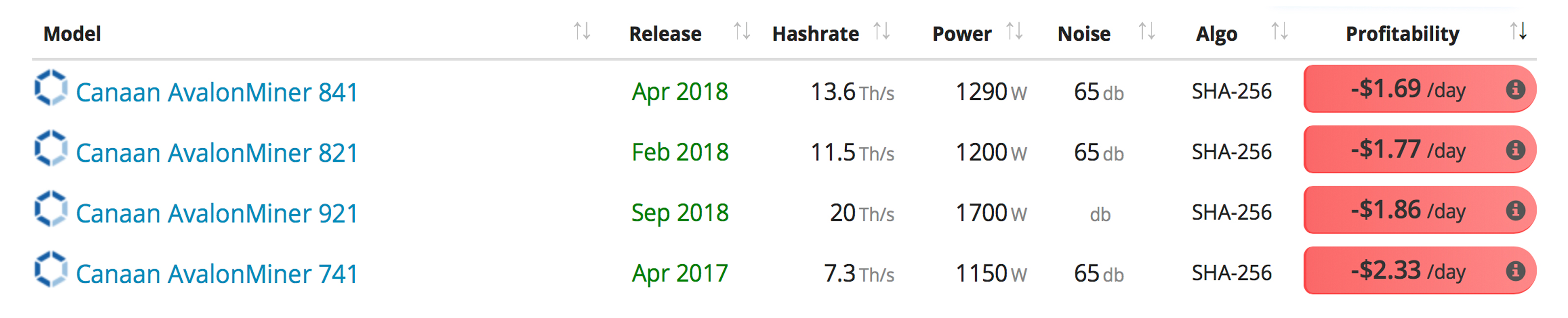
Innosilicon’s previous models, besides the unobtainable T3, are all seeing losses at the time of publication. The top four Whatsminer models (M10, M10s, M3, and M3X) lose $1-4.25 every 24 hours, according to the statistics. A large variety of SHA-256 Bitmain models, including the S9, R4, S11, and many other series, are unprofitable. The Canaan Avalon series is in the same boat as the 841, 821, and 921, losing about $1.69-1.86 per day with current BTC prices at $3,500 per coin.
Only five bitcoin mining devices released in 2018 are profitable this december

Bearish SHA-256 algorithm coin prices have affected network hashrate considerably over the last few months. For instance, the bitcoin core (BTC) hashrate touched 61 exahash per second (EH/s) during the last week of August, but this month the BTC hashrate is only 35 EH/s. However, there may be many facilities which are still making a profit with older machines if their electric cost is highly subsidized or nearly free.
Only five bitcoin mining devices released in 2018 are profitable this december

Many flashy machines announced this year have touted 7 and 10 nm chips and much bigger processing power, but cryptocurrency market prices have made it so only a few machines are profitable. But if markets push higher again turning from a bearish-to-bullish trend, then a great majority of the newly released 2018 mining rigs should become profitable again.

What do you think about these mining rigs and their profitability rates with current prices? Let us know what you think about this subject in the comments section below.

Disclaimer: bitcoin.com does not endorse these products/services. Readers should do their own due diligence before taking any actions related to the mentioned companies or any of its affiliates or services. This editorial is intended for informational purposes only. bitcoin.com and the author are not responsible, directly or indirectly, for any damage or loss caused or alleged to be caused by or in connection with the use of or reliance on any content, goods or services mentioned in this article.

Images via Shutterstock, Ebang, Asicminer Nano, Bitmain, and Asicvalue.com.

Need to calculate your bitcoin holdings? Check our tools section.

The post Only Five Bitcoin Mining Devices Released in 2018 Are Profitable This December appeared first on Bitcoin News.

Previous Article

EOS becomes biggest gainer among top-10 club; news comes on the back of Coinbase announcement

Next Article

UK Parliament Member Wants You to Pay Your Taxes with Bitcoin

You might be interested in …

Img_1273

IMG_1273

IMG_1273By NoticiasUFM on 2014-01-21 18:28:39[wpr5_ebay kw=”bitcoin” num=”1″ ebcat=”” cid=”5338043562″ lang=”en-US” country=”0″ sort=”bestmatch”]

Decred Launches Proposal System to Advance Blockchain Governance

Decred

Decred, which describes itself as an autonomous “digital currency for the people,” is announcing the launch of an “intelligent” blockchain proposal system. Powered by Politeia, a stand-alone tool for off-chain data storage, the system allows anyone in the community to submit a formal proposal for the evolution of the Decred platform. This proposal is time-stamped, versioned and permanently stored in an off-chain repository to promote transparency and eliminate the possibility of censorship.

“Decred is bitcoin as it should have been,” argued crypto investor Jon Creasy. According to Decred evangelists, bitcoin was conceived as a decentralized community project, but, today, it’s de-facto controlled by an oligarchy of top developers and miners and vulnerable to pressures from powerful external actors.

The Decred project wants to build a more open and progressive cryptocurrency with a system of community-based governance integrated into its blockchain.

“We are more committed than ever to a sustainable and fair system of governance,” said Jake Yocom-Piatt, Decred Project Lead. “For Decred, Politeia will provide an off-chain public record of proposals, comments on proposals, and stakeholder votes. Although Decred will be using Politeia in a public capacity, it can provide similar utility as a private unalterable store of data. Public and private use-cases include document and record storage, reputation and identity systems, and supply chains.”

The Decred team wants to create an ideal infrastructure for self-governance of a cryptocurrency. Politeia, named after a classical Greek term that can be translated as “system of government,” is an off-chain store of data, both versioned and time-stamped (in other words, “git plus timestamping”). While Politeia will initially be used in Decred’s proposal system, it has been developed as a generic tool that allows its users to create and maintain arbitrary data in a version-controlled and time-stamped environment.

Time stamps and proposal anchors

All proposals for the evolution of the Decred platform, initially formatted as text with markdown and PNG images, will be stored in Politeia with version control and time stamps anchored in the blockchain. Proposal anchors in the Decred blockchain include a transaction hash and a merkle path to indicate that a particular git commit hash existed before the time stamp on the next anchor in its repository.

“In addition to powering our proposal system, Politeia has been developed as a stand-alone tool that allows its users to create and maintain arbitrary data in a version-controlled and timestamped environment,” Yocom-Piatt told bitcoin Magazine. “Although it does depend on using a dcrtime server for creating time stamps, Politeia does not require users to hold any decred, and we believe it has a wide array of potential applications, e.g. for records storage, identity systems, supply chains and other provenance-driven domains. Open sourcing this technology will bring the real-world utility that is necessary to attract a broad community of users.”

According to Yocom-Piatt, having cryptographically verifiable public records will give users of Politeia the assurance that their governance is being executed in a transparent fashion, with all records independently verifiable and stored in a format that is difficult to forge. “By making Decred’s governance data time-ordered in a verifiable fashion, we ensure that attempts to manipulate Decred’s governance, either from outside or within, will be much more difficult than when using a conventional website or similar,” notes Yocom-Piatt.

Any proposal submitted to Politeia that is censored can be publicly demonstrated as having been censored, creating accountability for the administrators of the proposal system and avoiding “one of the more insidious and common practices of modern social media sites, where data is silently censored.”

Comments on proposals, editing proposals and voting on proposals will be added to the Politeia platform. Decred is also announcing a competition for projects based on Politeia with winners to be announced at an event in Austin, Texas, on December 1, 2017. The prizes for 1st, 2nd and 3rd place will be the equivalent of $10,000, $5,000 and $2,000, respectively, paid in decred.

The post Decred Launches Proposal System to Advance Blockchain Governance appeared first on Bitcoin Magazine.