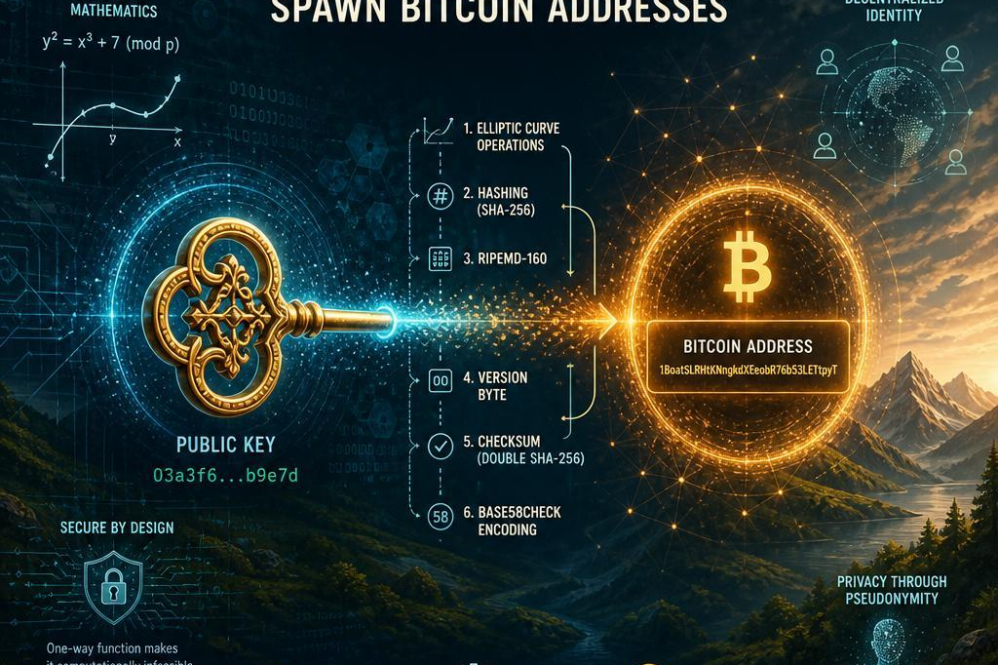
Here are 6 consecutive headings for an article about “How Public Keys Spawn bitcoin Addresses”:
For those new to bitcoin and its underlying technology, understanding how public keys spawn addresses can seem daunting. A public key is essentially a cryptographic identity that allows users to send or receive funds on the network. When a user wants to receive Bitcoins, they need to share thier public key with othersand the system generates a unique address from it.
Here’s what happens behind the scenes: when a new account is created, the wallet software generates a pair of cryptographic keys – a public key and a private key. The public key is used for receiving funds and can be shared openly, while the private key must remain secret to prevent unauthorized transactions. When someone wants to send coins to your address, their wallet software calculates the address using your public key. This process involves complex mathematical calculations, specifically elliptic curve digital signatures.
Here’s a rough analogy to help you grasp how this works:
| Public Key | Wallet Software | Private Key |
| Shared openly | Uses public key to generate address | Kept secret |
Ultimately, understanding how public keys spawn bitcoin addresses requires a grasp of cryptography. It’s essential for developing secure wallets that don’t risk private key exposure, which can compromise users’ funds.
The Role of Elliptic Curve Digital Signature Algorithm in Address Generation
In order to understand how public keys spawn bitcoin addresses, we need to delve into the mathematical background that underpins digital signatures and address generation. At its core, Elliptic Curve Digital Signature Algorithm (ECDSA) is a method for verifying the authenticity of messages or data, ensuring they haven’t been tampered with during transmission. This is crucial in cryptocurrency systems like bitcoin, where trust relies heavily on secure and clear transactions.
The key component facilitating this process is the public key, which contains essential data used to verify transaction signatures. Here’s how it happens: a public key consists of a pair of numbers (r and s) generated from an elliptic curve cryptographic application. These numbers are derived directly from the private key, which must be kept confidential in order to prevent unauthorized use. With this crucial information stored in a compressed format within a bitcoin node, wallet software can create an address by hashing the public key with another value known as a checksum (which serves as a verification tool, ensuring correct key storage and retrieval).
This is where ECDSA’s elliptic curve capabilities come into play. Considered more efficient and secure than earlier encryption techniques due to its smaller key sizes (measured in bits), Elliptic Curve digital Signature Algorithm effectively enables the creation of unique identities for each wallet, thereby making bitcoin transactions possible. The address itself contains a compact representation of the public key; it comprises 34 alphanumeric characters, including letters and numbers that make up the destination of every transaction. When funds are transferred to this address, they contain essential metadata embedded within the transaction block, which is then relayed through the network.
Here’s a breakdown of components in a bitcoin public key:
| Component | description | Size |
|---|---|---|
| r | Elliptic Curve Digital Signature | 32 bits |
| s | 32 bits |
When put together, this information provides the mathematical basis upon which each unique identifier in bitcoin transactions is generated. This crucial cryptographic layering creates an environment where integrity of data and accountability of transactions can be preserved through public key verification.
Deriving a Compressed Public Key from Wallet Data
How Public Keys Spawn bitcoin Addresses
To understand how a compressed public key is derived from wallet data, it’s essential to grasp the relationship between public keys and bitcoin addresses. A public key, in essence, serves as a unique digital identifier, much like an email address in the physical world. Though, unlike traditional email addresses, which are static, a public key is generated through cryptographic processes during each wallet’s initialization.Each blockchain user, especially those who manage their own wallets directly, generate new keys for every new address created. This process involves mathematical functions to create unique identifiers that can then be used in transactions. As an example, an individual with multiple wallets will have multiple sets of public and private key pairs associated with each wallet’s addresses.
A simple illustration can help break down the relationship:
| Address | Compression |
| — | — |
| Key 1 (normal) | compressed: 037…9e |
|
Key 2 (compressed) | Not Applicable |
By understanding how wallets manage keys, users can better comprehend the inner workings of bitcoin’s cryptographic infrastructure. Public key generation and address creation are tied closely to private key management within a wallet, emphasizing the importance of secure storage practices.
The Importance of Base58Check Encoding in bitcoin Address Format
bitcoin addresses are more than just a string of seemingly random characters; they’re actually a carefully crafted combination of mathematical operations and base58check encoding. To understand how they’re generated, we need to start with public keys, which are a fundamental component in the world of cryptocurrencies like bitcoin.Public keys are large, 256-bit numbers that represent a user’s account information on the bitcoin network. These massive numbers are used for sending and receiving funds, but it’s not feasible to share the actual public key due to its size and cryptographic properties. That’s where base58check encoding comes into play – it allows us to convert these large numbers into easily readable strings called bitcoin addresses.When converting a public key to a bitcoin address, various steps occur in the base58 encoding process.First, a checksum is added to ensure that any potential typos or errors can be detected and corrected during processing. this checksum provides an additional layer of security when dealing with bitcoin transactions. The resulting encoded string is then shortened through removal of excess ‘1’ characters, resulting in the more compact bitcoin address we’re familiar with.
Translating the Hash Function Output into a Human-Readable address
Public keys in bitcoin are more than just abstract numbers – they’re the gatekeepers to a unique digital realm.When you initiate a transaction, your nodes communicate with each other using these numerical identities. But have you ever wondered how that seemingly cryptic hash function output ultimately translates into a human-readable address?
The process begins with hashing,where complex algorithms transform input data (such as the public key) into an irreversible,fixed-length string of characters. This is where things get interesting – each unique input yields a distinct output hash, which becomes the foundation for your corresponding bitcoin address. Consider it akin to assigning a one-of-a-kind license plate number to identify a vehicle. while you can’t derive its original make or model from just the plate, you can pinpoint this asset in question across the network.
This irreplaceable key serves as an essential component of your wallet information when transmitting funds between parties.As the recipient’s nodes attempt to verify said transaction, they must ensure that their internal checksum tallies with the expected output generated from your public key.Failure to match would thwart the entire operation.
Verifying a Valid bitcoin Address for Secure Transactions
When you send bitcoin to an address, it’s essential that the recipient receives the funds correctly. A simple mistake in the address can lead to the loss of your assets. So, how do we ensure we’re sending Bitcoins to the correct address? To understand this, let’s first look at how public keys spawn these addresses.
A public key is a long sequence of characters beginning with “1” or “3”. It serves as an identifier for each bitcoin wallet on the network. When you create a new wallet, it generates a unique public key and a corresponding private key (don’t share your private key with others). The public key can be thought of as your wallet’s address book entry, allowing others to send Bitcoins to your account. Your wallet application will usually display both the public key and the spawned bitcoin address.
To verify that an address is valid, you should check its type first. there are two types of addresses in bitcoin: P2PKH (Pay-to-PubKeyHash) and P2SH (Pay-to-ScriptHash). Table 1 below lists the differences between these two address types.
😉
| Address Type | Format |
|---|---|
| P2PKH | Start with “1” or “3”, followed by alphanumeric characters (1-66 characters) |
| P2SH | Start with “3”, followed by 6 hexadecimal numbersand finished with 33-38 alphanumeric characters |
When comparing two addresses side-by-side, look for the address’s prefix, which indicates its type. The ‘bech32’ format is an additional valid address type used in newer wallets like Electrum and BlueWallet,but we’ll not cover bech32 here due to its length and complexity.