
At the Israel Crypto $BTC Summit at Tel Aviv University on Jan. 8, veteran cryptographer Nick Szabo explained that the use of censorship-resistant cryptocurrencies will rise in countries sanctioned from trade and economies suffering from failed monetary planning. Szabo also argued that the world’s central banks might turn to cryptocurrency reserves in the future in order to supplement national gold reserves.
Also Read:
Nick Szabo Strongly Believes Distraught Economies and Sanctioned Countries Will Seek Refuge In Cryptocurrencies

Cryptographer Nick Szabo is an interesting character and a well known figure in the cryptocurrency community. Long before Satoshi Nakamoto introduced Crypto $BTC, Szabo designed the concept back in 1998. Two years before that, Szabo’s forecasted the use of smart contract technology and autonomous organizations. On Jan. 8, Szabo spoke at the at Tel Aviv University and gave the crowd a history lesson on the use of currencies worldwide. During the talk, Szabo explained to attendees that he believes countries blacklisted from trade and regions dealing with hyperinflation will turn to digital assets. Over the last two years, cryptocurrencies like BTC and have been gaining traction in areas like , , and .
According to attendees at Tel Aviv University’s cryptocurrency event, Szabo’s keynote was in response to comments made by Avi Simhon, senior economic policy advisor and Israel’s head of the National Economic Council. Simhon at the summit that Crypto $BTC technology is “intrinsically inefficient” and “will disappear.” Moreover, the economic policy advisor for the prime minister explained that using the technology on a global scale would waste “trillions of dollars of actual cost in energy.”

Even Central Banks May Attempt to Hoard Crypto $BTC Reserves Over Gold
Of course, Szabo wholeheartedly believes in cryptocurrencies and his talk explained the many benefits of the digital revolution. Additionally, Szabo asserted that it is possible in the future some of the world’s central banks will turn to cryptocurrencies rather than gold.
“There’s going to be some situations where a central bank can’t trust a foreign central bank or government with their bonds for example,” Szabo during his talk. “One solution that’s been developed is to have the Swiss government hold it for you – that’s not a trust minimized solution. The Swiss government itself is subject to political pressures and so a more trust minimized solution is cryptocurrency.”
Szabo continued:
The other problem with gold reserves is that they’re physically vulnerable. When the Nazis conquered countries in Europe, the first place they went to was a central bank’s gold reserves.
Over the last few weeks, a number of top market makers and economists have asserted that the world is . Traditional investment vehicles like equities and stocks have been but precious metals markets have recently seen significant gains. In contrast, this past Monday the spot price of gold touched a at $1,288.03 per ounce and gold futures settled at $1,289.90 per ounce. Meanwhile, because of increased demand and worldwide shortages, palladium hit an all-time peak in value this week.
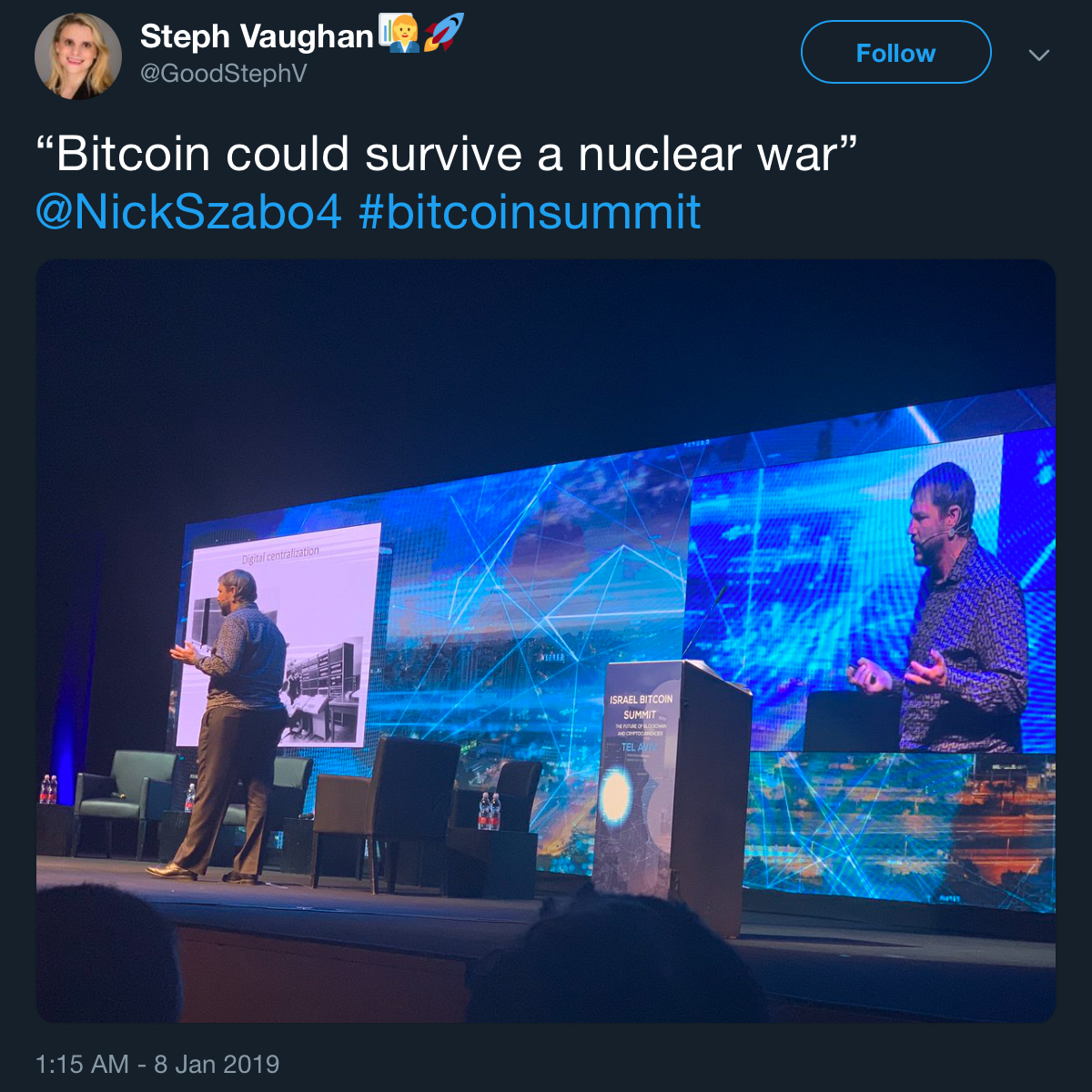
During the speech in Israel, Szabo seemed to be far more confident about the future of digital assets over precious metals. Many cryptocurrency proponents over the years take the cryptographer’s predictions seriously because of his early forecasts about the future of smart contracts. An audience member at the Tel Aviv summit even Szabo for saying “bitcoin could survive a nuclear war.”
What do you think about Szabo’s statements about cryptocurrencies? Let us know what you think about this subject in the comments section below.
Image credits: , Steph Vaughan, Shutterstock, and Pixabay.
At Crypto $BTC.com there’s a bunch of free helpful services. For instance, have you seen our page? You can even look up the exchange rate for a transaction in the past. Or calculate the value of your current holdings. Or create a paper wallet. And much more.
The post appeared first on .

is author of this content, TheBitcoinNews.com is is not responsible for the content of external sites.
source:
Published at Thu, 10 Jan 2019 04:20:54 +0000