February 26, 2026

Capitalizations Index – B ∞/21M

‘Maximum Pain’: Joe Lubin, Jimmy Song Strike $500K Crypto Bet on Ethereum’s Future

‘maximum pain’: joe lubin, jimmy song strike $500k crypto bet on ethereum’s future

‘Maximum Pain’: Joe Lubin, Jimmy Song Strike $500K Crypto Bet on Ethereum’s Future

‘maximum pain’: joe lubin, jimmy song strike $500k crypto bet on ethereum’s future

The terms of a much-hyped bet have finally been settled, and, at current prices, more than $500,000 in crypto is on the line.

“It’s a maximum pain kind of bet,” Jimmy Song said during a session of CoinDesk Live at Consensus 2019. “Skin in the game.”

The new details stem from an onstage agreement from Consensus 2018, where Lubin told Song that he would bet “any amount of bitcoin” that ethereum’s decentralized apps would have a non-trivial number of users in five years.

Song had accused Lubin of “weaseling” out of the bet in recent weeks, including calling Lubin out on Twitter.

But the meeting of the two crypto thought leaders on Tuesday did not disappoint, especially in terms of how much crypto was wagered.

Deal terms

If ethereum is doing great four years from now, Song will pay Lubin (or his beneficiary) 810.8 ETH. If the dapp economy is sputtering at that point, Lubin will send Song 69.74 BTC.

For Lubin to win, Ethereum needs to have 15 unique dapps achieving 10,000 or more daily active users and 100,000 monthly active users for any six calendar months in any 12-calendar-month period up to and including May 23, 2023.

To be clear, this is not a small bet for either side, and both acknowledge that whichever side wins, it will hurt badly. It’s also possible the loser will be giving up considerably more money in 2023 than they would today.

When the bet was first made, on May 14, 2018, BTC was trading at $8,577. So, Lubin had effectively bet $598,190 based on prices at the time. That’s $564,307 at today’s prices.

The difference in ETH was much more stark, however. At the time of the bet last year, ETH was trading at $722.86. So, Song effectively bet $586,095 at prices at the time – but only $168,030 at today’s prices.

If he wins, Song was very clear that the BTC will go straight to him. “I want it to hurt for you,” Song told Lubin. “I don’t want you to feel like you are donating to charity.”

“I’m fine with that,” Lubin replied.

The terms have slowly been hammered out over the last year since the bet was first spoken into existence. The two sides have been working on a shared document that they’ve committed to share with CoinDesk once the final piece is in place: settling on a public arbiter.

“Jimmy’s thesis was that there would be no significant applications on blockchain, and the only thing relevant in blockchain was bitcoin,” Lubin said on CoinDesk Live. “My thesis is bitcoin is awesome, and there’s a narrow set of use cases built on bitcoin and that’s wonderful. We love that, but decentralized applications are also really useful.”

There are some definitions of daily active users in the document. The point, Song explained, was for the dapp in question to achieve something like the numbers an Android mobile app would need to be deemed an early success.

Critically, Song argued that the transactions only count if they are on chain. It doesn’t matter who pays for the gas to put them on chain, he agreed (the startup itself could front that), but it needs to hit the base layer.

The sticking point had been what it meant to spend money, but once Song agreed that it didn’t have to be paid by the user – as long as it hit the chain – terms were done.

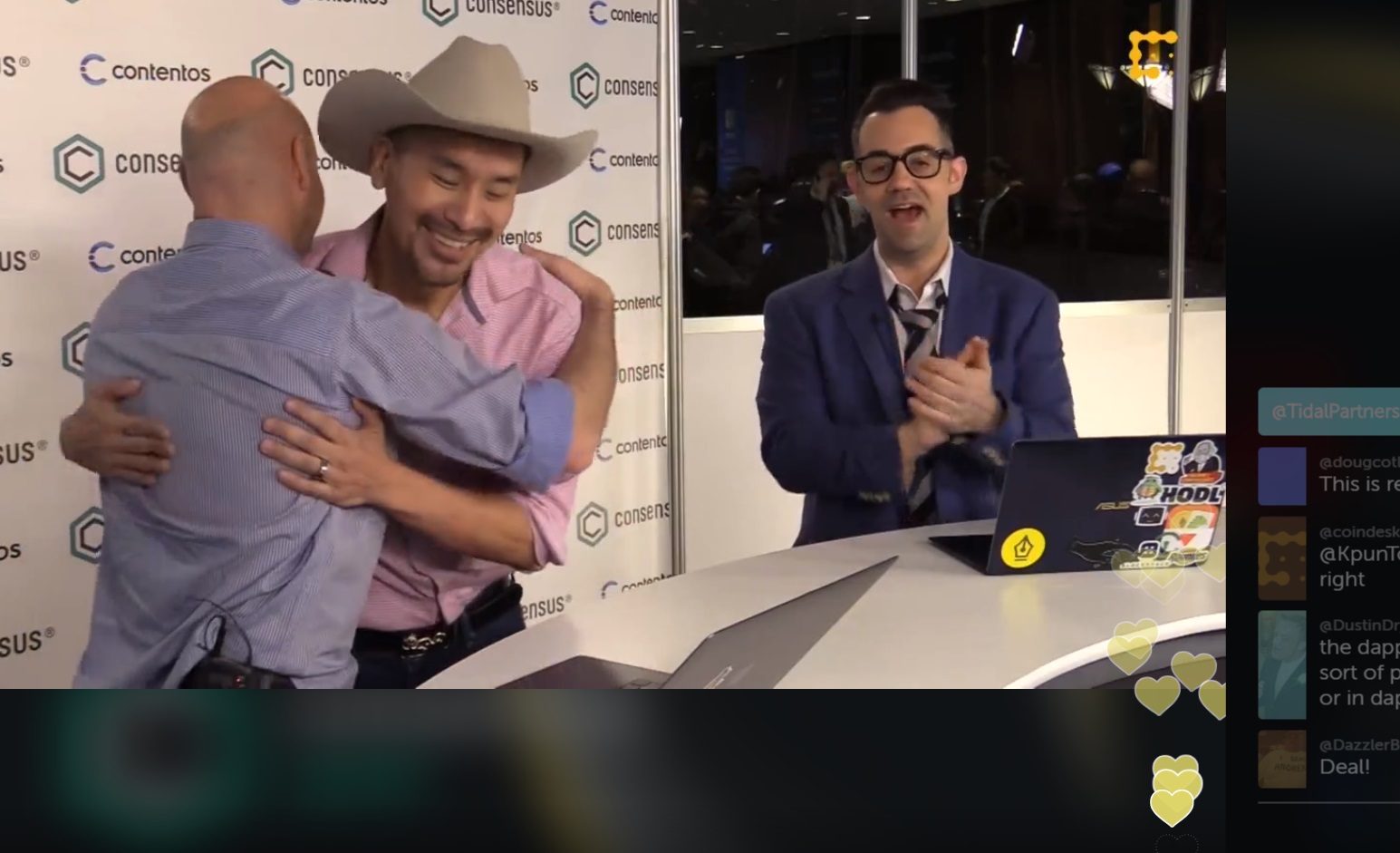
Lubin proposed a hug and Song accepted.

You can watch the full exchange here:

Web3 or bust

At its core, the bet hinges on whether the decentralized web will come to fruition – and whether ethereum will deliver it.

Song argued that centralized technology will always be faster and easier to develop on, and that’s why he doesn’t believe the decentralized web has a future.

“The only reason dapps exist is to raise money from gullible people or from greedy FOMO people, and that’s essentially what the ethereum platform has done,” Song said.

It’s possible that the world could change in a way that doesn’t fit the terms of the bet. For example, Felix Salmon and Ben Horowitz made a bet five years ago that bitcoin would be widely used in payments. Five years later, Horowitz lost that bet, and yet at the same time he’s still won by investing successfully in crypto.

To that point, Lubin noted:

“It’s possible that there are many many successful applications on ethereum that are sufficiently decenteralized and they don’t hit exactly those two criteria. So it’s possible I will lose and the ecosystem will be strong.”

Screenshot of Joe Lubin and Jimmy Song via CoinDesk Live/Periscope

Published at Tue, 14 May 2019 16:30:06 +0000

Previous Article

Is Ongoing Bitcoin Price Boom a Pump-and-Dump Action?

Next Article

Max’s Corner: Homer’s Golden Blockchain

You might be interested in …

China’s Biggest Exchanges to Add Ethereum, Other Altcoins as Demand Surges

As altcoins continue to gain popularity throughout the world, bitcoin exchanges in China are also getting in on the action and listing alternative cryptocurrencies.


Huobi to Support Altcoins

As the moratorium on cryptocurrency withdrawals is expected to soon end in China, exchanges in the country seem to be turning their attention to alternative cryptocurrencies. Two days ago, one of the big three exchanges in China, Huobi, announced it will launch Ethereum trading on May 31.

The announcement reads:

We are excited to announce the CNY/ETH will be listed on our exchanges. Trading will start at 12:00 May 31st (GMT +8). ETH deposit and withdrawal is available from now on.

Today, Huobi released a list of altcoins that are to be added in the future according to the rank of the coin in said list. According to Huboi’s underlying model, Ethereum, Litecoin and Ripple are the highest ranking coins following bitcoin, followed by Dash, Zcash and Dogecoin.

Online news service cnLedger tweeted:

//platform.twitter.com/widgets.js

The list was ranked using a model created by Huobi which factors in the coin’s strategy, marketing, activity, risk and technology to calculate the relevance of the coin.

The list and underlying model can be seen in Huobi’s official announcement.

BTCC to Get In On the Action as Well

Huobi isn’t the only bitcoin exchange in China that is to list alternative cryptocurrencies.

After a two-week poll, in which over 190k votes by the cryptocurrency community were counted, Ethereum Classic will be listed in the BTCC exchange. Bobby Lee, CEO of BTCC tweeted:

//platform.twitter.com/widgets.js

Although the exchanges employed a completely different method in which Huobi used a model to rank cryptocurrencies and BTCC used a community poll, both exchanges are interested in opening the doors for the Chinese community to invest in  alternative cryptocurrencies.

Huobi and BTCC, however, are not the first exchanges in the country to list alternative cryptocurrencies. The China-based Yunbi exchange allows users to buy and sell cryptocurrencies like Etherem, Ethereum Classic, Zcash, QTUM, Bitshares, and others. BTC38 also offers a multitude of cryptocurrencies to be bought and sold for CNY. Lastly, CHBTC also lists Ethereum, Ethereum Classic, and Litecoin.

Crypto in Asia

Although less-known exchanges in the country offer altcoin trading, most Chinese users are only familiar with bitcoin and Litecoin, given that most cryptocurrency investors use one of the big three exchanges in the country, BTCC, OKCoin and Huobi.

China plays a big part in the bitcoin world, ranking in the top 3 countries by daily trading volume but other countries in the continent are becoming increasingly interested in cryptocurrencies and it’s not just bitcoin and Litecoin.

Take Japan, for example, where the recent Bitcoin law has created an accentuated demand for cryptocurrencies, making the JPY the biggest Bitcoin pair in the world by trading volume and that’s not all. Other cryptocurrencies are also gaining traction in the country.

Co-Founder of IndieSquare and Community Director at the Counterparty Foundation, stated in a recent blog post:

First, one of the unique characteristics of the Japanese crypto space is that altcoins are very popular as a means of investment and some of them have very strong and dedicated communities; some even more active than the bitcoin community itself in a way. Among them, two of the most popular altcoins in Japan are XRP(Ripple) and XEM(NEM).

In South Korea, Ethereum and Ethereum Classic are also extremely popular, even more so than bitcoin whose daily trading volume is smaller than that of ETH or ETC.

With China adhering to the altcoin craze, could Asia become the capital for alternative cryptocurrencies?


Images courtesy of Shutterstock.com, Twitter 

The post China’s Biggest Exchanges to Add Ethereum, Other Altcoins as Demand Surges appeared first on Bitcoinist.com.