Naturwissenschaftlern, Ingenieuren und Mathematikern dürfte Mathematica ein Begriff sein. Das Softwarepaket ist durch die Möglichkeiten in Sachen symbolische Mathematik und bekannt. Entsprechend viel Anwendung findet die Wolfram Language im akademischen Bereich.
Die Bekanntheit von Mathematica ist zugunsten der von Python und R jedoch gefallen:
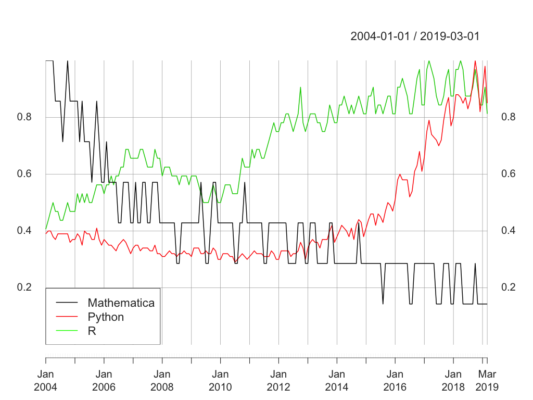
Der hohe Preis und die deutlich aktivere Community um die beiden anderen Programmiersprachen werden ihren Teil dazu beigetragen haben, dass Mathematica gerade hinsichtlich statistischer Auswertungen viel an Python und R abgeben musste.
Mathematica 12: Eine Brücke zu Ethereum
Neben Möglichkeiten kostenloser Nutzung über die oder durch die Integration in Raspian versucht Wolfram, auf anderen Gebieten eine Competitive Edge zu bewahren. Eines dieser Gebiete ist die Blockchain. Vor knapp einem Jahr berichtete BTC-ECHO darüber, dass die Version 11.3 von Mathematica Nutzern ermöglichte, Daten auf einer Wolfram-eigenen zu speichern. Wie im verlinkten Artikel dargestellt, könnte eine derartige Lösung im Kontext von Open Science und Open Data hilfreich sein.
Für Mathematica Version 12 soll dieser Blockchain-Fokus noch weiter ausgearbeitet werden. Ein Ziel scheint weniger die Nutzung einer Wolfram-eigenen Blockchain als vielmehr die Analyse bestehender Netzwerke zu sein. Außerdem ist ein besonderer Fokus auf Smart Contracts und dem Austausch zwischen On-Chain- und Off-Chain-Informationen. Details dazu kann man einem Video entnehmen:

Wolfram Blockchain Labs – Ein Unternehmen für die Blockchain
Dass sich Unternehmen heutzutage mit dem Begriff Blockchain schmücken, ist nichts Neues. So auch Wolfram. Um diesem Trend zu begegnen, hat Wolfram ein Tochterunternehmen gegründet, welches sich mit der Blockchain-Technologie auseinandersetzt.
Anscheinend haben Smart Contracts Stephen Wolfram schon länger interessiert, weshalb er bereits 2016 eine Brücke von seinen Gedanken über Computational Law zu intelligenten Verträgen . Er sieht in der Sprache hinter Mathematica eine perfekte Sprache für Smart Contracts.
Das erste Ziel von wäre, eine Faktenquelle zu schaffen, sprich eine Quelle, die für Oracles korrekte Ereignisse liefert. Er sieht in Wolfram Alpha ebendiese Quelle. Wolfram Alpha soll schon jetzt die Informationsquelle für viele Oracles sein. Auf den Elephant in the Room geht Stephen Wolfram jedoch nicht ein: Wie steht es mit dem Vertrauensproblem, wenn Smart Contracts auf eine zentrale Informationsquelle zugreifen? Im oben verlinkten Vortrag geht er ein wenig auf formelle Verifizierungen ein, jedoch beantwortet er die Frage noch nicht.
Mit neuer Wissenschaft zu neuen Netzwerken: NKN und Stephen Wolfram
Auch von der Blockchain-Seite findet eine Annäherung statt. So möchte das Projekt NKN basierend auf sogenannten zellulären Automaten verschiedene Probleme in üblichen blockchainbasierten Netzwerken lösen.
Zelluläre Automaten sind einfache Programme, die jedoch für die Simulation von komplexen Verhalten verwendet werden können. Conways Spiel des Lebens ist wohl der bekannteste zelluläre Automat. Stephen Wolfram hat sich seit den frühen Achtzigern mit derartigen Algorithmen beschäftigt. Die Forschungsergebnisse flossen in dem Buch oder kurz NKS zusammen. NKN steht, in Anlehnung an Stephen Wolframs Werk, für New Kind of Network und versucht, die Skalierungs- und Zentralisierungsdebatte um blockchainbasierte Netzwerke mithilfe von zellulären Automaten zu lösen.
Die Verwandtschaft zwischen beiden Ansätzen führte schließlich dazu, dass NKN Stephen Wolfram als Advisor gewinnen konnte. In einem recht technischen mit Yilun Zhang, dem CTO von NKN, diskutiert er deren Ansätze zur Konsensfindung. Eine etwas einfachere Zusammenfassung ist zu finden.
Sicherlich ist das Engagement von Stephen Wolfram und Wolfram insgesamt unter dem Branding-Aspekt zu sehen. Dennoch ist es spannend zu sehen, dass sich die Wissenschaftswelt mit Blockchain-Technologie auseinandersetzt. Außerdem gefällt das vollständige Fehlen einer „Blockchain statt bitcoin“-Argumentation. Ebenso gefällt, dass bitcoin und Ethereum nicht auf die jeweiligen Kurse reduziert sind, sondern dass augenscheinlich die kommende Mathematica-Version einen Fokus auf Chain-Analyse haben wird.
Schließlich ist es für Naturwissenschaftler interessant zu sehen, wie zelluläre Automaten im Bereich Blockchain-Technologie und Konsensfindung Anwendung finden. Was sich der Altcoin-Interessierte bezüglich Mathematica jedoch noch wünschen würde, wäre ein Framework, mit dem beliebige Blockchains untersucht werden können. Vielleicht kann hier die Kooperation mit NKN oder der Start von Blockchain Labs helfen.
Daten für obige Abbildung sind in normalisierter Form von Google Trends übernommen
Kennst du schon unseren Krypto-Shop?: Hardware-Wallets, Krypto-Lektüren, bitcoin-Schlüsselanhänger, bitcoin-Sammlermünzen, coole Shirts oder eine bitcoin-Beginner Box für den einfachen Einstieg in die Krypto-Welt. Hier wirst du sicher fündig.
Published at Sat, 09 Mar 2019 16:00:07 +0000