
August 6, 2026

Capitalizations Index – B ∞/21M

Market Recovers by $5 Billion but Why Are Ethereum and Bitcoin Cash Plunging?

Market recovers by $5 billion but why are ethereum and bitcoin cash plunging?

Market Recovers by $5 Billion but Why Are Ethereum and Bitcoin Cash Plunging?


Ethereum wallet dapp cryptocurrency
Advertisement

Over the last 24 hours, the crypto market has added $5 billion to its valuation, demonstrating a slight recovery from $106 billion to $111 billion. Despite the recovery of the market, Ethereum (ETH) and Bitcoin Cash (BCH) continue to fall in value, both recording a three percent drop against the U.S. dollar.

On December 9, the Ethereum price fell by around three percent from $97 to $93, failing to sustain the short-term momentum it garnered from an unforeseen recovery it experienced on Saturday. Since its daily peak, Ethereum has declined by more than six percent against the U.S. dollar, from $100 to $93.

bitcoin Cash has also demonstrated a weakness in its short-term price trend as it lost nearly half of its value within a two-week period. Since November 6, the Bitcoin Cash price declined from $200 to $100, by exactly 50 percent.

Market recovers by $5 billion but why are ethereum and bitcoin cash plunging?Why is Ethereum and bitcoin Cash Dropping So Rapidly?
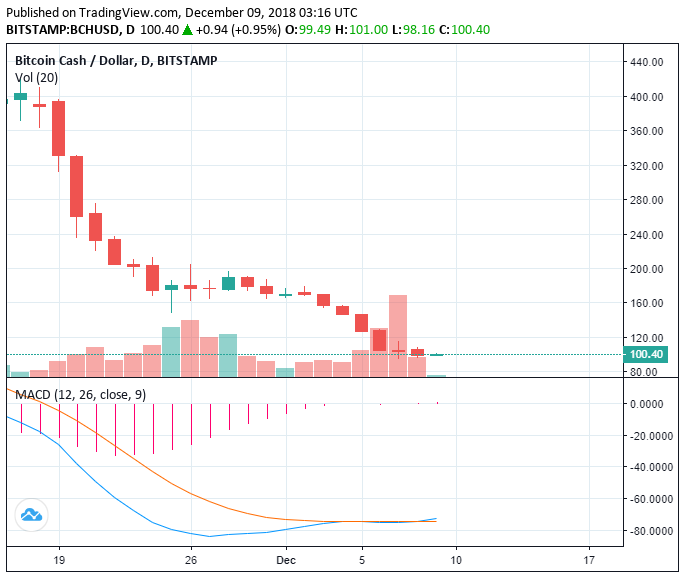
The gap between Ethereum and Ripple, which recently took over Ethereum as the second most valuable cryptocurrency in the global market, has increased to more than $3 billion within a three-week span.

Technical indicators demonstrate oversold conditions but the sheer intensity of the drop in the price of the two cryptocurrencies have created a difficult environment for the two assets to recover or even maintain a low price range.

It is possible that as investors in the cryptocurrency market resort back to fundamentals, cryptocurrencies that have struggled to see a noticeable increase in accessibility, adoption, and usability are falling harder than bitcoin.

Ethereum, for instance, as seen in the case of ConsenSys, the largest blockchain software company in the world, has been successful in creating an efficient infrastructure for decentralized applications (dApps) to a certain extent, but struggled to see much progress in Plasma, Sharding, and Casper, the projects three major solutions to scaling.

ERC20 tokens, most of which are based on Ethereum, given its dominance in the smart contract sector, have also failed to showcase products that can actually be used by casual users and the mainstream.

Seeing a clear lack of adoption of dApps and decentralized systems, Joseph Lubin, a co-creator of Ethereum and the founder of ConsenSys, said that the company will move forward and begin focusing on the development of products that can be utilized by users in the ecosystem.

Lubin said in an email sent to the company’s employees:

“ConsenSys 2.0 requires us to evaluate our endeavors more rigorously. We will seek to run leaner projects because often better decisions are made in a context of more constrained resources. Scarcity sharpens the senses and forces discernment in decision making. Lush plentitude, while perhaps a noble goal in many circumstances, should be hard won; otherwise it leads to complacency and dull-wittedness.”

bitcoin Cash, a cryptocurrency with a large transaction capacity, has seen limited merchant adoption which it sought out for when it first launched in August.

bitcoin Will Likely Survive Better in Bear Market

With large-scale financial institutions like Nasdaq, NYSE, ICE, and Fidelity vowing to build infrastructure around bitcoin first, the dominant cryptocurrency is expected to continue to outperform both major digital assets and small market cap cryptocurrencies throughout the bear market.

Featured Image from Shutterstock. Charts from TradingView.

Get Exclusive Crypto Analysis by Professional Traders and Investors on Hacked.com. Sign up now and get the first month for free. Click here.

Advertisement

Published at Sun, 09 Dec 2018 03:46:17 +0000
Previous Article

Mediar crowdsale announced

Next Article

Market Recovers by $5 Billion but Why Are Ethereum and Bitcoin Cash Plunging?

You might be interested in …

Creating Intrinsic Value in Cryptocurrencies

Particl Thumb 2

The investment banker Jamie Dimon caused a stir when he declared
recently
that bitcoin will collapse because it is “worth nothing.”
bitcoin’s current market value, he claimed, is driven almost entirely by speculation,
rather than by any real and present intrinsic value that bitcoin actually
provides.

Casting aside the debate over whether bitcoin
has intrinsic value or not, it seems fair to say that Dimon doesn’t know the
cryptocurrency market well. If he did, he might have noted that bitcoin is only
one of dozens of major tokens available. Some tokens were designed with
intrinsic value as a specific goal.

Background

Particl, which was created last spring, is
building a decentralized eCommerce platform, a framework for third party apps,
and a suite of privacy tools to go with it.

PART solves various privacy problems associated with BTC, such as
the ability of third parties to trace transactions. Adding multiple cryptographic
proofs like Ring Signature Confidential Transactions (RingCT) and Confidential
Transaction (CT) plus trustless mechanisms like MAD escrow, Particl provides
100 percent anonymity to people who buy and sell using PART.
While the Particl privacy platform and upcoming Marketplace supports
most major cryptocurrencies, PART serves as its utility token.

PART
and Intrinsic Value

The value of bitcoin has risen astronomically over the past
several years in part because people believe bitcoin will one day be widely
used and provide services that other forms of currency cannot. For this reason,
the growth in value of bitcoin has far outpaced actual bitcoin adoption.
PART is different. PART’s value is based on more than the
potential future worth of the Particl Platform or PART tokens. People who own
PART tokens derive immediate benefits from them, including the following.

Token Flexibility

PART is a flexible cryptocurrency, especially with respect to the
level of privacy and anonymity users wish to have.

Voting Rights

PART ownership confers voting rights within the PART community.
The future development of the Particl Project and its privacy platform is
decided by users who own PART tokens. In this sense, PART tokens have an
intrinsic value that is absent from a cryptocurrency like bitcoin, where the
ability to propose or vote on platform changes is not linked to coin ownership.

Passive Income

PART tokens generate passive income for their owners through
working for the network (staking) and from fees collected from privacy DApps
built on the platform like the upcoming Marketplace. PART is an inflationary
token, therefore its supply increases by 5 percent in the first year and
decreases by one percentage point until the fourth year, when the inflation
rate reaches 2 percent. Inflation is then maintained at a 2 percent rate
indefinitely.

Utility Coin

Default transactions on the Particl network are pseudo-anonymous
like bitcoin. The network is Proof of Stake (PoS) so only default and stealth
addresses can stake PART. Exchanges and services also transact with the network
using public PART addresses.

If they wish, PART users can benefit from features like RingCT in
order to gain a privacy experience equivalent to using a token like Monero, which
created RingCT. Alternatively, they can use PART tokens with CT blinding
features applied to hide amounts sent between addresses.
This flexibility adds to PART’s intrinsic value because it allows
PART to be used for different sorts of transactions and is 100 percent based on
user preference. If — as proponents of bitcoin
pointed
out
in response to Dimon’s criticisms — bitcoin provides intrinsic
value in part by enabling transactions that traditional currency can’t, then
PART’s ability to accommodate a range of transaction types and use cases makes
it even more valuable.
 
In each of these ways, simply owning PART tokens generates
additional income independent of increases in the market value of the tokens on
an exchange.
 
Last but not least, as noted above, PART serves as the utility
coin on the Particl Platform. Sellers who use Particl Marketplace are always
paid in PART tokens (even though buyers can use any cryptocurrency of their
choice). In addition, like Ethereum, any decentralized application built on
Particl’s platform will transact using PART which also goes to stakers.
PART is therefore intrinsically linked to the Particl Platform. As
the adoption of the overall platform grows, so does the value of PART.

If you want to make the case that cryptocurrencies have intrinsic
value based on services they provide today, PART is a good subject to work
with. More so than bitcoin, PART derives its value from benefits that it
provides to all token holders natively, on its own privacy platform. Owning
PART is the furthest thing from speculating on tulip bulb futures (a historical
blunder to which Dimon compared bitcoin) as you can get.

The post Creating Intrinsic Value in Cryptocurrencies appeared first on Bitcoin Magazine.