July 3, 2026

Capitalizations Index – B ∞/21M

Litecoin Lights Up – 18% Surge With 73 Days to Halving

Litecoin lights up – 18% surge with 73 days to halving

Litecoin Lights Up – 18% Surge With 73 Days to Halving

Litecoin lights up – 18% surge with 73 days to halving

Another crypto correction was quashed this week as Bitcoin failed to fall lower than $7,500. This has increased the general momentum for altcoins and today’s top performer by a clear margin is Litecoin which has surged 18 percent on the day.


LTC Sees 18% Surge

Total market capitalization is back over $250 billion and the altcoins are starting to rev up. The only one in double digits at the time of writing is Litecoin as it pumps around 18 percent on the day.

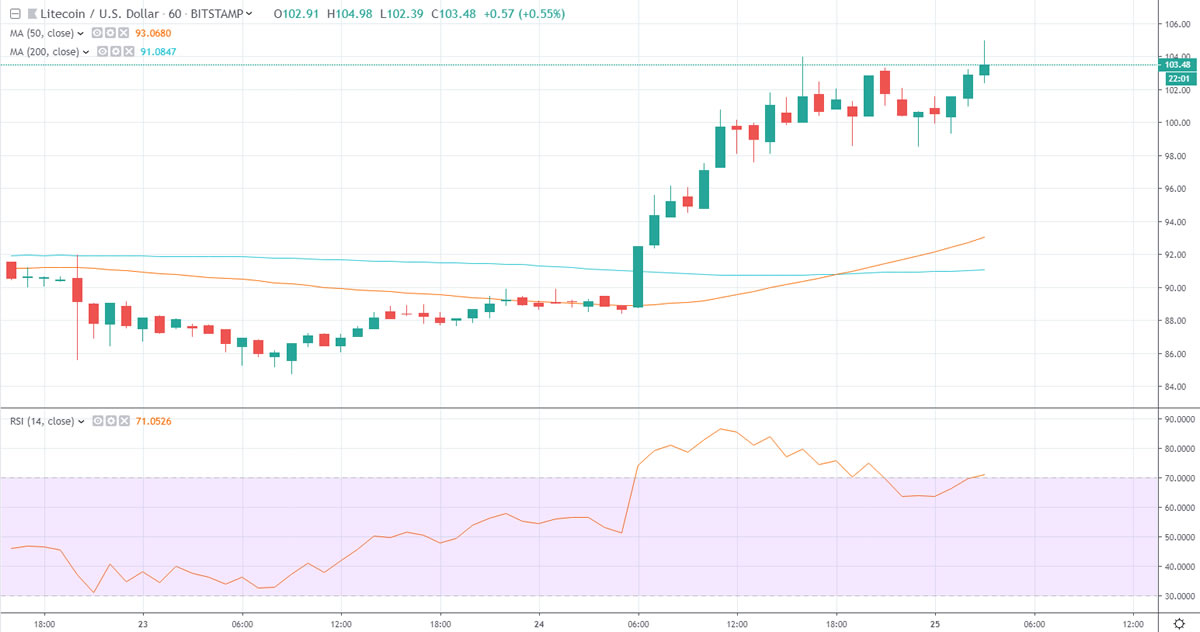
LTC 00 was pretty flat at around $88 this time yesterday. It started to move a few hours ago, topping out at $105. Daily volume has jumped from $3.2 billion to $6 billion pushing LTC market cap up to $6.4 billion. This has enabled it to power past EOS and take the fifth spot.

Litecoin price 48 hours – Tradingview.com

Litecoin is a stalwart of the crypto world; it has been around since 2011 and survived many bear markets. This year alone LTC has made an epic 240 percent, outperforming the majority of its brethren, including big brother Bitcoin.

Litecoin is currently trading at a new 2019 high and the highest it has been since June 2018.

Litecoin Halving in 73 Days

The current momentum is likely coming from the halving event which is predicted to occur on August 6, just 73 days away. The block mining reward halves every 840,000 blocks, and this one will see it decrease from 25 to 12.5 coins. This effectively increases scarcity and decreases inflation – a Litecoin becomes more valuable. Investors can see this supply drop correlate with an increase in demand which will drive price action.

Bull runs usually occur before halving events and with just ten weeks to go this one could send LTC even higher. Crypto trader ‘Crypto Cactus’ has taken a look at the charts and agrees, with many others, that Litecoin will continue to trade higher as the halving approaches;

$LTC not going long into resistance but will be slowing starting to add to my bag as we head straight towards the next halving in roughly 75 days for #litecoin. Wouldn’t expect something crazy but likely price will follow speculation and hype as we get closer to 6th august 2019.

Others have taken a more extreme look and compared fractals from the massive surge in late 2017 that sent Litecoin from where it is now at around $100 to over $350 in less than a month;

The next few days will be critical for Litecoin. $100 is a key resistance level and the price pulled back last time it was reached on May 16. Accumulation opportunities will arise if it repeats the correction, but the opposite could see LTC get to its next resistance zone around $125 very quickly.

How high will Litecoin go this time? Add your thoughts below.


Images via Shutterstock, Tradingview.com

Published at Sat, 25 May 2019 06:32:06 +0000
Previous Article

ICO, Blockchain and Cryptocurrencies: Impact on Different Spheres

Next Article

Bitcoin [BTC]: Paxful launches crypto-wallet; announces plans to spread crypto-awareness

You might be interested in …

Bitcoin Miners Miss the First BIP 148 “Deadline”

Bitcoin Miners Miss the First BIP 148 “Deadline”

bitcoin miners at large have missed the first BIP 148 “deadline” to prevent a “split” in bitcoin’s blockchain.

As bitcoin’s scaling dispute appears to be heading for a climax, the next couple of weeks could prove pivotal. One scaling solution in particular, Bitcoin Improvement Proposal 148 (“BIP 148”), is scheduled to trigger activation of Segregated Witness (SegWit) on August 1, 00:00 UTC. As a User Activated Soft Fork (UASF), all users that run a BIP 148 node will then start rejecting any and all blocks that do not signal support for SegWit by the “deadline” — or, perhaps more accurately, “ultimatum” — set by BIP 148 users.

BIP 148 and SegWit are backward-compatible protocol upgrades, which means that non-upgraded nodes will still accept SegWit-signaling and SegWit-utilizing blocks. Therefore, if a majority of hash power in one way or another adopts SegWit before August 1, all current bitcoin nodes would follow the same blockchain.

However, if only a minority of miners activates SegWit through BIP 148, bitcoin’s blockchain and currency would “split” in two. This would result in two types of “bitcoin”: one that activated BIP 148 and one that did not, while even more types of “bitcoin” could emerge as a result. A split between BIP148-nodes and non-BIP148 nodes would last at least until a majority of hash power joins the BIP 148 chain, or until the BIP 148 chain is abandoned by all users and miners for good.

Miners essentially have three options to avoid such a split. This first option was to lock in SegWit before August 1 through the activation mechanism proposed by Bitcoin Core and implemented in many nodes on the network. This required 95 percent of hash power to signal support for the upgrade within a two-week difficulty period. Specifically, such a difficulty period consists of 2,016 of these sequential blocks, which means that a minimum of 1,916 blocks must signal support. Or, in other words, if more than 100 blocks — at least 101 of them — do not signal support for SegWit within a single difficulty period that ends before August 1, this BIP 148 deadline is missed.

Ignoring extreme statistical deviations or other unexpected events, the final difficulty period to end before August 1 started on Friday (UTC). And out of the first day and a half worth of blocks within this difficulty period, only about half of them signaled support for Segregated Witness. This means that the threshold of 101 blocks not signaling support has now been reached.

With two more BIP 148 deadlines ahead, the first one was probably also the most likely to be missed. Its threshold was the hardest of the three to achieve as it required the highest level of hash rate to succeed. Additionally, a large majority of miners (by hash power) indicates that they will activate SegWit through BIP 91 instead. This is the next BIP 148 deadline.

This next deadline will be on July 29. This is the last day that BIP 91 can activate in time to be compatible with BIP 148. In order to do so, 80 percent of hash power must have signaled support for SegWit2x within 2 1/3 days. As such, miners should at the very latest start signaling support for BIP 91 on the 26th of July. Though like the now-missed BIP141 deadline, which is technically not until August 31, the BIP 91 deadline could actually be either missed or met before July 29 as well.

If this next BIP 91 deadline is missed too, miners will have one more chance to avoid a “split.” A majority of hash power would have to activate SegWit through BIP 148 itself by August 1, 00:00 UTC. Alternatively, a majority of hash power could switch to the BIP 148 chain even after August 1 to reunite both chains, but this will likely cause significant disruption on the bitcoin network(s), and potentially a loss of funds for users not aware of the risks.

For more information on how to keep your bitcoins safe during a potential coin-split, click here.

The post Bitcoin Miners Miss the First BIP 148 “Deadline” appeared first on Bitcoin Magazine.

Bitcoin_nocashday-34

bitcoin_nocashday-34

bitcoin_nocashday-34By CashlessWay – Global Hub for ePayment Culture on 2014-06-28 09:38:54[wpr5_ebay kw=”bitcoin” num=”1″ ebcat=”” cid=”5338043562″ lang=”en-US” country=”0″ sort=”bestmatch”]