July 10, 2026

Capitalizations Index – B ∞/21M

Japan’s financial regulator introduced the five main requirements cryptomenysis

Blockchain on Medium
Japan’s financial regulator introduced the five main requirements cryptomenysis

Japan’s financial regulator introduced the five main requirements cryptomenysis

The Japanese financial services Agency (FSA) financial regulator has introduced five new criteria for all cryptocurrency exchanges in the…
Ethereum World News
Litecoin Price Analysis: Can LTC/USD Break 100 SMA?
Litecoin price analysis ltc

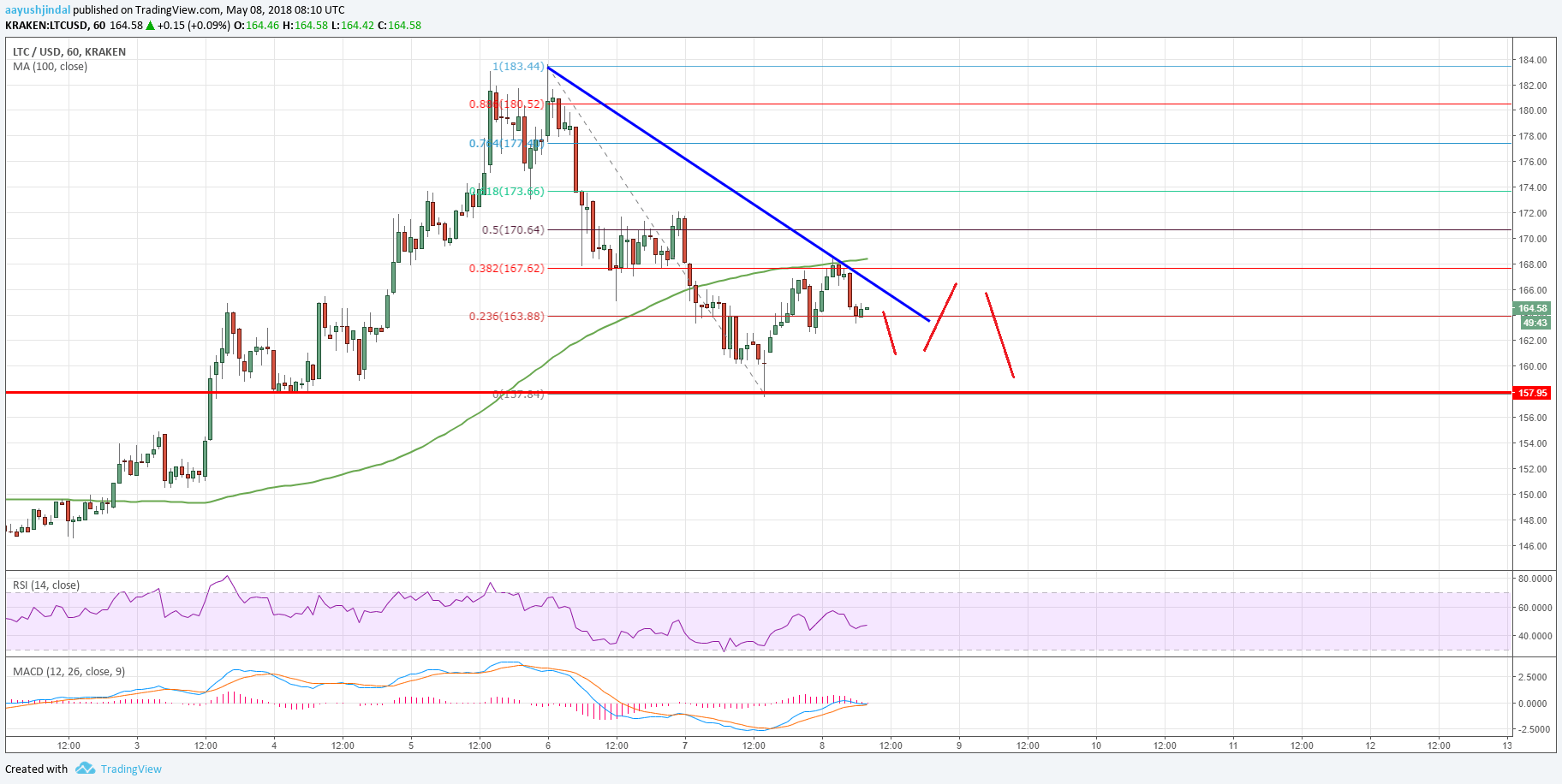
Litecoin price corrected lower and tested the $157 level against the US Dollar. LTC/USD now has to break the 100 hourly SMA to gain upside momentum.

Key Talking Points

Litecoin price is holding the $156-157 support area very well (Data feed of Kraken) against the US Dollar.
There is a key bearish trend line forming with current resistance at $166 on the hourly chart of the LTC/USD pair.
The pair has to move above the $168 resistance and the 100 hourly simple moving average to gain momentum.

Litecoin Price Forecast

Yesterday, we saw a downside correction in litecoin price from well above the $180 level against the US dollar. The LTC/USD pair declined and traded below the $180, $170 and $166 support levels.

Looking at the chart, the price even broke the 50% Fib retracement level of the last leg from the $142 swing low to $183.44 high. However, the downside move was prevented by the $156-157 area.

Litecoin price analysis ltc

A support base was formed at $157.50 and the price started an upside move. It traded above the 23.6% Fib retracement level of the last decline from the $183.44 high to $157.50 low.

However, there is a strong resistance near the $167-168 zone. More importantly, there is a key bearish trend line forming with current resistance at $166 on the hourly chart of the LTC/USD pair. Additionally, the 100 hourly SMA is at $168, and is acting as a strong barrier for buyers.

Moreover, the 38.2% Fib retracement level of the last decline from the $183.44 high to $157.50 low acted as a resistance. Therefore, it is quite clear that the price has to move above $168 resistance and the 100 hourly simple moving average to extend the current move.

A close above the $168 resistance may open the doors for a run towards the $180 level. On the downside, the $157.50 low is a short-term support.

As long as litecoin price is above the $156 support, LTC/USD could move higher in the near term.

Trade safe traders and do not overtrade!

The post Litecoin Price Analysis: Can LTC/USD Break 100 SMA? appeared first on Ethereum World News.

Cryptovest
CryptoKitties Releases Stephen Curry Sports Collectibles

CryptoKitties has partnered with NBA star Stephen Curry for an exclusive sports collectible series.

Previous Article

Nimfamoney ICO — How does Nimfamoney Android DEMO-app work

Next Article

Popular Portuguese Tech Publication Starts Investing in Cryptocurrencies

You might be interested in …

BIP 91 Has Locked In. Here’s What That Means (and What It Does Not)

BIP91.jpg

It looks as if bitcoin is getting Segregated Witness.

Bitcoin Improvement Proposal 91 (BIP 91) just locked in. Up to 90 percent of all hash power signaled support for this soft fork, which implies miners intend, in turn, to trigger Segregated Witness (SegWit) activation. By extension, this should make BIP 148 obsolete and August 1 a non-event.

But SegWit is not certain. In fact, on a technical level, SegWit is not any closer to activation at all.

BIP 91

Segregated Witness, defined by BIP 141, locks in if at least 95 percent of miners (by hash power) signal support for the upgrade within a two-week difficulty period. To do so, miners need to embed a piece of data called “bit 1” in the blocks they mine.

Importantly, this is technically the only way for SegWit to activate right now. And this threshold has not yet been met.

But there are alternative strategies to try and trigger this threshold “indirectly” — like BIP 91.

BIP 91 is a bitcoin Improvement Proposal proposed by Bitmain Warranty engineer James Hilliard. It is compatible with the New York Agreement and backed by a number of bitcoin companies and mining pools. It is also compatible with BIP 148, another strategy to trigger the BIP 141 threshold indirectly.

Miners have been signaling support for BIP 91 over the past couple of days through another piece of data, “bit 4.” Once 269 blocks within a 336-block window included bit 4, this BIP 91 soft fork locks in. This threshold was just met.

This means that after another 336 blocks, a little over two days from now, all BIP 91–compatible nodes will reject any block that doesn’t include bit 1.

As long as a majority of hash power enforces BIP 91, this majority should eventually control the longest valid chain according to all bitcoin nodes. And as this chain consists of bit 1 SegWit-signaling blocks only, it would in turn lock in SegWit on all SegWit-ready nodes by mid-August. SegWit itself should then be live on the bitcoin network after a two-week “grace period” by the end of that month.

If all goes well …

What Could Go Wrong?

Although well over 80 percent of hash power has signaled bit 4 for BIP 91 lock in, this doesn’t actually guarantee anything. Most importantly, it doesn’t in itself mean that these miners will signal bit 1 for SegWit.

Indeed, so far, most miners don’t. Currently, the proportion of miners signaling bit 1 is still far lower than BIP 91 activation would suggest. It is even lower than 50 percent.

Moreover, BIP 91 will probably be enforced by hardly any economically relevant nodes; that is, nodes operated by users that accept bitcoins as payment. Almost no bitcoin users on the network recognize BIP 91 or its bit 4 signaling at all, and will therefore continue to accept blocks with or without bit 1.

BIP 91 will, instead, be enforced by hash power alone. This in turn means that a majority of miners (by hash power) could back out of BIP 91 with little more than reputational damage. They could continue to mine blocks that do not signal bit 1, even after BIP 91 activates in a few days. As long as these miners are in a majority, they will still control the longest valid chain: valid according to most miners, and valid to most users.

Furthermore, any minority of miners and the few nodes that do enforce the BIP 91 soft fork would then be forked off the bitcoin network. In a few days from now, these miners would mine (on top of) blocks that almost only they themselves would care for, while most of the rest of the entire bitcoin network would completely ignore them.

With this week’s bit 4 signaling, a majority of miners have effectively made a statement that they intend to start to activate the SegWit soft fork within a couple of days. But for now, that’s really all it is: a very public, blockchain-based statement of intent.

Actual SegWit activation should start next week, if miners stick to their stated intent.

The post BIP 91 Has Locked In. Here’s What That Means (and What It Does Not) appeared first on Bitcoin Magazine.