The views and opinions expressed here are solely those of the author and do not necessarily reflect the views of Cointelegraph.com. Every investment and trading move involves risk, you should conduct your own research when making a decision.
Ethereum (ETH), the second largest cryptocurrency by market capitalization, is facing scrutiny from American regulators this month.
The cryptocurrency is subject to a looming enquiry by the US Securities and Exchange Commission (SEC) as well as the Commodity Futures Exchange Commission (CFEC) . According to the , regulators are taking a close look at the cryptocurrency and whether it should be classed as a security, as set out in the Securities Act 1933.
The major point of concern is the presale of ETH tokens in 2014. In total, 31,000 BTC were raised by the Ethereum Foundation to fund the development of Ethereum – worth around $18.3 mln at the time (and about $300 mln at press time).
Regulators are concerned that the presale itself could be classed as securities sale, due to the fact that investors likely bought tokens in the hopes that their value would increase in the future. If this is found to be the case, the Ethereum Foundation should have registered ETH as a security before the token sale was carried out.
SEC and CFTC regulators are due to meet May 7 to discuss the appropriate course of action. Another focal point is the influence that the Ethereum Foundation holds over the cryptocurrency.
Ethereum co-founder refutes claims
At the beginning of May, at a tech conference in New Orleans. Lubin confidently stated that there were no concerns that the cryptocurrency would be classed as a security:
“We spent a tremendous amount of time with lawyers in the US and in other countries, and are extremely comfortable that it is not a security; it never was a security… many regulators that matter understand what Ethereum is.”
Furthermore, Lubin believes that Ethereum does not need to be regulated, because it does not meet the classifications of a security at all.
The Howey test
In 1946, the US Supreme Court resided over a case between the SEC and WJ Howey Co. , the case laid the foundation for what is now commonly known as the ‘Howey test’.
Quite simply, Howey Co. sold a portion of its citrus farm to investors, who bought the land in the interest of earning profits from the citrus farming operation. It was eventually deemed to have been a securities contract by the Supreme Court, because of this definition given by Justice Murphy:
“The scheme involves an investment of money in a common enterprise with profits to come solely from the efforts of others.”
In layman’s terms, the Howey test is used to determine if the value of a transaction between two parties is dependent on one of the parties work. This very test has been the subject of much speculation when it comes to cryptocurrencies, and especially .
Arguments against securities classification
In the case of Ethereum, Lubin is of the opinion that it is not a security for two reasons.
Firstly, Ethereum’s blockchain requires miners to validate transactions, create new blocks and unlock ETH tokens. Lubin believes the fact that many parties are involved in the work creating value rules out classification as a security:
“I think we already have a regulatory scheme; securities laws in this country govern securities. If you fail the Howey test, you’re not a security. This is a way of accessing a shared compute resource, so I’m not sure [ETH] needs to be regulated in any way.”
Secondly, the Ethereum Foundation refuted claims made by former CFTC chairman Gary Gensler last week, who said both Ethereum and Ripple .
Ethereum Foundation head Aya Miyaguchi diffused any talk of the organisation’s influence over the value of the cryptocurrency . Miyaguchi stated that the foundations does no control the supply or issuance of ETH, and it’s own holding of ETH amounts to 1 percent of the total supply, which is in fact lower than amounts held by other users in the network.
Legal ramifications
If the SEC chooses to label Ethereum as a security, the foundation the matter to the courts. This could end up in a legal battle that could last a number of years.
Cointelegraph consulted to explore the possible legal ramifications of the ongoing debate around Ethereum. As Steinbeck explains, the SEC considers all ICOs as securities offerings – which means there is always a risk of a cryptocurrency being classified as such:
“However, the SEC is pragmatic. It would be a mistake, in my opinion, for the SEC to go after Ethereum for a couple of reasons. First, Ethereum is not a bad actor. There are plenty of fraudsters and con artists the SEC should be focusing on. Why focus SEC time and resources going after the good guys? Second, there are nuances in the way the Ethereum platform utilizes its tokens that may allow it to fail the Howey test. I don’t think the SEC can risk losing an enforcement action of this magnitude at this stage.”
Steinbeck expresses his belief that there would be no definitive decisions or outcomes anytime soon. He also agreed that Ethereum’s protocol, which utilizes mining to validate transactions and the blockchain, provides a compelling argument against being classified as a security.
“Mined tokens, versus those issued in an ICO, are less likely to qualify as securities. In fact, I think the CFTC will take the position that mined tokens are commodities and should be treated as such.”
What if’s?
There are a few eventualities that do need to be considered. If Ethereum is found to be a security, a number of things could happen.
First and foremost it that the price of the cryptocurrency would take a knock as American exchanges would be trading a security – which they would need to have registered for with the SEC. Trading would have to be stopped in order to do so. Secondly, as Steinbeck pointed out, “failing to comply with securities laws can have serious ramifications, including fines, penalties and civil litigation by “damaged” purchasers or sellers of the security.”
According to the , the SEC can dish out monetary fines for parties infringing on regulations. Individual penalties range from $7,500 to $160,000 while companies or entities face penalties from $80,000 to $775,000.
A fine can then be compounded depending on how many investors were ‘misled’ by the party under scrutiny.
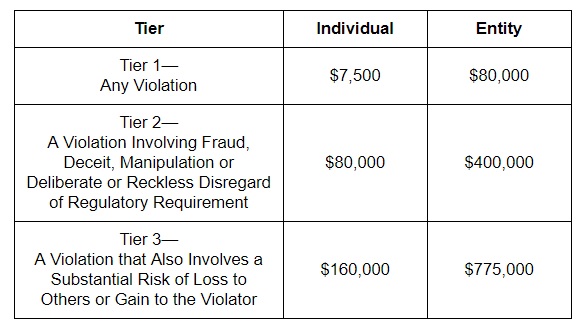
Source:
People or businesses found guilty of selling unregistered securities could face jail time, but that is highly unlikely, as lawyer . In essence, if Ethereum is found to have violated SEC laws, the foundation, exchanges and other ICOs that were built on the Ethereum blockchain could face penalties at the very least.
Nevertheless, it seems unlikely that the regulators from the SEC or CFTC will be rushing to a conclusion in the case of Ethereum. The cryptocurrency has been running successfully for over three years and its market capitalization shows its worth as a revolutionary blockchain technology.
Published at Sat, 05 May 2018 21:27:14 +0000
Blockchain
