November 2, 2026

Capitalizations Index – B ∞/21M

Interview: NANO Lead Dev Talks Zero-Fee Transactions, $170 Million BitGrail Theft

Interview: nano lead dev talks zero-fee transactions, $170 million bitgrail theft

Interview: NANO Lead Dev Talks Zero-Fee Transactions, $170 Million BitGrail Theft

Interview: nano lead dev talks zero-fee transactions, $170 million bitgrail theft
Advertisement

Join our community of 10 000 traders on Hacked.com for just $39 per month.

CCN spoke with NANO lead developer Colin LeMahieu right before a live-streamed Q&A carried out earlier today. LeMahieu told CCN that the presentation would be an introduction to NANO as well as himself, and said he was looking forward to it very much, saying “I’ll be highlighting what makes Nano unique and what our team envisions for Nano as we move into the future.”

While different cryptocurrencies are focusing on different use cases (cross-border payments, long-term stores of value), NANO is in the camp of day-to-day currency. Value transfer is and feeless, making it one of the crypto coins that may have a use case as a currency suitable for microtransactions and regular purchases.

“Nano focuses on instant and free transactions. Unlike most cryptocurrencies, Nano is a DAG (directed acyclic graph) and we call its structure a block lattice. Nano utilizes a DPOS form of consensus where users can delegate their votes to trusted nodes.

This results in no mining, the total supply of Nano has been distributed. Our mission is to make Nano a global currency with instantaneous transactions and zero fees over a secure, decentralized network.”

Shortly after rebranding from RaiBlocks to NANO, the project made headlines when 170 million worth of NANO was lost through the BitGrail exchange. BitGrail CEO Francesco Firano claimed that the funds were stolen, and suggested that developers fork the currency to replace the missing funds.

The situation had the NANO (then known as XRB) community in an uproar, negatively impacting the price and sending shockwaves through the cryptocurrency community in general by fostering widespread distrust of smaller exchanges. Many users had been trying to withdraw their funds for weeks before the incident and found that there were only periodic opportunities to do so, leading people to cry fraud when the funds were eventually stolen from the hot wallet of the exchange.

The NANO team cut off contact with Firano and contacted the Italian police to help deal with the issue. Firano claimed that NANO timestamp technology was responsible and that there were transactions missing from the ledger, and those claims were later proved to be false – BitGrail and Firano may yet be held criminally responsible for the alleged theft. The exchange opened for a total of three hours last week or the first time since the incident before being shut down by authorities.

When asked about this, LeMahieu told CCN:

“While the BitGrail situation is extremely unfortunate, it has not impeded the project. We allocated significant resources towards both determining what exactly happened, as well as investigating legal options, but as far as protocol development and overall project milestones are concerned we have continued to move forward.

Our team has been focused on the development and release of wallets as well as the implementation of a new block type, Universal Blocks, which will replace the existing send, receive, change and open block.”

Finally, we asked LeMahieu about the future of the cryptocurrency space and the role that NANO is destined to play in it. LeMahieu expressed the belief that the future of the cryptocurrency space will be very different, and that “we certainly don’t need thousands” of cryptocurrencies.

“I think there’s going to be a large consolidation as the market narrows in on precisely what problems cryptocurrency solves. I feel like Nano is strongly positioned, offering instantaneous and fee-less transactions, something that will always be in demand.”

LeMahieu gave a live-streamed presentation today at the Seoul Blockchain online event, and his Q&A can be seen on the here..

Featured image from Shutterstock.

Follow us on Telegram.
Advertisement

Published at Thu, 10 May 2018 12:15:11 +0000

Interview

Previous Article

Bitcoin Beats Gold as New Flight Capital

Next Article

SIRIN LABS Unveils Specs for the World’s First Blockchain Smartphone Named FINNEY

You might be interested in …

Blockchain, ai, nlp and other tech trends for 2019

Blockchain, AI, NLP and Other Tech Trends for 2019

Blockchain, AI, NLP and Other Tech Trends for 2019 It’s hard to keep track of everything that’s been going on in the fast-developing tech world. There was a burst in chatbots you can get in […]

Bitcoin Gets Technology Theory Backing, Can Reach $100,000 by 2021

“Moore’s Law” has been identified by a Harvard Scientist in bitcoin, and as such the belief is that the digital currency can reach $100,000 by February 2021, according to this theorem.


With bitcoin reaching a big milestone in its scaling debate, an issue that has dogged the digital currency for some time, it is now once again breaking records with little slowing it down.

Fear and speculation ran rampant leading up to the August 1 hard fork, which saw the creation of a new digital currency called bitcoin Cash – a fork of the original bitcoin. However, even since its creation, and rise to third-largest digital currency for a while in regards to market cap, it has not slowed bitcoin’s growth.

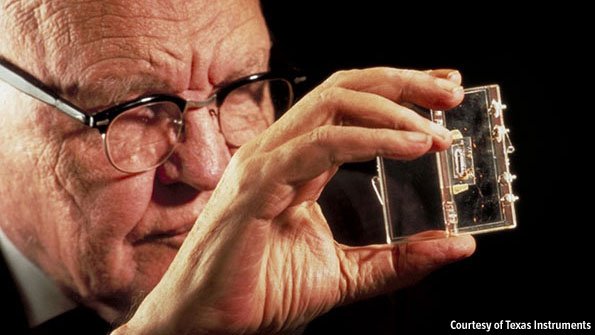
Gordon Moore - Moore's Law

Moore’s Law

Moore’s Law is a theorem and a formula that was created by the co-founder of Intel’s Gordon Moore Processor. It states that, on a processor, the number of transistors on the new microprocessor models will increase approximately twice every 18-24 months.

This law has been identified by Denis Porto, and investor, as well as a Harvard Scientist. It is his opinion that bitcoin has become the first digital currency to show signs of this law, even though it is not specifically aimed at this form of technology.

In a recent interview with Markets Morning, Porto said:

Moore’s law is specifically applied to the number of transistors per circuit, but it can be applied to any digital technology. […] Any technology that grows exponentially (i.e. following Moore’s Law) has a doubling moment.

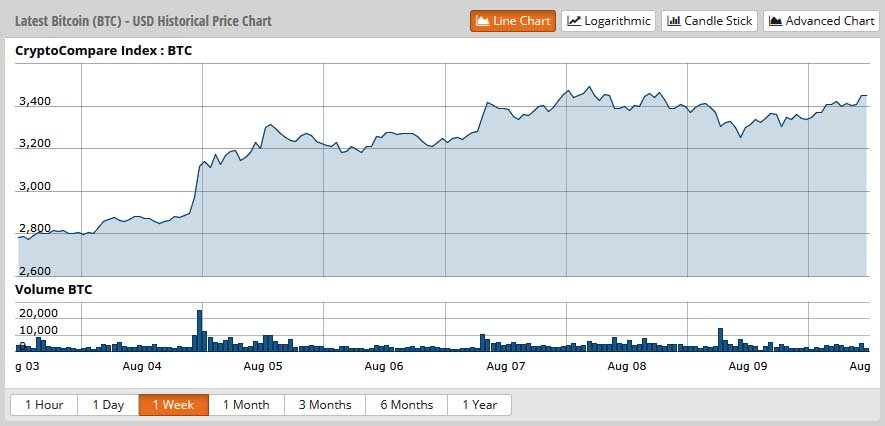
Bitcoin's price surge last week sparked renewed confidence and optimism

Contributing Factors

In the wake of bitcoin reaching its latest all time high last week, optimism and confidence have skyrocketed once again for the original digital currency. There have been a number of factors that have pushed bitcoin’s growth, and those same factors have seen it follow the trajectory of Moore’s Law as identified by Porto.

bitcoin’s ability to scale through SegWit, and suffer no ill effects from the hard fork, and instead grow to new heights has set this path to $100,000 in the next four years.

There are other factors in the pipeline as well that can also help bitcoin to stick to this trajectory of $100,000 as on Tuesday it was reported that Russia is looking to take over the mantle as the king of bitcoin mining.

Dmitry Marinichev, one of Russian President Vladimir Putin’s advisors, is preparing to boost Russia to be the global power of bitcoin mining, in an attempt to compete with China.

Are these prediction far too high? Can an asset really reach such prices or is there a real threat of a bubble? Let us know your thoughts in the comments below!


Images courtesy of Pixabay, Texas Instruments, Cryptocompare

The post Bitcoin Gets Technology Theory Backing, Can Reach $100,000 by 2021 appeared first on Bitcoinist.com.