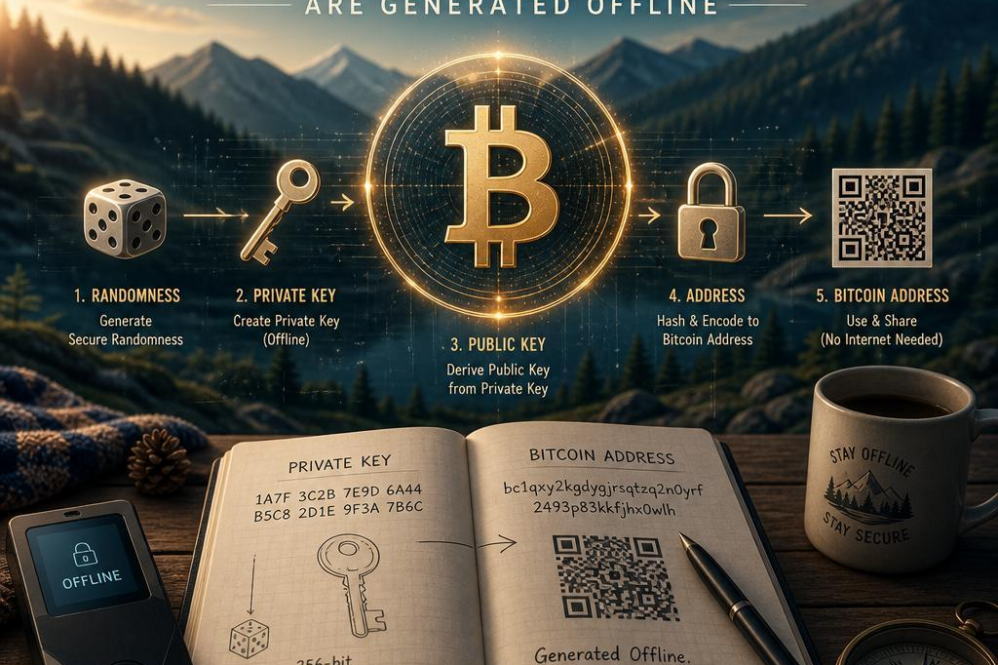
bitcoin addresses can be generated offline without connecting to the internet. The process is entirely mathematical: wallet software creates secret key material,derives the corresponding public facts,and formats it as an address. The internet only becomes useful later, when you want to look up a balance, receive transaction dataor broadcast a signed transaction.
That separation is the foundation of cold storage. A private key or recovery seed can be created and kept on an air-gapped device, while the public address is shared freely for receiving bitcoin. The vital part is not simply disconnecting a computer, though. The device, the softwareand the source of randomness all need to be handled carefully.
Start with real randomness
A bitcoin private key cannot safely come from a memorable phrase, a date, or a string that merely looks random. It needs entropy: unpredictable input that another person cannot reproduce or realistically guess. for a standard wallet, 128 bits of entropy is commonly treated as a minimum security target. A 12-word BIP39 recovery phrase is generally produced from 128 bits of entropy plus a checksum.
The source matters. A well-maintained operating system can provide suitable randomness, as can trusted hardware random-number sources. Physical dice rolls are another option for someone who wants an offline source that can be checked by hand, provided the rolls are recorded and converted correctly. Some people mix autonomous sources, such as dice entropy and local system randomness, as an added precaution.
being offline does not automatically make randomness safe. A disconnected machine can still produce weak or predictable keys if its random-number generator is faulty, poorly initializedor compromised. Avoid shortcuts such as hashing a password, using personal information, relying on a small number of coin flipsor using an online “paper wallet” generator. Those approaches can seem private while producing keys that are far easier to search than they should be.
Wallet software should also enforce bitcoin’s valid private-key range. Established wallet software does this automatically and rejects invalid values rather than trying to turn them into something usable.
Choose and verify the software frist
Before taking a device offline, obtain the wallet software from the project’s official release channel. Do not trust a search ad, a random download mirroror a file someone reposted elsewhere. open-source software is useful as its code can be reviewed, but that does not by itself prove that the file you downloaded is the project’s genuine release.
where available, download the release file along with its checksum and cryptographic signature. Check the checksum to make sure the file was not damaged or altered in transit, then verify the developer’s signature and confirm the signing-key fingerprint through an independent source. A checksum alone is not enough if an attacker can replace both the software and the checksum displayed beside it.
Do this verification on a separate, regularly updated computer before transferring the software to the offline machine. If the project offers reproducible-build instructions, they can provide another way to compare a locally built program with the published release. Once the software has been verified, move it using media you control and disconnect the target device from all networks before creating wallet material.
Removable media deserves some caution too. Scan it before use, avoid plugging it into unknown computersand keep a record of the wallet version and release files you used. That record can be helpful years later if you need to understand or recover an old setup.
Create the wallet on an air-gapped device
An offline address begins with private-key material created on a device that is not connected to Wi-Fi, Ethernet, Bluetooth, or any other network. Ideally, it is a purpose-built signing device rather than an everyday computer that happens to be disconnected for an afternoon. The goal is to keep the secret away from remote access and network-based malware at the moment it is created.
Once the wallet generates a seed phrase or private key, the public addresses can be exported for receiving payments. The secret stays behind. This is the basic division between a signing wallet and a watch-only wallet: the watch-only setup can hold public addresses and show balances, but it cannot spend funds because it does not have the private keys.
Protect the secret as you would protect the bitcoin itself. Anyone who gets the seed phrase or private key can spend the funds. Do not type it into a website, email it, photograph it, store it in a cloud driveor paste it into a messaging app. The device is not a substitute for a backup, either. A hardware wallet, a carefully writen recovery phraseor a durable metal backup can all be part of a sensible plan, provided they are stored securely.
How an address is derived
No blockchain connection is needed to turn a private key into a public key. The private key is a secret number within bitcoin’s allowed range.Wallet software uses the secp256k1 elliptic curve to calculate the matching public key locally. It does not ask a server for permissionand the private key does not need to leave the device.
The wallet then derives an address from the relevant public-key data and encodes it in a format bitcoin software recognizes. Older address types commonly use Base58Check encoding. Native SegWit addresses use Bech32, while certain newer SegWit address types use Bech32m. The exact steps depend on the address type, but the work is still done locally.
An address is not the same thing as a public key. The private key authorizes spending; the public key is derived from that secret and can be shared; the address is a receiving identifier derived from public-key-related data. In a modern wallet, a recovery seed often generates many private keys and addresses, rather than just one.
This is why offline generation works so well for cold storage. The cryptographic relationship between the private key and address is the same whether the device is online, offlineor never connected to a network at all.
Keep backups private and usable
A seed phrase is usually the most important backup in the setup. It can restore the wallet and regenerate the private keys it controls. A single exported private key has the same practical importance for the specific funds associated with that key. Neither should be treated like an ordinary password.
Write recovery words down in the exact order shown by the wallet,and confirm them on the offline device. Keep the backup somewhere protected from casual access, moistureand fire.paper can be perfectly adequate when stored well; metal may be a better fit where physical durability is the main concern. Avoid labeling a backup in a way that identifies it as a bitcoin seed or ties it directly to you.
If you use an optional BIP39 passphrase, store it separately from the seed phrase and make sure you understand the consequence of losing it. The seed alone will not recover a wallet protected by that passphrase. It can add protection, but it also adds a recovery risk that should not be taken lightly.
most people are better off letting their wallet manage individual private keys rather than copying them by hand. If a workflow requires exporting a key,keep temporary copies to a minimum and remove them when they are no longer needed. The aim is to have a recovery path without leaving unneeded traces of the secret behind.
Check the setup before using it
An offline wallet can validate the structure and checksum of a newly generated address without going online. That can catch a typing mistake or damaged QR-code data before you share the address. It does not confirm that the address has received funds or reveal its balance; those questions require access to blockchain data through a separate online or watch-only setup.
Before sending a meaningful amount, compare the receive address shown on the offline signing device with the address you plan to share. they should match exactly. It is also wise to make a controlled recovery test before relying on a new backup. Restore the wallet from the seed phrase in a safe surroundings and confirm that it reproduces the expected addresses. Start with a small amount of bitcoin rather than making yoru first test with funds you cannot afford to lose.
Physical backups need occasional attention. Check that the words remain legible, that storage conditions have not damaged the materialand that replacement copies reproduce the same wallet addresses before you retire an older backup. Never use a website or cloud document to test a seed phrase.
Offline generation is about keeping secrets offline
Generating a bitcoin address offline is straightforward in principle: create strong random key material, derive the public information locallyand share only the address. The harder part is maintaining discipline around the secret-using verified software, protecting the recovery phrase, limiting copiesand testing backups before large sums are involved.
An internet connection is useful for monitoring or broadcasting transactions, but it is not part of address creation. Keep the signing keys offline, use public information for everything that must go onlineand treat every backup as if it can unlock the wallet-because it can.


