July 4, 2026

Capitalizations Index – B ∞/21M

Hedge Fund Manager: Floored Bitcoin Price is Under-Owned

Hedge fund manager: floored bitcoin price is under-owned

Hedge Fund Manager: Floored Bitcoin Price is Under-Owned

Hedge fund manager: floored bitcoin price is under-owned
Advertisement

Get Trading Recommendations and Read Analysis on Hacked.com for just $39 per month.

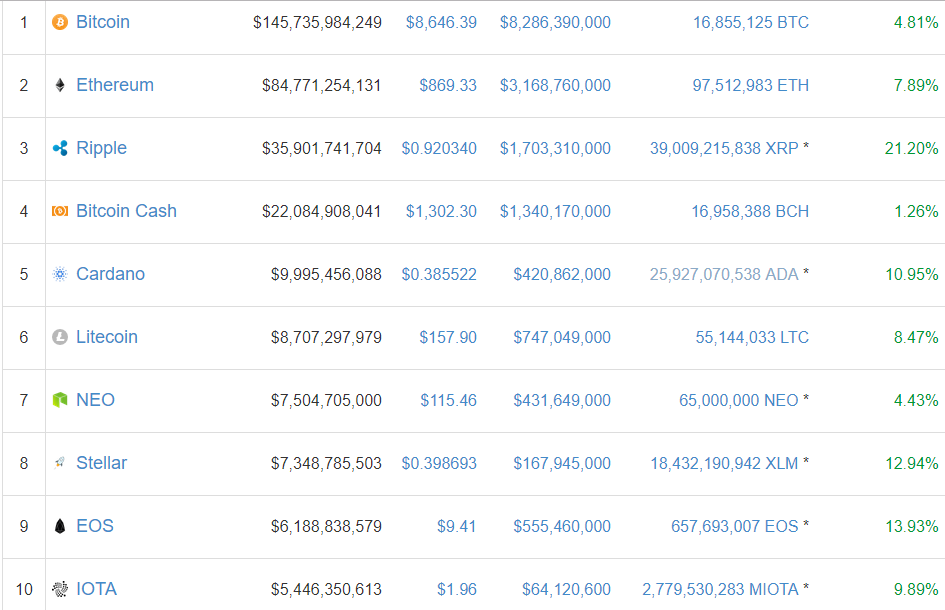
bitcoin and the other leading digital coins are trading in the green on Friday. The bounce doesn’t surprise Dan Morehead, head of Pantera Capital, a $1 billion long/short cryptocurrency and blockchain hedge fund, who as an early bitcoin investor has seen this movie before, telling CNBC that bitcoin in recent days had reached a bottom. bitcoin closed below $7,000 on Feb. 5, but it’s been mostly recovering ground since then, with the top cryptocurrency perched above $8,600 on Feb. 9. Meanwhile, institutional investor exposure to bitcoin hasn’t even scratched the surface.
Hedge fund manager: floored bitcoin price is under-owned

Institutional Interest

Morehead’s bullish position on bitcoin seems to be predicated, at least somewhat, on his knowledge of his institutional peers, where he says “there’s such an appetite to get exposure to this,” adding that it’s a $500 billion asset class that “nobody owns.” With most hedge funds, pensions, private equity, etc. on the sidelines, the bitcoin price continues to march to its own drummer.

But a sign that the hedge fund industry’s interest is piqued is reflected in the data. HFR, which is the most widely cited hedge fund AUM and performance data for the industry, also oversees blockchain composite and cryptocurrency indexes. Meanwhile, those hedge funds with exposure to digital coins shed 10% in January, as per HFR data, but that was one in only a handful of months in which hedge funds with exposure to cryptocurrencies suffered declines.

Pantera’s Morehead has owned bitcoin since it was trading at $72 in a portfolio that also extends to Ethereum and XRP. In December, when the bitcoin price was nearing $20,000, he warned that the digital coin would shed 50% of its value before rallying again. “It’s volatile on the upside. It can be volatile on the downside,” he told CNBC.

It wasn’t the first bear market for Morehead, a former Wall Street trader, and he’s using tools from his MBS days to help navigate the tricky cryptocurrency markets. While there aren’t any guarantees, he does recognize a pattern. Based on the average cryptocurrency bear market cycle of slightly more than two months (71 days), the market will normalize within a couple of weeks. At that point, bitcoin will be poised to gain new territory.

Meanwhile, he touts bitcoin for its low 0.1% correlation to the broader financial markets, such as stocks, which he says is difficult to achieve in other asset classes.  And while he’s got exposure to the main digital coins, he likens the digital tokens being issued in upcoming ICOs to small-cap stocks — high growth potential coupled with high risk — making them an interesting way to play the cryptocurrency markets.

That’s not too surprising, considering Pantera has tested the ICO waters itself, having launched a token sale last year. At its peak, the hedge fund was up 2,922%, boasted $2 billion-plus in AUM and had to disincentivize investors with higher fees to slow the pace of investments.

Featured image from Shutterstock.

Follow us on Telegram.
Advertisement

Published at Fri, 09 Feb 2018 20:45:01 +0000

bitcoin Opinion

Previous Article

Meet Brian Forde: Californian Congressional Candidate and Crypto Enthusiast

Next Article

Bitcoin Ethereum Litecoin Ripple Technical Analysis Chart 2/8/2018 by ChartGuys.com

You might be interested in …

CryptoKitties Creates Massive Backlog on the Ethereum Network

The new decentralized game CryptoKitties launched last week, with the purpose of the game to collect, bred, and trade electronic cats. Due to the game’s unbelievable popularity, the Ethereum network has been seeing record rates of transaction backlog.


Cat-Based Trading Game

CryptoKitties launched at the end of last month as one of the first games based on a decentralized blockchain. A kooky combination of Pokemon meets Beanie Babies on the blockchain, the goal of the game is to buy virtual cats and collect them. Each cat has is unique and has its own “DNA” that is recorded on the blockchain. Once you start acquiring a decent number of cats, you can start breeding them to create new, rarer cats. These cats have a value on the open marketplace, with the first cat created dubbed the “Genesis Cat” fetching upwards of $110,000 in ether.

Image result for crypto kitties

These cats are traded via Ethereum transactions, and it is quickly taking over the network. At the beginning of the weekend, CryptoKitties trades amounted to roughly 4% of the network’s transaction volume. Today they account for almost 15% of the transaction volume. It has gotten to the point where the team behind the game has announced that they are doubling the fees needed to birth a new cat to make sure the transaction can get processed in a timely manner.

We’re beginning to see cracks in the second biggest blockchain in the world, adding an urgency to scaling solutions that blockchain technology desperately needs. bitcoin has been experiencing full or near full blocks for over a year now. With Ethereum soon to be hitting its capacity, research into new options to help decentralized technology scale are needed soon.

Fixing the Problems at Hand

Some people are requesting that miners increase what is known as the gas limit, which is like blocksize in bitcoin. Gas is a measure of computational effort, and each operation has a set amount of gas attached to it. Operations can be things like adding numbers together, calculating a hash, or sending a transaction. The limit is the maximum amount of gas that can be included in a block. With this limit in place, it can cap the block size and the speed of propagation around the network. These two things are essential to maintain the decentralized nature of blockchain technology.

Unfortunately, miners are unlikely to change this parameter as it has its own adverse effects as well. A statement made on Reddit by the operator of EtherChain, a large Ethereum mining pool, has stated

The network uncle rate has already reached levels (~30%) comparable to the Network DoS attacks during October 2016. This means that currently every 3rd Block get orphaned. Increasing the gas limit will likely make the current situation even worse. Without substantial improvements on how those large blocks are processed by the current implementations and distributed through the network I don’t think increasing the gas limit further is feasible right now. While high end systems are still able to validate heavy blocks within several 100 ms, low end systems already take up to a few seconds to validate and distribute a block.Bottom of Form

A solution is needed for the current levels of congestion, as some transaction fees are hitting close to a dollar, a level that the Ethereum Network was never supposed to hit.

What do you think about this new game? Do you own any crypto kitties? Let us know in the comments below!


Images courtesy of CryptoKitties.co, BitInfoCharts

The post CryptoKitties Creates Massive Backlog on the Ethereum Network appeared first on Bitcoinist.com.