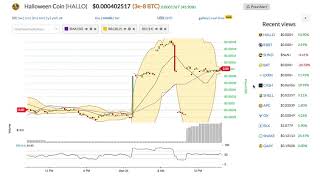
Halloween Coin (HALLO) Price Alert, Chart & News on BitScreener.com
More detail: https://bitscreener.com/coins/halloween-coin
Halloween Coin (Symbol: HALLO) is a Halloween themed digital currency that is a Proof-of-Work/Proof-of-Stake hybrid utilizing the x11 algorithm. Via bitcoin, the team have discovered that even in the case of digitally mined resource, an ecosystem is created around mining. These miners and companies give them allowance to invest in ecosystem and commodity. They have the intention of spending time, money and resources on work leading to a profitable sale of the product. Therefore, Halloween platform is following the same ethics as a wanted coin like bitcoin. Halloween will be a reserve commodity with Proof – Of – Stake remaining to be the near costless distributed token. The coin reserve role is incentivizing with a lower fee for sending and slower block times, which allows stable, secure mining.
Lightning Labs CEO Challenges Blockchain Over bitcoin Narrative CEO of Lightning Labs, the developer of the Lightning Blockchain scalability protocol, Elizabeth Stark has spoken out to challenge the Wall Street and traditional financial sector narrative […]
Bloq, a Chicago-based blockchain developer and software startup, is now developing blockchain platforms and best practices for one of the most promising use cases for blockchain technology: trade finance and supply chain management.
Interest in the use of blockchain for trade is growing rapidly as companies and organizations like IBM, Microsoft, Hyperledger, JP Morgan and Walmart recognize that antiquated trade systems are long overdue for a complete restructuring and that blockchain technology has the potential to revolutionize the systems that make up global trade.
A common problem with current trade systems is fraud. The trip from farm or factory to store shelves involves numerous opportunities to falsify shipping documents and alter shipping container records or contents with little accountability.
“Global supply chain management has drastically changed in the last 10-15 years,” William Nieusma, Vice President, Government Strategy at Bloq told bitcoin Magazine: “Regulatory mandates, operational complexity and data security concerns have ramped up the pressure to overhaul these outdated systems.”
Nieusma is one of the authors of Bloq’s recently released , “Accelerating Global Trade Processes with Blockchain,” designed to introduce their new project to develop a model blockchain network for companies involved in trade.
“But it’s not all doom-and-gloom; adopters of blockchain-based systems can cut costs, improve customer service and find new, verified business partners,” added Nieusma.
Alan Cohn, attorney and consultant and advisor to Bloq told us:
“Global trade is an area where blockchain can play a transformative role, not just for industry but also for government.”
Nieusma noted that Bloq believes that in the future, the most significant and valuable business systems, including trade, will run on blockchains.
IBM has the potential of blockchain and trade. In partnership with seven European banks, it is building a pilot blockchain trade program with Hyperledger to enable companies like Walmart and Maersk to use blockchain technology to better track the movement of farm and factory products to the store shelves.
Microsoft is also building a model trade using the Ethereum blockchain in a pilot project with JPMorgan.
Blockchain Tech and Trade Are a Perfect Fit
Trade finance and supply management lend themselves well to the particular advantages of blockchain technology. The Bloq white paper states:
Blockchain technology holds considerable promise to substantially improve supply chain security and transparency. Blockchain’s inherent architectural attributes solve several weaknesses in current trade IT systems and processes to ensure information immutability and transaction auditing, thereby increasing trade value capture and value creation.
Bloq’s model trade platform promises companies high levels of cybersecurity, reduced waiting times, transparency, ease of revenue payments, low infrastructure investment, easily auditable transactions, efficient accommodation for additional participants, immutability and automatic bonding and payments through smart contracts.
Bloq plans to build a “permissioned, federated network” built on the bitcoin blockchain that, depending on the client’s needs, will also support Ethereum and Hyperledger. Nieusma said:
“Bloq believes that the future is a multi-chain, multi-network world and that interoperability is a guiding principle in network buildout.”
The Bloq program will connect all parties involved in a trade including buyers, banks, sellers and transporters so that information about a shipment is distributed among all involved parties at the same time.
As the white paper states:
“Trade can be safer, more secure, and more profitable with less human error. We hope this discussion leads to an evolution in trade that benefits all stakeholders.”