
· February 6, 2018 · 11:00 pm
Capitalizations Index – B ∞/21M
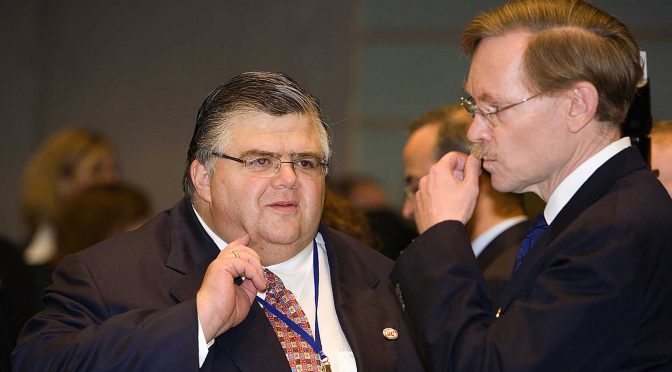
The head of the Bank for International Settlements (BIS), has today called on central banks to . But it almost definitely has nothing to do with the fact that they stand to make his job obsolete. Honest.
Agustin Carstens described bitcoin as “a combination of a bubble, a Ponzi scheme, and an environmental disaster.”
Pot, kettle, much?
We might as well get it out of the way first. I have honestly never seen a man as fitting of that description as he is. A combination of a bubble, a Ponzi scheme, and an environmental disaster. It must take the resources of several hectares of land just to clothe and feed the guy.
And before you say, “well he looks more like an inverted pyramid, so that isn’t a Ponzi scheme”… That’s exactly what the people at Global Intergold say, and trust me, an inverted pyramid is still a pyramid. If it requires fresh blood to pay dividends to earlier investors and make the operator rich, then I shouldn’t have to tell you to steer well clear.
Hence it isn’t a Ponzi scheme; end of. And although we are admittedly, just coming through our second big bubble, that doesn’t mean that the entire concept is a bubble. The dotcom bubble burst, yet the internet is more integral to our daily lives now than it was back then. People still buy tulips, and houses, and shares.
Something else bitcoin doesn’t need is a Bank for International Settlements. So when Carstens warns “cryptocurrencies could become more interconnected with the main financial system and become a threat to financial stability,” he is talking about the financial stability of the banking fat-cats.
agustin carstens (1) : “BTC is a ponzi scheme” A Ponzi scheme is a fraudulent investment operation where THE OPERATOR generates returns for older investors through revenue paid by new investors (wikipedia). Who’s “the operator” of ???🤔
— CLAUDY (@CryptoClaudy)
He wheeled out the same tired old rhetoric about crypto only being used for illegal activities. That the current fascination was concerned with speculative mania rather than electronic payment. No mention that the majority of users wish the speculative maniacs would leave crypto alone.
He acknowledged that many central banks have been investigating blockchain technology, but claimed that the findings were that:
[These] systems are very expensive to run and slower and much less efficient to operate than conventional payment and settlement systems
However, a quick Google search provides lots of examples that contradict this claim.
Oh, I put the conclusion in the first paragraph. He didn’t say anything that you wouldn’t expect someone in his position to say. Just the standard FUD that we’ve heard for years from people controlling traditional financial institutions.
Sadly, despite all the forward-thinking governments and central banks who realize that they have to integrate new technologies and explore the possibilities, there are still Luddites like Augustus here, who fear the winds of change. Or maybe in this case he just has too much inertia to change? Yeah, I ain’t too proud to take the cheap shot.
Do Carstens’ accusations have merit or are they driven purely by his own sense of self-preservation? In other words, is he just FUDding because he is worried that crypto will put him and all his fellow banking fat cats out of a job? Let us know what you think in the comments below.
Images courtesy of Wikimedia Commons
Disclaimer: The views and opinions expressed in this article are solely those of the author and do not necessarily reflect those of Bitcoinist.com.
Published at Wed, 07 Feb 2018 04:00:03 +0000
Marcus Hutchins, the British security researcher who aided ailing Wannacry malware victims, including the UK’s National Health Service, arrested by the FBI in Las Vegas.
The security researcher who stopped the Wannacry malware attack by registering an internet domain that the malware communicated with has reportedly been arrested at an airport. According to emerging , Hutchins was arrested in Las Vegas as he was leaving the country after attending the Blackhat and Def Con conventions which are held annually for security researchers.
who were with him at the conventions say they do not know his whereabouts and have not heard from him for 18 hours. The , however, released the following statement:
Marcus Hutchins… a citizen and resident of the United Kingdom, was arrested in the United States on 2 August 2017, in Las Vegas, Nevada, after a grand jury in the Eastern District of Wisconsin returned a six-count indictment against Hutchins for his role in creating and distributing the Kronos banking Trojan.
Members of both cryptocurrency and cyber security communities have taken to Twitter to express their disbelief and confusion:
I really hope this is a mistake. Guardian: “indictment filed on behalf of the Eastern District Court of Wisconsin”
— Kenn White (@kennwhite)
//platform.twitter.com/widgets.js
Others were quick to rush to the 23-year-old security researcher’s defense:
Hey please get on this! Marcus Hutchins needs your help.
— Mister Johnson ⚠️ (@mrjhnsn)
//platform.twitter.com/widgets.js
EFF is deeply concerned about security researcher Marcus Hutchins' arrest. We are looking into the matter, and reaching out to Hutchins.
— EFF (@EFF)
//platform.twitter.com/widgets.js
Motherboard was the to break the story, where there still seemed to be confusion about quite what had happened. In an e-mail to the publication, a U.S. Marshals spokesperson stated:
My colleague in Las Vegas says this was an FBI arrest. Mr. Hutchins is not in U.S. Marshals custody.
Ironically, hours after Hutchins was arrested, more than $130,000 worth of the bitcoin ransom taken by the creators of appear to have been tumbled through a mixer for withdrawal. This marks the first movement of the coins on the bitcoin network since the attack.
It is important to note that there is absolutely nothing to suggest that the withdrawal is in any way connected to Hutchins’ arrest.

The Kronos malware was spread through emails with malicious attachments, hijacking credentials such as internet banking passwords and other such sensitive information. Malware such as Kronos and Wannacry are increasingly getting media attention and look set to be at record numbers in 2017 released by antivirus companies are to be believed.
What are your thoughts on this? Is Marcus Hutchins’ arrest possibly only a case of guilt by association? Let us know in the comments below.
Images courtesy of Shutterstock
The post appeared first on .
Crypto New Media Dow Jones in Bear Market Territory, Why White House Failed to Ease Investors Crypto New Media Press This week, the Dow Jones recorded a steep sell-off from 23,970 points to 21,846 points, […]