February 23, 2026

Capitalizations Index – B ∞/21M

Examining previous BTC cycles

Examining previous btc cycles

Examining previous BTC cycles

Examining previous btc cycles

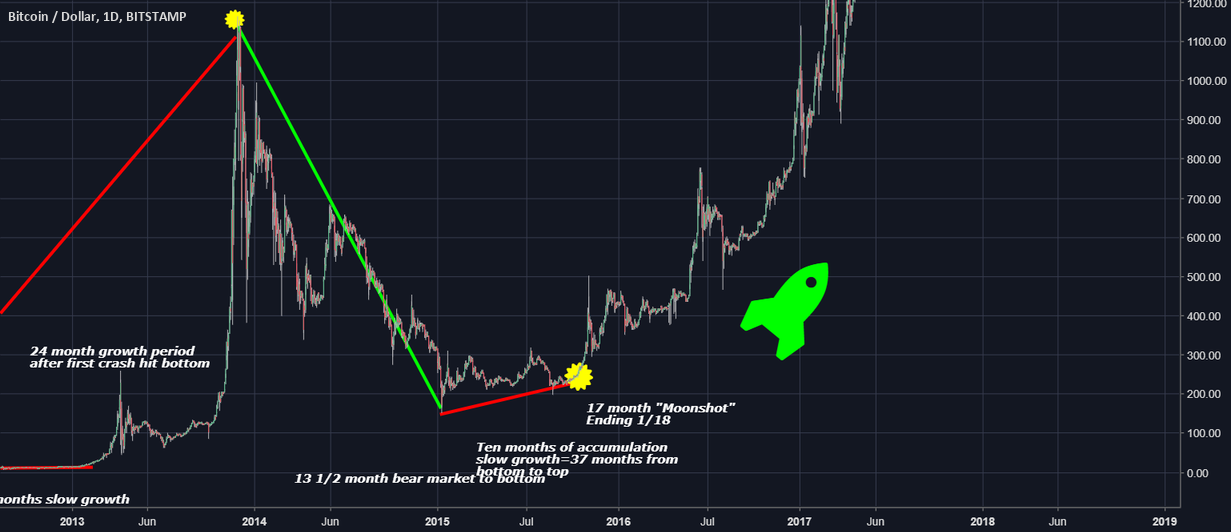
From the 2011 BTC bottom, there was 24 months of growth until the January 2014 peak, followed by a 13 ½ month bear market correction, a length of time 43.75% shorter than the growth period. After it bottomed out, there was meager/slow growth for ten months, swinging may be $150 in price at most. January 2015 marked the steady increase in growth that ended in January 2018. From bottom to top, that took 37 months, at which 43.75% would mean 20 months correction period, which would mean a bottom would be in August, 2019. Measuring the short history of two cycles, there’s not much data to speculate with.

However, only 2 ASIC miners are “profitable (if you don’t include the $2k+pricetag) at $3500, meaning BTC is primarily mined by large operations that have subsidized electricity, 2 phase liquid cooling units, or solar/wind/other power. Further price drops eliminate retail mining and threatens large operations with massive investments. It’s hard to believe that those interests and their investors wouldn’t step in to prop up the price; if they didn’t, BTC has no incentive for miners, and it’s steps to lower mining difficulty might never catch up with the falling price.

Also, the 2014-2015 correction was before mainstream media hype and the ICO hysteria. The growth until late 2016/early 2017 was hyped, scams were plenty, the earliest mainstream adopters came in (and got REKT). Unlike the previous cycle, there’s far too much mainstream money dumped into BTC for “whales” to afford BTC to cross the threshold of mining cost/profit ratio, even with the subsidized and alternative energy/cooling operations which need to cover many other costs. It’s sideways or up unless some miracle in mining difficulty reductions occur.

I also expect a huge war between nChain, which doesn’t rely on miner consensus for direction and creating use case, and bitcoin Core developers. Whatever you think of Craig Wright, he has a plan and patents to make bitcoin SV a global yet state-free currency on which a new internet can be built, basically all of the sh*tcoin dapp and Internet of Things platforms built on bitcoin . Core and miners might not be able to keep up if you prefer BTC or not.

Published at Thu, 13 Dec 2018 09:54:46 +0000

Previous Article

Senior Backend Engineer – Paradex

Next Article

BCHUSD – 1D Chart Analysis

You might be interested in …

WeTrust Launches Lending Circles (ROSCA) Platform, Offers Opportunity to Participate in On-Going Crowdsale

Ethereum blockchain platform WeTrust has announced its very first Trusting Lending Circles product and Trustcoin crowdsale. WeTrust is a reciprocal aid platform that leverages smart contracts to enable all to create a ROSCA (Rotating Savings and Credit Association) within a trusted group dynamic to assist each other.


Trusted Lending Circles will be the first in a long line up of WeTrust products marketed for imminent release. The new product will apply the idea of ROSCA on Ethereum blockchain to create a transparent, trusted group or a closed community oriented investment and reciprocal aid system. Trusted Lending Circles presently supports ROSCAs set up by a small, tight-knit group of family members and close friends. In addition to TLC, WeTrust also has other products and features on the horizon, such as Large scale ROSCAs, trusted direct lending/borrowing and mutual insurance.

The Trusted Lending Circles is open to anyone who wishes to create or join a ROSCA. A group of trusted participants agree to contribute a specific amount at timed intervals, based on a mutually confirmed framework for distribution amongst the participating associates in a way that is democratically agreeable.

The total collected contribution is later allocated in a reverse auction in which the lowest the lowest bidder is offered the bidding amount, and the remainder is distributed amongst the remaining participants. The Ethereum Blockchain records every ROSCA related transaction as smart contracts underpin the bidding process to ensure transparency and eliminate the requirement for a trusted third party.

WeTrust logo

The WeTrust pilot is momentarily restricted to the cryptocurrency community, but once a precedent is set for blockchain-based ROSCAs, the platform will then extend to other communities through the integration of stablecoins for those who are comfortable with the use of fiat currencies.

The WeTrust currency Trustcoin (TRST) crowdsale started on March 2, 2017, and will continue for six weeks. Of the 100 million tokens, 80 million will be allocated to the participants, and the remaining 20 million will be reserved for the founding team, advisors and bounty programs. Founding team and advisors will receive 10 million TRST over two years, the organization Finclusion Labs responsible for building the platform will receive 8 million TRST, leaving 2 million for various bounty programs.

Participating crowdsale investors can buy Trustcoin with both bitcoin and Ether. Those investing early on become eligible for bonuses offered for early bird investors. The platform offered the first-day bonus of 30%, after which it has been set to decrease as the sale continues.

All Trustcoin token sale participants receive their tokens upon crowdsale completion, after which it can be used for services performed by WeTrust and other service providers within the WeTrust ecosystem.


Images courtesy of WeTrust, AdobeStock

The post WeTrust Launches Lending Circles (ROSCA) Platform, Offers Opportunity to Participate in On-Going Crowdsale appeared first on Bitcoinist.com.