“When the Foundation was founded, the Foundation was . People in the Foundation were the ones that were building . Now, that’s not the case.”
That’s Aya Miyaguchi, executive director of the Foundation, the non-profit organization founded and dedicated to the continuing development of the world’s second-largest by total value.
Since Miyaguchi’s appointment in early 2018, however, the platform has faced severe market turmoil, with the price of the ’s native , , dropping from a high of roughly $1,100 in early 2018 to roughly $130 today. Further, it’s seen rising competition in the form of new blockchains touting more advanced smart contracts and more sustainable decentralized application infrastructures.
Still, Miyaguchi tells CoinDesk that, in her view, the important change over that time as it relates to the role of the Foundation is not ether’s fluctuating price or the shifting market for infrastructure, but rather ’s growing community of global developers.
“With the nature of open-source technology, [] has changed over the years and the entire ecosystem has grown a lot bigger,” said Miyaguchi.
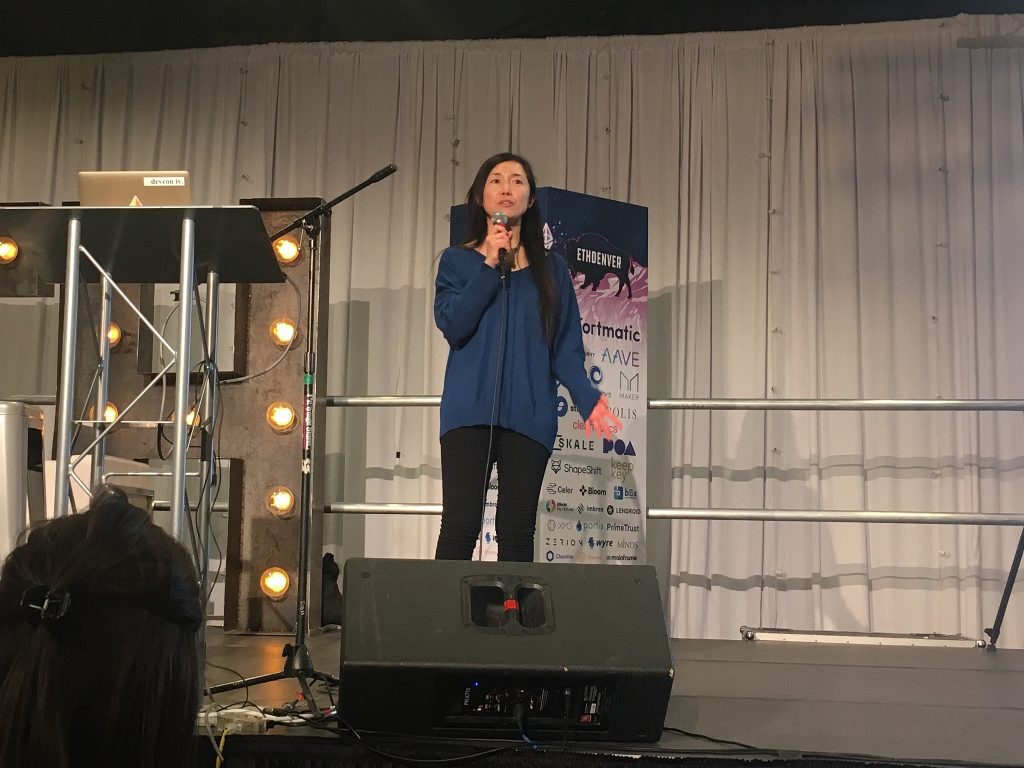
Giving a short address at the opening of the second annual hackathon, ETHDenver, Miyaguchi highlighted her desire to see that the Foundation does not remain stagnant, hinting at what could be considered a redefined mission for one of the industry’s oldest non-profits.
“I believe the role of the Foundation also needs to shift … What are things that only the Foundation can do?” asked Miyaguchi to the crowd of developers and enthusiasts.
As the earliest non-profit organization to promote and invest in , Miyaguchi said that one of the foundation’s greatest strengths was its trusted brand.
She told CoinDesk:
“I believe the Foundation has established this trust relationship in the world where we do have the brand. People trust us to be neutral or honest about information so we just want to deliver the true information.”
Miyaguchi aims to lead the organization to focus more heavily this year on improved communications to the general public about the progress and development of the platform.
“Someone needs to fill in this role,” insisted Miyaguchi. “Who can do this better than others? Not that we’re experts in doing this, it’s more like our position being a non-profit and being neutral [means] we don’t have any business incentives.”
‘Supporting and coordination work’
As such, Miyaguchi concedes the Foundation is no longer the central hub it used to be for developers, research projects and technology development. Yet, she argues the Foundation still has a role to play in communicating to, as well as, coordinating work between different startups and projects.
“I think that even the supporting and coordination work is still a reason for why the Foundation should exist,” affirmed Miyaguchi to CoinDesk.
As Miyaguchi points out, an area of increased coordination she’d like to see this year is with the grants program non-profit administers.
Having recently seen its fifth wave of grantees, seven different projects were awarded an undisclosed amount of funds to address “urgent, important and unique improvements which further the vision,” as stated in Thursday’s
But according to Miyaguchi, the grants program for a long-time running hasn’t been strictly organized by Foundation members, nor does she envision it as a strictly Foundation initiative.
“The grants process is being improved and one of the things I mentioned is we’re involving other community members to assess projects that apply,” explained Miyaguchi. “We have some foundation members, but some members from the community who are part of the grant process.”
Miyaguchi highlighted that the grants program presently was looking at potential partnerships with other startups in the ecosystem such as venture capital studio Consensys to co-fund the program.
“There’s a lot of [potential for] collaboration since ConsenSys is bigger than us and they have a lot of resources,” said Miyaguchi to CoinDesk.
ConsenSys, which has its own company-specific grants program, announced at ETHDenver the acceptance of new applicants to whom it will seek to give .
Though the award amounts given away to Foundation grantees this year was not specified, the fourth wave of grantees last October received collectively over in funding support.
What others are saying
Outside of funding, the Foundation was once the focal point for developers to explore, discuss and ultimately implement protocol design changes as necessary.
But as highlighted by Hudson Jameson – community relations manager for the organization – its role in regards to decision-making about protocol changes has taken “a very important step towards further decentralization.”
“They haven’t taken their eye off of the ecosystem … However, they are less involved in direct decision-making of the ecosystem,” said Jameson to CoinDesk.
Jameson highlighted the role the protocol’s creator Vitalik Buterin as proof of this transition, stating “[Vitalik] is definitely still a voice that holds a lot of weight in the ecosystem … [but] his influence has decreased over time by necessity in order to have the community [itself] make more direct decisions.”
Miyaguchi couldn’t agree more. Noting that the very definition of an “core developer” is naturally changing because “it really is not only Foundation people who are building [,]” Miyaguchi told CoinDesk.
She said:
“Our definition of success is not the success of the Foundation. If ultimately the Foundation getting smaller is best for the ecosystem, we are happy with it.”
At the same time, this transition has caused some degree of concern from those within the community over how exactly decision-making should now progress.
Speaking at an ETHDenver panel about governance, Jameson, Foundation researcher Vlad Zamfir and Foundation developer Piper Merriam all agreed the present hybrid form of decision-making about the protocol was not sustainable.
“I don’t think governance is like [any] open-source governance we’ve seen before … Is the structure that [] already has sustainable? I think the answer is no,” said Zamfir during the panel.
Remaining optimistic about the present “opaque” form of governance on , Merriam added that he is “confident in that group of [core developers] to contribute at least for a while to make reasonable decisions [about the protocol.]”
On this front, Miyaguchi contends the path forward when it comes to decision-making on an irrefutably global like today consists of not just “one, two or three voices” but many.
Miyaguchi concluded:
“Our job is to coordinate but the actual decision-making is not. It can be done by our members. They can be part of it but not all of it.”
Aya Miyaguchi image via Christine Kim for CoinDesk
Published at Sun, 03 Mar 2019 10:51:22 +0000

