
July 1, 2026

Capitalizations Index – B ∞/21M

EOS Decentralization Questioned Again as Block Producers Freeze 27 Accounts

Eos decentralization questioned again as block producers freeze 27 accounts

EOS Decentralization Questioned Again as Block Producers Freeze 27 Accounts


Eos decentralization questioned again as block producers freeze 27 accounts
Advertisement

After just one week of the EOS mainnet going live, the community is questioning its decentralized nature. Early last week, the network’s 21 block producers who verify transactions and validate blocks froze seven EOS accounts allegedly belonging to thieves who had stolen funds by scamming users through phishing scams or other attacks.

Thought the first order had a lot of controversies, the EOS Core Arbitration Forum (ECAF) has sent out another order instructing block producers to freeze 27 additional accounts

The ECAF emergency measure of protection order said:

It is hereby ordered that the EOS Block Producers refuse to process transactions for the following accounts and keys indefinitely. (Until further official notice and instructions from the ECAF.)

Dated 22 June 2018, the order was signed by Sam Sapoznick, in the capacity of interim emergency arbitrator. The previous order to block seven accounts was also signed by Sapoznick.
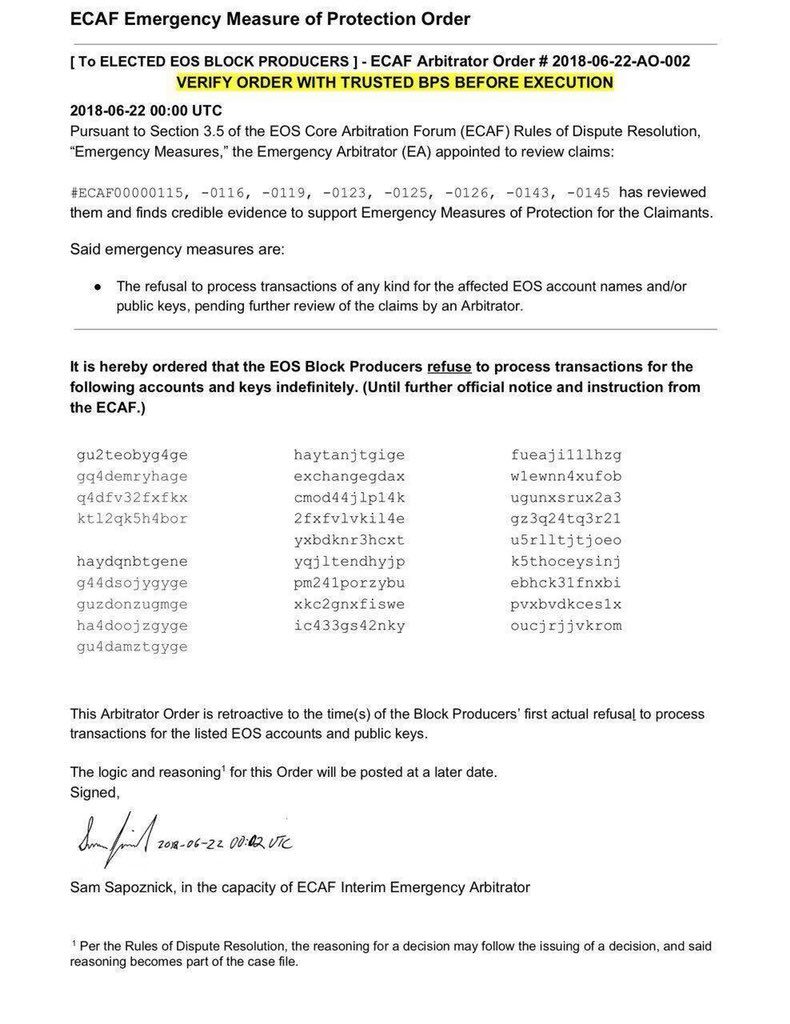
Eos decentralization questioned again as block producers freeze 27 accounts

There is no stopping for Block Producers though it violates the EOS constitution, which delegates such on-chain governance decisions to an arbitration body.

According to Article IX from the EOS constitution:

“All disputes arising out of or in connection with this Constitution shall be finally settled under the Rules of Arbitration of the International Chamber of Commerce by one or more arbitrators appointed in accordance with the said Rules.”

On both the orders, it is said: “The logic and reasoning for the order will be posted at a later date.” The block producers have controversially chosen not to disclose any reason pertaining to the frozen accounts. For the previous instance, EOS New York justified the decision by claiming they had to take these steps upon carefully reviewing the evidence. However, for the current block, no one has come forward to give an explanation.

Supporters of the move were happy to point out that these steps were necessary to keep bad actors out of EOS Blockchain. However, sceptics have pointed out that bitcoin was successful in the first place because no one had authority over it. The community has begun questioning the decentralized nature of EOS and if it is truly trustless.

On the initial ban of 7 accounts, Charlie Shrem, the founder of BitcoinFoundation compared EOS with Ripple for their centralized structure and the capacity of a small group of people having enough authority to freeze accounts. Ripple, in 2014 introduced a feature called ‘freeze’ which enables the company to stop the movement of XRP whenever they want.

When another user pointed out that these steps were necessary for mass adoption of cryptocurrencies, Shrem declared mass adoption is not worth having if it involves losing immutability.

EOS took a significant dip once the news broke out. At the time of writing the article, EOS is priced at $8.42, losing nearly 12% in the last 24 hours, which is the highest among the top 10 cryptocurrencies.

Follow us on Telegram.
Join CCN’s crypto community for $9.99 per month, click here.
Want exclusive analysis and crypto insights from Hacked.com? Click here.
Open Positions at CCN: Full Time and Part Time Journalists Wanted.
Advertisement

Eos decentralization questioned again as block producers freeze 27 accounts

Published at Sat, 23 Jun 2018 13:07:03 +0000

Altcoin News

Previous Article

EOS Decentralization Questioned Again as Block Producers Freeze 27 Accounts

Next Article

+700% IN 7 DAYS! (GPUCoin, Nullex, GreenCoin, Game com, INK)

You might be interested in …

Gameleaguecoin (gml) price alert, chart & news on bitscreener. Com

GameLeagueCoin (GML) Price Alert, Chart & News on BitScreener.com

GameLeagueCoin (GML) Price Alert, Chart & News on BitScreener.com More detail: https://bitscreener.com/coins/gameleaguecoin There is no information about this crypto. Its website is inactive. If you have any information about this coin, feel free to contact […]

Who Created Ethereum?

Who Created Ethereum?

While working on a number of bitcoin projects, a 19-year-old programmer from Toronto, Vitalik Buterin, conceived the idea for Ethereum. Ethereum was intended to be a robust platform that allows developers to build blockchain applications. Buterin was inspired by some of the shortcomings he faced when trying to build applications on the bitcoin blockchain. He believed that the potential of blockchain technology was not limited to financial applications and quickly set out to create a blockchain that could support more common computations.

Vitalik Buterin was first introduced to bitcoin and cryptocurrencies in 2011. That same year he co-founded Bitcoin Magazine and wrote many articles explaining his views on the digital currency’s future. He later worked on Mastercoin and some alternate coins based on the bitcoin codebase. This work led him to believe the bitcoin blockchain was limited in scope.

The Ethereum white paper was released in 2013, and it documented a new open-source protocol for creating decentralized applications.   

Ethereum was officially announced on the Bitcointalk forum in 2014. In addition to Buterin, Ethereum was co-founded by Mihai Alisie, Anthony Di Iorio and Charles Hoskinson. Buterin also announced that he was working with developer Dr. Gavin Wood and Joseph Lubin. Wood soon released the Ethereum yellow paper, which covered the Ethereum Virtual Machine (EVM), the runtime environment that executes all of the smart contracts on the network. Lubin would go on to found ConsenSys, a venture studio focusing on decentralized applications.

The Ethereum Foundation held an ether crowdsale in July 2014 during which they sold 60 million tokens. 12 million ether (ETH) tokens were created so the Ethereum Foundation could expand its development and marketing efforts. The Frontier was the first release of the Ethereum network. It was released a year after the crowdsale and provided a bare-bones mechanism for developers to interact with and build apps on the network.  

Both the Ethereum network and community have grown substantially over the last year. The Ethereum Enterprise Alliance, an initiative working to connect the world’s largest companies to the Ethereum network, recently announced 86 new partners including Microsoft, Intel and BP. Similarly, a multitude of new blockchain projects leveraging the Ethereum blockchain have gained attention and capital.

Ethereum broke into the mainstream in early 2017 when the price of ETH increased by 1000 percent over the course of a couple months. This led to a similar rise in the price of alternative blockchain tokens, dubbed “altcoins.” A slew of new investors quickly entered the space as Ethereum was covered by large media outlets including CNBC, Reuters and Quartz. Investors and developers are awaiting the release of Metropolis, the next update to the Ethereum network promising to abstract a lot of functions and pave the way for user-friendly application designs.

The post Who Created Ethereum? appeared first on Bitcoin Magazine.

New zcash software sets stage for 'sapling' upgrade

New Zcash Software Sets Stage for 'Sapling' Upgrade

New Zcash Software Sets Stage for 'Sapling' Upgrade The development team of the zcash cryptocurrency has released new software that contains support elements of the network’s planned Sapling upgrade, set to take place later this year. […]