The platform will bring risk trading to the forefront of exchange by addressing multiple inherent problems in today’s risk management industry.
The future is full of uncertainties. We cannot predict what will happen in the coming days, months, and years. The obvious solution to this problem is active management of risk in the forms of insurance for general public and derivative products for institutions to mitigate the effects of unforeseen circumstances.
With a global gross transaction volume of 4.8 trillion USD in 2017, the risk management industry is growing by the day. GRE is a blockchain based platform that banks on the power of decentralization and brings this industry into the future with streamlined, instant risk transfer at the touch of a button.
Current Problems in the Industry
The risk management industry is currently characterized by issues that make it very tedious and expensive to participate, and has a high barrier to enter:
High Channel Costs: The existing value chains of insurance and derivative market are plagued by intermediaries who charge a significant amount for their services, making premium or risk hedging costs very expensive.
Centralized Product Design: Insurances and derivative products are designed on similar terms, which makes them easier for mass distribution, but making people with different risks profiles hard to meet personalized needs. The homogenous risk management products fail to deliver their full potential this way.
User Data Privacy: In traditional insurance market, insured are required to submit various kinds of personal documents and information, which is stored on centralized server and is exposed to information misuse and theft.
Opaque OTC Derivative Market: OTC derivative market’s risk pricing relies on internal calculation of financial institutions, leading to distorted risk measurements and subsequently, low-value pricing for consumers.
Tedious Claiming Processing: A insurance claim made by a consumer often takes a lot of time since the insurer relies on a traditional, time consuming process of verification and then a slow monetary transfer through banks.
GRE’s Solution to the Risk Market
, as a blockchain-based platform, intends on revolutionizing how the risk management market currently works. By offering services that are efficient, more personalized, and fast claiming process, the decentralized risk marketplace gives consumers what benefit they have been deprived of for so long:
Risk contract buyer and seller connect and transact directly via GRE. Low risk trading cost by eliminating the intermediaries, using direct order matching process similar to a stock exchange but in a decentralized way.
Customized products lines as each risk is designed according to its own dynamics and is unique. This ensures maximum risk coverage to the diverse group of buyers.
Data protection thanks to blockchain’s decentralization and security makes all data encrypted and near impossible to hack into.
Instant Claims as smart contracts integrated into all risks contracts, a claim is automatically checked and if granted, the smart contract gives instant token payout to the claimant directly.
Paul Qi, Actuarial Representative of GRE, says:
“The system works by requiring insured’s premiums and insurer’s capacity remain on-chain, rather than premiums going into insurers’ pockets straightaway. Instead, premiums capacity are locked in the smart contracts from which any claims can be immediately paid out.”
The business model caters to short-term, relatively small premium products in the property and casualty side of the industry. But it also opens such customer segments to insurers, which previously would not have been able to offer these products at an affordable rate.
GRE: Roles and Stakeholders
In the GRE ecosystem, there are 5 roles, namely contract designer, insured, insurer, GRE platform and block producers:
Contract Designer – The role of the contract designer is to provide insurance expertise to GRE, which can be any individual or institution with actuarial capability. Contract designer will be rewarded a portion of the transaction fees derived from their own risk management contract based on its transaction volume.
The Insured – This group of users in the GRE ecosystem are the individuals and institutions in the real world who want to buy risk management contracts to hedge their risks. They shift their own risks away to others who are willing to take them at the cost of premiums and will be compensated when that risk actually happens.
Insurer – Insurer in GRE ecosystem can be real-world insurance companies, reinsurers and ILS(Insurance Linked Securities) investors. They accept the risks transferred by the insured, assume the risks passed on by the insured, and pay the corresponding claims when the risks occur. They provide their insurance capacity to GRE platform and are rewarded with a portion of transaction fees for providing insurance capacity and liquidity to the system.
GRE Platform – The GRE Foundation is an independent body, which will: Support the technical development of the GRE blockchain platform, selecting and introducing major partners and actively developing the GRE community. The GRE Foundation will be responsible for community development, incentives design, legal affairs and compliance, will be responsible for the design of the smart contract, allow community developers to submit the code changes and bugs, and will establish a fair and reasonable evaluation mechanism.
Block Producers / Witnesses – In the GRE platform, the block producer / witness’s job is to collect all risk transactions within a period of time, package the transaction into the block, sign the block with private key and broadcast to the whole network. They will also report the result of all risk events occurring within a block time according to oracles, and pack those results into the block, sign and broadcast to the entire network.
RISK Token for Trading
The platform utilizes an utility token for all transactions, called the RISK. GRE intends to generate 10 billion RISK tokens in total, with 40% (4 billion) tokens to be distributed to users via private and public token sale in the future.
With the token, any user on the platform can buy, sell, develop or trade a risk or venture into a secondary market of risks. Through smart contracts, the RISK tokens of buyers and sellers will be locked digitally and depending on the risk outcome (time period ends or a successful claim is settled), the platform will automatically release the tokens to the intended recipient.
The post appeared first on .
Quantum Computing has come a long way since being theorized. Qilimanjaro is ready to help take it to the next step. Quantum Computers will be able to help humanity solve problems like modelling complex chemical processes which current computers do not have the capacity to do.
Companies like Google, IBM and smaller startups are working rigorously to create the next generation of quantum computers, but there is still a long road ahead.
Qilimanjaro: Bringing the Future to You
Qilimanjaro wants to share this technology with the public to help accelerate the progress that is being made by private companies. Quantum technology is currently highly centralised, resulting in a small number of individuals having access to the technology.
Keeping such a powerful and complicated technology in the hands of few hinders the potential progression that can be made.
This is where Qilimanjaro shine, as they aim to share this technology with the world via cloud computing allowing everyday people to work with quantum computing without the need for aposition in a specific company or the financial burdens of expensive hardware.
Qilimanjaro’s Computing and Software Services
wants to provide two unique services to users: Qilimanjaro Computing Services (QCS) and Qilimanjaro Software Services (QSS). Both tools aim to share quantum technology at an affordable price for anyone to have a crack at:
The QCS was built in stages to help achieve a computing power that can reach tens of qubits which is accessible to anyone and everyone with a simple user friendly cloud platform. This platform will allow external users to form custom programs via the online editor which has all the features necessary to allow users to tailor the programs to their needs.
The QSS will aid companies, startups and individuals who want to engage with quantum algorithms to help solve problems by running and analyzing experiments on their quantum computer. QSS will assemble an operating system that can be featured on their very own Qilimanjaro Quantum computer which provides a powerful service to its users. Furthermore it will allow users to optimize existing quantum algorithms on current quantum hardware.
Qilimanjaro have also created a universal quantum open source language called Qibo which allows users to work over any quantum programming environment. This tool is key to boosting quantum technologies designed to reach a broad collective of software developers.
The post appeared first on .
Cryptocurrency exchanges have stagnated in their capacities to innovate and provide versatile trading tools, ones that are ready for the ever-advancing blockchain era are needed.
Presently, the majority of crypto-exchanges tend only to facilitate cryptocurrency trading, leaving users without many other exciting or diverse ways to spend, send and invest their accumulated cryptocurrencies.
Going beyond the norm, is raising the bar by offering a number of secure, cost-effective and innovative tools to cryptocurrency traders, businesses, merchants and consumers.
The CGCX platform has bundled together four modules that when put together, completely transforms how the world will engage with cryptocurrencies.
CGCX: 4-in-1 Features
Exchange: This part of the platform is a 24/7 cryptocurrency hybrid exchange offering a broad and growing range of cryptocurrencies, fiat and other assets. Additionally, the exchange is loaded with state-of-the-art security, bot prevention and IP flagging as well as real-time settlements of financial instruments.
The exchange also offers a versatile range of order types and innovations; furthermore, the exchange has multiple and competitive fiat to cryptocurrency exchange rates, which include: Euro (EUR), US Dollar (USD), Korean Won, Singapore Dollar (SGD) and more.
Merchant Tools: Merchants who wish to accept cryptocurrency can now do so simply and easily; with the CGCX Merchant payment system, e-commerce businesses can use the CGCX plugin or API which contains features such as:
Multi-Currency Conversion
Integrated exchange rates
Know your customer
Reports & Analytics
ICO Listing: Initial Coin Offerings are extremely popular investment opportunities but often have issues with ease of access; the CGCX community will be in control of which ICOs make it on to the platform, making CGCX a launchpad for new cryptocurrencies.
Smart Contracts: Smart contracts will be the fourth module in the CGCX platform that brings speed and cost-effectiveness to all trades that occur on the platform. Self-executable trades and settlements trigger once the conditions of the contract are met, speeding up turnaround times and saving money.
The CGCX exchange is also insured against cyber attacks; all tokens held within wallet son the exchange are protected, relieving CGCX wallet owners of concerns regarding how their cryptocurrencies are stored.
The team behind the exchange has decades of collective financial and blockchain experience, and understand that the exchange should cater towards the needs of those who are worried about cyber-security as well as that of newcomers seeking to purchase their first bitcoin, or larger institutional investors who seek to trade larger than average amounts and volumes.
CGCX Token Sale and Token Economics
The platform will have its own utility token aptly named CGCX; the ERC20 compliant token supports all Ethereum (ETH) wallets. A quantity of 1 Billion CGCX tokens will be offered, which is 50% of the total issuance volume of 2 Billion. CGCX tokens will be priced at 1 ETH per 8500 CGCX tokens.
The token Pre-Sale is live with a 20% bonus ending May 25th, 2018, and the Main Sale begins June 1st, 2018 and ends June 30th, 2018. The token is a vital part of the platform’s ecosystem; the tokens can be used as the payment for transaction costs of trades and earn discounts on transactions fees as detailed below:
Year 1 = 50% Discount
Year 2 = 25% Discount
Year 3 = 15% Discount
Year 4 = 6.5% Discount
Year 5+ = 5% Discount
The post appeared first on .

After delving into the world of cryptocurrencies one can see that good majority of digital asset proponents are big fans of privacy and anonymity. Just recently a spreadsheet document was published that lists the top privacy-centric coins and the various differences between them. The paper called “Privacy Coin Matrix,” allows enthusiasts to see a comprehensive list of cryptocurrency networks that focus on promoting financial privacy.
Also read:
Introducing the Privacy Coin Matrix
A Google Docs’ spreadsheet has been recently published on the wide variety of cryptocurrencies that aim to bolster financial anonymity. The paper is very comprehensive and includes various details about each coins’ attributes strewn across a very long spreadsheet. Coins that are present in the include bitcoin Core (BTC), Monero (XMR), Zcash (ZEC), Dash, Verge (XVG), PIVX, bitcoin Private (BTCP), and more. There are a total of twenty cryptocurrencies listed, alongside some relatively unknown coins like Zoin (ZOI), and Colossus Coin (COLX). There are a bunch of privacy-centric coins missing from the list as well such as anon tokens like Boolberry (BBR), and bitcoin Dark (BTCD).
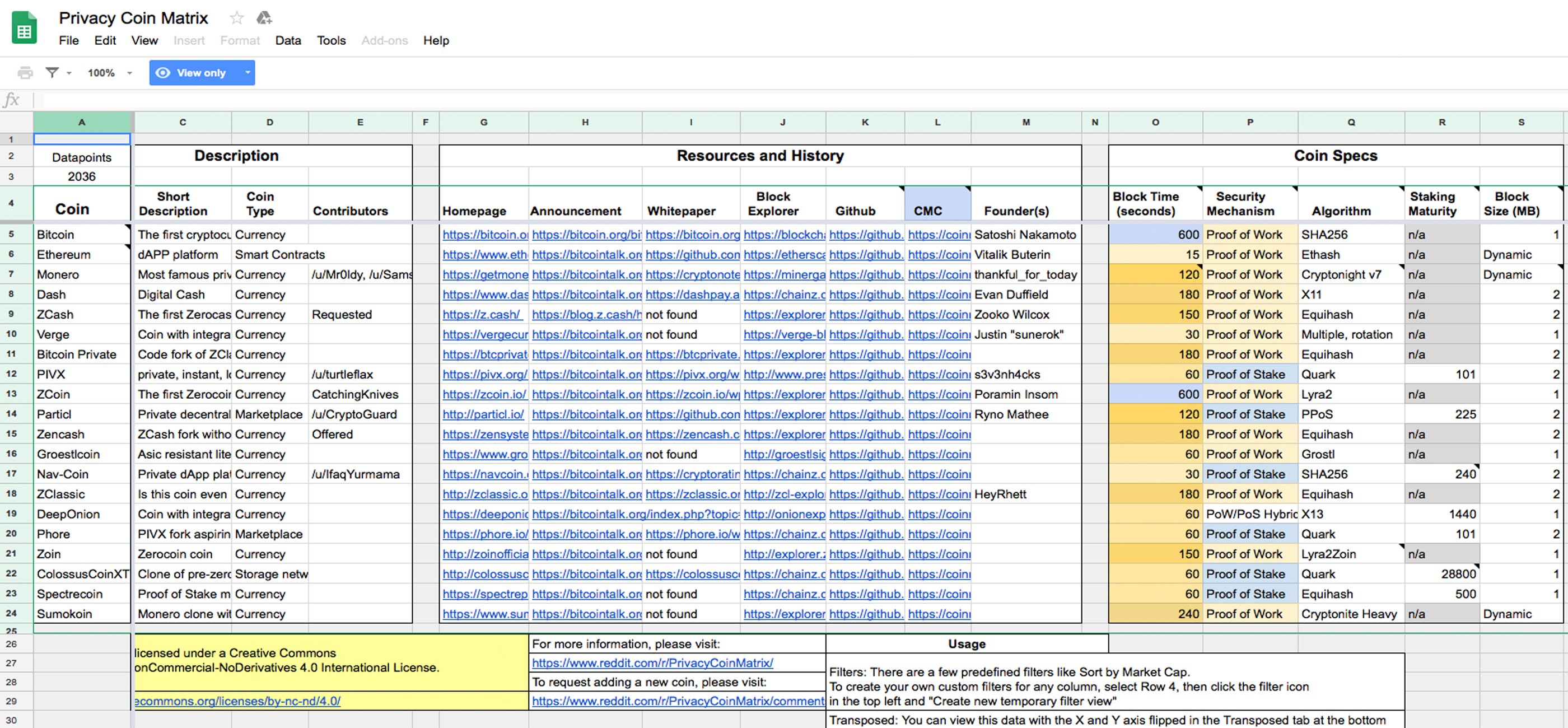
There are fourteen separate sections that distinguish each coin such as the asset’s summary, features, resources, trading, supply and distribution, wallets, and privacy benefits. With each section summarizing the protocols’ features it can give a reader an in-depth look at how much privacy these networks actually give to users. For instance, in the ‘privacy’ section, readers will likely get the most information concerning anonymity methods. Both bitcoin Core (BTC) and Ethereum (ETH) mentioned in the list fail miserably when it comes to nearly everything privacy related.
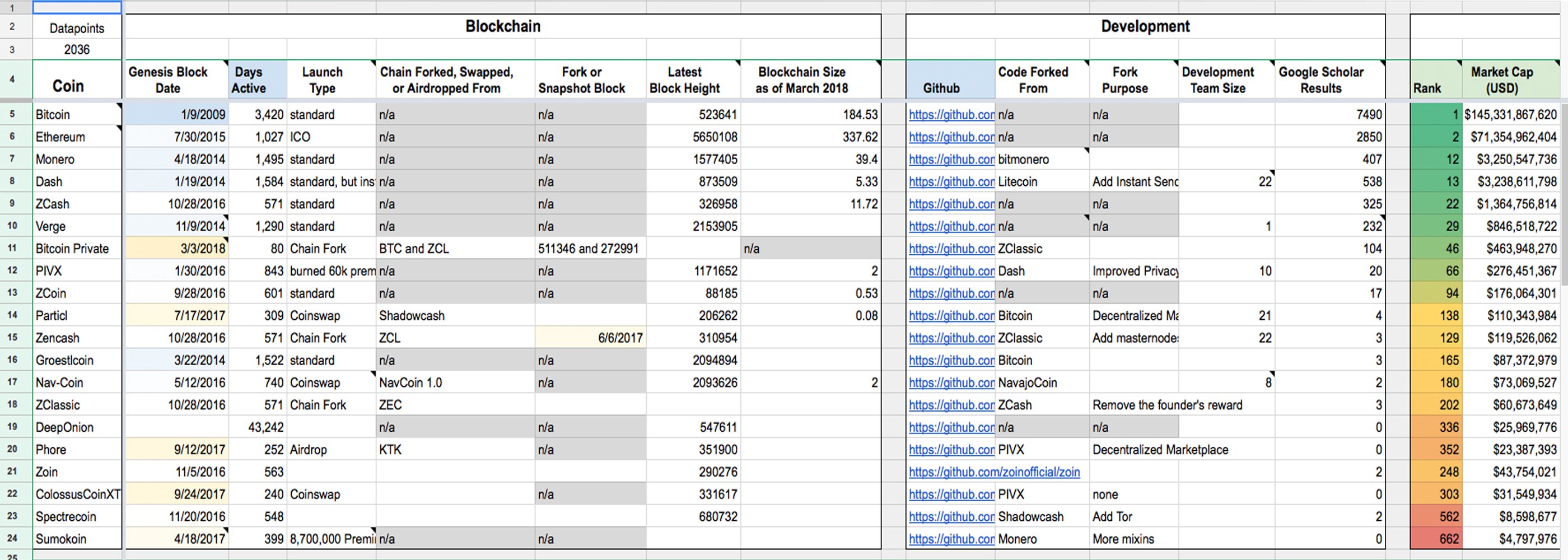
Some Coins Offer Very Little Privacy, Scaling is Dependent on Unfinished Second Layer Solutions, and Others Have No Wallet Support
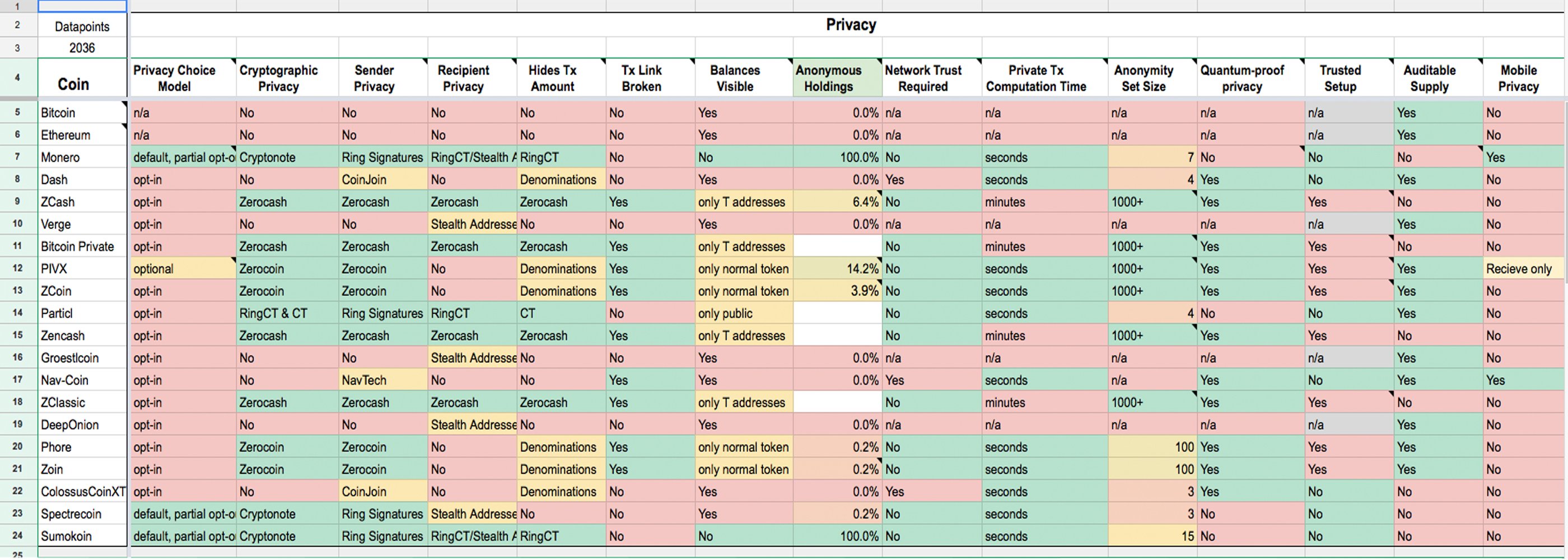
The lists details that other coins such as Monero, Zash, Particl, bitcoin Private, Zencash, Zclassic, and Sumocoin obfuscate a recipient, and a senders’ transactions with certain features. Anonymity protocols these coins use are methods like ring signatures, stealth addresses, and zsnarks (zerocoin). According to the Matrix spreadsheet many of the other coins mentioned like Dash, and Colossus show no cryptographic privacy, and they depend on techniques like Coinjoin. Further, the list also details whether or not the coins have an auditable supply and a trusted setup.
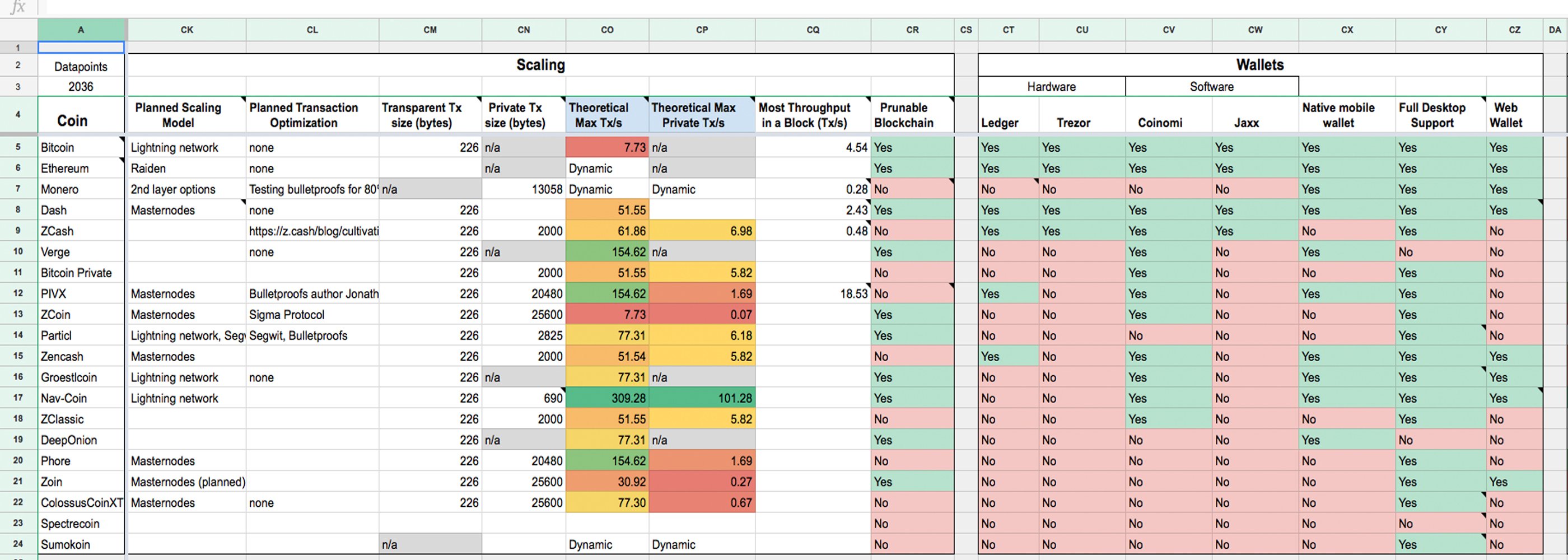
The coins’ ability to scale is also a section worth reading as it shows which cryptocurrencies have begun to scale through forks, and others waiting on technologies like Lightning to come to fruition. Other technologies mentioned in the scaling section include masternode protocols, bulletproofs, and other second layer options. Lastly, some of the coins mentioned have wallet implementations across most clients created within the industry, while other coins have very little wallet support making utility very difficult for coins like Phore, Zoin, Colossus, Spectrecoin, and Sumokoin.
Matrix List Cuts Through the Anon-Coin Hype
Besides this list, there are more anonymity focused cryptocurrencies in existence that claim to provide significant privacy for users utilizing these networks. However, the Matrix spreadsheet cuts through all the anon-coin hype, headlines, and shilling taking place across the web by separating features, attributes, and facts, into a list of things cryptocurrency proponents care about.
What do you think about the Privacy Coin Matrix spreadsheet? Are there privacy coins that you didn’t see mention in the Matrix list? Let us know your thoughts on this subject in the comments below.
Images via the Matrix, The Wachowski Brothers, and the Matrix spreadsheet.
Do you agree with us that bitcoin is the best invention since sliced bread? Thought so. That’s why we are building this online universe revolving around anything and everything bitcoin. We have a. And a. And a, a and real-time .
The post appeared first on .
