Crypto Market Tumbles: EOS, Tron (TRX), BTC Cash, ADA Price Analysis
The total crypto market cap made a sharp U-turn and declined below the $115.00 support.
EOS price is down around 5% and it broke the $2.45 and $2.40 support levels.
bitcoin cash price is under pressure and it recently broke the $125 support level.
Tron (TRX) price failed to stay above the $0.0250 support and it could revisit $0.0220.
Cardano (ADA) price declined more than 6% below the $0.0450 support level.
bitcoin and the whole crypto market fell sharply in the past few hours. , Ethereum, , EOS, BCH, ADA and altcoins are currently under a lot of selling pressure.
bitcoin cash price failed to stay above the $130 support level and recently started a sharp decline against the US Dollar. BCH/USD declined below the $126 and $125 support levels to move into a bearish zone. The price is down around 5.5% and it may continue to move lower towards the $120 or $118 support levels.
If there is an upside correction, the previous supports near the $125 and $126 levels may now act as barriers for buyers in the near term.
EOS, Tron (TRX) and ADA Price Analysis
EOS price is down around 5% after it failed to gain pace above the $2.65 resistance. The price declined below the $2.50 and $2.40 support levels. The next key support is at $2.30 where buyers are likely to emerge.
Tron price trimmed most of its and declined below the $0.0260 and $0.0250 support levels. TRX price is down 3.5% and it seems like it may continue to decline towards the $0.0220 support.
Cardano price fell more than 6% after it broke the $0.0460 support. ADA price is now trading near the $0.0430 level, with an immediate support at $0.0420. The next major support is at $0.0412, followed by $0.0405.
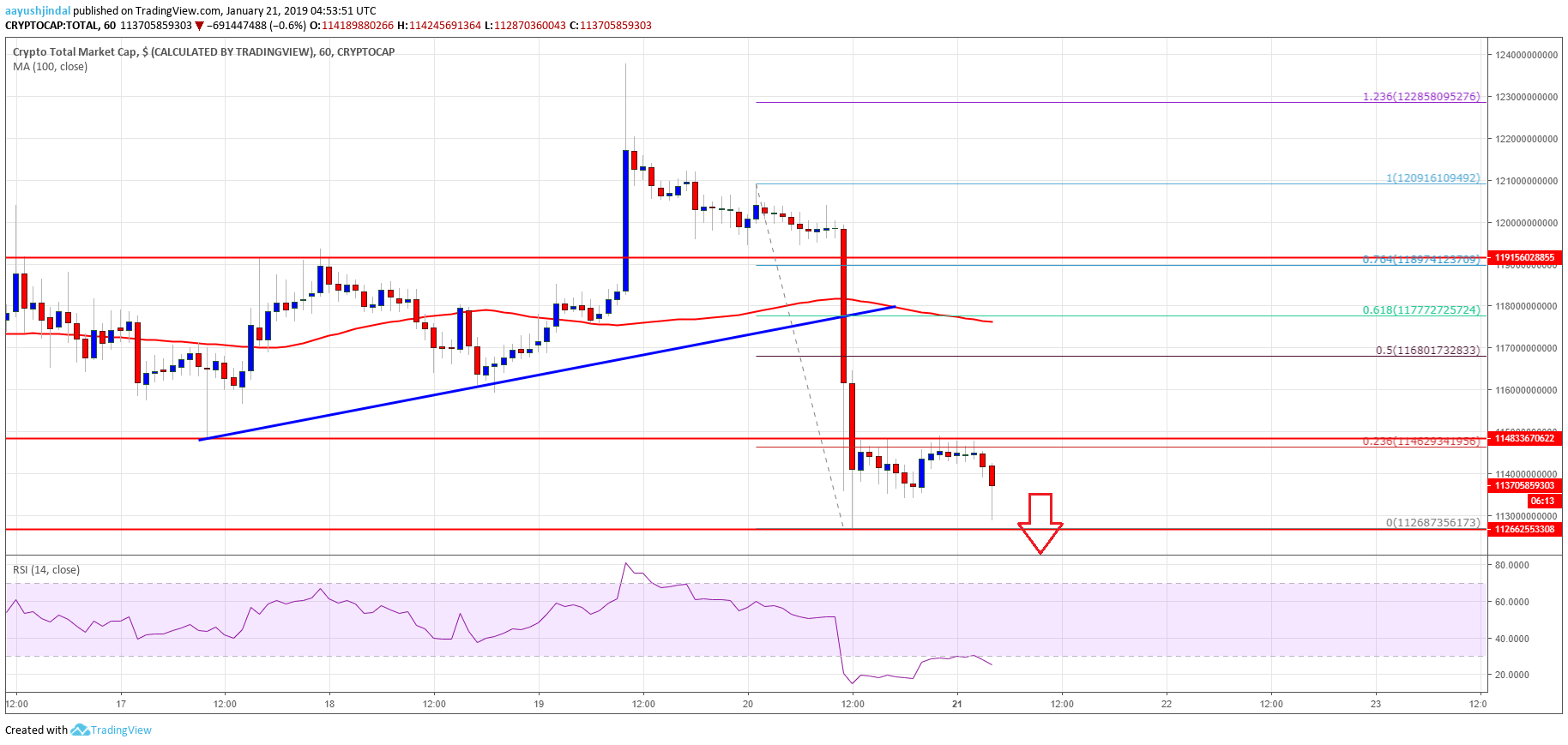
Looking at the total cryptocurrency market cap hourly , there was a sharp downside reaction from well above the $122.00B level. The market cap dipped sharply below the $120.00B support and a major bullish trend line on the same chart. It opened the doors for more losses and the market cap reached the $112.00B support level. There may be a short term correction, but upsides in BTC, , tron, litecoin, EOS, ripple, XLM, IOTA and other altcoins remain capped.
Okay bitcoin, is it going to be 4200 or 5200? Part 7 What a sick move today, Saturday manipulation at it’s best. This market is just so easy for these people when volume is low. […]
Innovative technology companies are leveraging blockchain technology to build next-generation business models and Content Delivery Networks (CDNs) for video streaming, a multibillion-dollar industry that continues to grow. According to data revealed by Theta Labs, one of the companies covered below, the video content and streaming market accounts for 67 percent of current internet traffic and could reach 82 percent by 2020. The new players promise to decentralize global video streaming, while at the same time making it more efficient.
LBRY
According to Jeremy Kauffman, co-founder and CEO of the blockchain-based content distribution platform , blockchain technology could transform the monetization of online content by altering the way that creators get paid, and .
The LBRY protocol allows creators to publish online, making their content discoverable with a small payment in LBRY’s own cryptocurrency token. Viewers pay creators in LBRY tokens to see their work.
“[Blockchain technology] allows us to build technology that’s owned by the users rather than any one party,” Kauffman . “That’s the problem that blockchain [technology] solves.”
Kauffman explained that under the LBRY model, creators are paid without an intermediary taking an inappropriately large cut. Since LBRY is a protocol, the company can’t control what gets discovered.
Kauffman said that LBRY recruited 4,000 YouTubers in specifically targeted demographics, several of which have 500,000 or more subscribers, which seems a good first step toward challenging YouTube in its own turf.
Theta Labs
YouTube’s co-founder Steve Chen himself, as well as Justin Kan, co-founder of Twitch, are among the advisors of , a subsidiary of live video streaming company , which is announcing a new blockchain-based decentralized video streaming network.
“Theta’s innovation is set to disrupt today’s online video industry much in the same way that the YouTube platform did to traditional video back in 2005,” said Chen. “One of our biggest challenges had been the high costs of delivering video to various parts of the world, and this problem is only getting bigger with HD, 4K and higher quality video streams. I’m excited to be part of the next evolution of the streaming space, helping Theta create a decentralized peer-to-peer network that can offer improved video delivery at lower costs.”
Theta is developing a new blockchain-based network, outlined in the , which could enable users worldwide with unutilized PC bandwidth and resources to cache and relay video streams to others in the network, while mining Theta tokens at the same time, similar to bitcoin and Ethereum. According to the company, the new peer-to-peer decentralized network will allow for much more efficient, high-quality streaming without the need to develop expensive content delivery network infrastructure.
In December, Theta will implement its first generation of ERC20-compliant tokens on the SLIVER.tv platform. These application tokens can be used for virtual gifting and incentivizing streamers. Eventually, these ERC20 tokens will be 1:1 exchangeable for native Theta tokens when the new blockchain launches at the end of 2018.
“We’ve been on the cutting edge of live streaming technology, and by leveraging blockchain [technology] we will truly be able to transform the video and entertainment industry,” said Mitch Liu, co-founder and CEO of Theta Labs. “Theta will be uniquely built to leverage the incentive mechanisms of the blockchain, enabling end-users to contribute their excess PC bandwidth and resources to relay video streams to others and earn Theta tokens at the same time. It’s a win-win for all stakeholders in the ecosystem.
“We’re committed to solving the challenges of today’s video streaming industry,” Liu told bitcoin Magazine. “We think there’s a huge opportunity to democratize the video delivery infrastructure, to reward end users with excess PC resources and bandwidth to help stream to their neighbors and friends.”
“I think the Theta team is going to revolutionize video delivery with its new native blockchain,” Theta advisor and CEO told bitcoin Magazine. “I’m thrilled to be part of this innovative, organic platform to decentralize streaming. This will impact a number of industries from esports to advertising, benefiting our esports fans as well as influencers and content creators. I can see how Theta’s peer-to-peer mesh network will empower our G FUEL community, rewarding them with Theta tokens when they help stream to others in the network.”
Stream
Another new video platform, , has received $5 million to back its Ethereum-based Stream Token in an advisor round of funding led by blockchain investment firms including Pantera Capital, Fenbushi Capital and CoinFund, as well as individual participants like Jed McCaleb, David Johnston and Andrew Yashchuk.
Founded by , Stream wants to facilitate direct transactions between content creators and consumers with a zero-fee structure. Yu was a successful early cryptocurrency investor who became an internet celebrity with videos that received tens of millions of views. In 2011, Yu left his studies at Harvard and accepted a $100,000 , like Ethereum creator Vitalik Buterin before him, eventually launching and Stream.
The Stream Token to allow digital media creators to earn a fair living from their work, without being exploited by streaming platforms that take unreasonably large shares of their revenue. It is also designed to free content creators from the strictures of advertising models that limit creativity and freedom of expression.
“Stream Token is part of the larger Silicon Valley movement to fulfill the original intention of the internet: universal access to information. We can finally reward those who share information without curtailing freedom of expression. Content creation doesn’t have to be a zero sum game,” said Greg Kufera, CTO of Stream. “And we’re ensuring it won’t be.”