November 20, 2026

Capitalizations Index – B ∞/21M

CoinMarketCap Crypto Assets Now Feature Flipside Letter Grades

Coinmarketcap crypto assets now feature flipside letter grades

CoinMarketCap Crypto Assets Now Feature Flipside Letter Grades

Blockchain analytics startup Flipside Crypto is bringing crypto asset letter grades to a slew of online publishers.

The Fundamental Crypto Asset Score (FCAS) metric – which evaluates factors such as developer activity and a broad set of transaction data – was recently added to CoinMarketCap, along with publishers such as MarketWatch, TheStreet and Stocktwits. The move comes ahead of the launch of CoinMarketCap’s first Android app, scheduled for April.

Carylyne Chan, head of global marketing at CoinMarketCap, told CoinDesk these easy-to-use metrics will give users a more transparent view of how these assets are evolving. According to Chan, the site attracted 125 million repeat visitors in 2018 alone.

She added:

“If I’m a new user coming in with more tools and fundamental analysis like FCAS, the focus will be more holistic as opposed to only looking at the front page with the price.”

Plus, she added this partnership is part of a broader push to add educational content to CoinMarketCap, such as explainers about blockchain technology and how different groups like developers impact the ecosystem.

“It will be a good addition to the price and market data that we already have there,” Chan said. “There is a wider scope of collaboration that we’ll be working on with [Flipside Crypto].”

Flipside raised a $4.5 million seed round last November and has since launched several products with different types of analysis. These include a portfolio tracker for crypto hedge funds and professional investors, the Hubble Monitor for companies and projects seeking to understand how users interact with their blockchain network, and the Coin Health Library for retail consumers looking for a deeper look at how the FCAS score is calculated and how more than 450 assets grow over time.

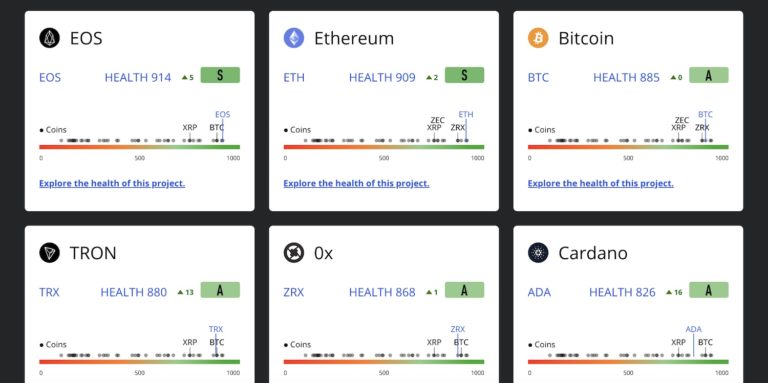
According to Chan, the most popular asset pages from 2018 include XRP, bitcoin, Tron and ether, all of which have relatively high FCAS ratings.

Flipside Crypto CEO Dave Balter told CoinDesk that, while dynamic FCAS ratings change according to live input from external exchanges and websites like GitHub, he estimates that only around 18 projects have high ratings like “Superb” or “Attractive.” (The “S” grade is actually higher than the “A” grade, differing from, say, your high-school report card.)

Roughly 350 projects have the lowest rating, “F” for “Fragile.”
Coinmarketcap crypto assets now feature flipside letter grades

The six highest-ranking tokens under the FCAS system. (Screenshot)

Balter said he hopes FCAS will someday become comparable to the price-to-earnings ratio used to analyze traditional stocks.

“Let’s look at crypto projects as if they were sophisticated businesses,” Balter added. “2019 is all about helping the market understand how to evaluate these assets beyond price.”

Indeed, MarketWatch general manager Dan Shar told CoinDesk that compared to traditional asset classes, readers often find cryptocurrency has “the least holistic view in terms of being able to compare these assets to each other.”

Now by listing the top 10 assets, as ranked by FCAS, in addition to the FCAS score on articles and pages related to a specific cryptocurrency, Shar said publishers like MarketWatch can strive to offer “as many tools and actionable insights as possible” for more sophisticated investment choices.

Image of co-founders, left to right, Dave Balter, Eric Stone and Jim Myers via Flipside Crypto

Published at Mon, 18 Mar 2019 20:30:24 +0000

Previous Article

Anti-Euro Bitcoin Art Pops Up in Paris Amid Protests

Next Article

Swiss Post’s Cryptographic E-Voting System Allows for Vote Manipulation Claims Research

You might be interested in …

Blockchain & Artificial Intelligence: Money of the Future?

Both artificial intelligence and blockchain technology have made major advances in the past few years. Could they be combined to bring us the money of the future?


Artificial Intelligence

Recently, many advances have been made in the field of artificial intelligence. In the past few years, we saw artificial intelligence beat one of the world’s best players at Go, save drivers from car crashes, and predict the outcome of the US Presidential Election.

Google Home & Amazon Echo

Many companies, both established market leaders and new startups, have started to incorporate artificial intelligence into mainstream products. AI technology can be found in voice and home assistants, such as Siri, Google Home/Assistant, and the Amazon Echo. These companies use artificial intelligence in different ways, including making predictions, voice recognition and image recognition.

AI in Finance

More and more, financial firms are turning to machines to replace humans at jobs that they have done for decades. Many wealth management firms already employ robots and artificial intelligence software to trade and invest for their customers. This is because computers are much quicker than humans at competing in a market where nanoseconds count. A slight delay could mean an entirely different outcome.

bitcoin price

This type of trading activity isn’t just limited to traditional financial markets. Artificial intelligence is also starting to be used in bitcoin and altcoin markets. This is extremely prevalent in altcoin markets wheremany bots and AI trading software are used to take advantage of price fluctuations.

However, this isn’t the only use case for artificial intelligence technology in financial and bitcoin applications.

Mobile Banking for the Unbanked

One new platform called Humaniq aims to bring banking services to those who lack access, especially for people in developing countries.

The platform is built on top of the Ethereum blockchain as a variety of smart contracts; but with a twist. Instead of requiring ID/Passport Verification like most bitcoin exchanges, the aim is to simply verify a user’s identity using artificial intelligence.

Bitcoinist_privacy

Users will be prompted to verify their identity when they start using the Humaniq system. However, only simple tasks need to be completed for this. Identity Verification would only consist of doing something very simple, such as taking a quick picture of themselves, or by reading a short piece of text. Voice and Image Recognition technology powered by artificial intelligence would then be able to quickly confirm their identity without any hassle or delay.

This could potentially be a huge step forward for citizens in developing countries integrating themselves into the global economy. Seeing that it’s currently estimated that there are more than 2.5 billion unbanked in the world, many stand to benefit from such a platform.

[Note: This is a sponsored article provided by Humaniq] 

Could Humaniq’s implementation be a real game-changer? Let us know your thoughts below!


Images courtesy of PC Magazine, Shutterstock

The post Blockchain & Artificial Intelligence: Money of the Future? appeared first on Bitcoinist.com.

Inheriting bitcoin: proper estate planning and key management crucial

Inheriting Bitcoin: Proper Estate Planning and Key Management Crucial

Securing Your‍ Digital Wealth ⁤ For maximum⁢ security,⁤ consider a ⁢multi-layered approach⁤ that includes both digital and legal ⁤strategies. Setting up a ⁤digital⁤ vault or a ‍password manager specifically tailored for cryptocurrencies is a practical […]