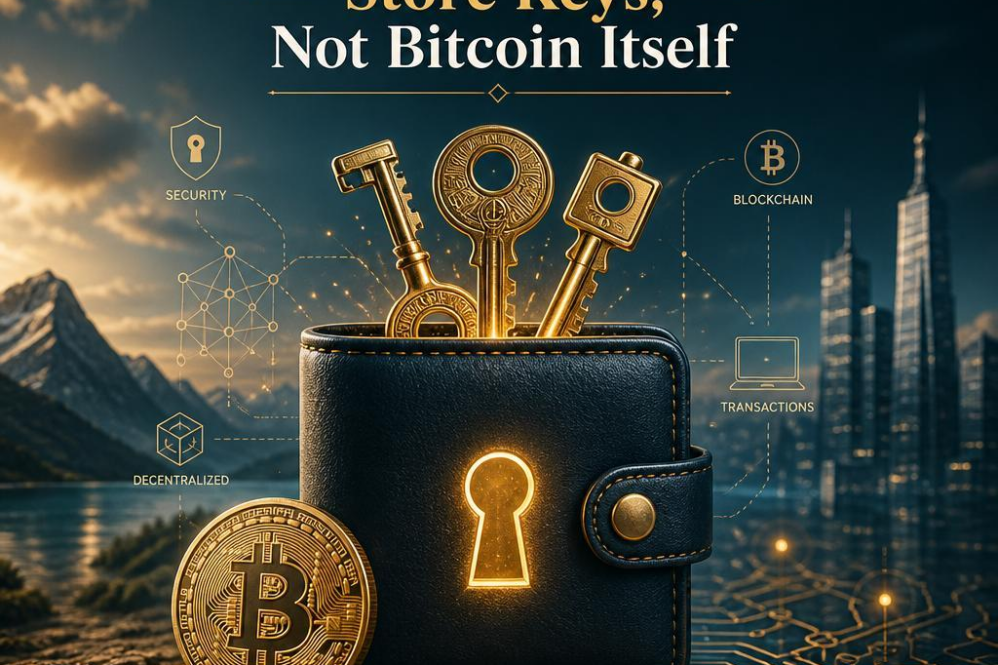
bitcoin wallets hold keys,not coins
It is indeed easy to picture a bitcoin wallet as a digital version of a physical wallet: something that holds coins until you spend them. That image is useful up to a point, but it is not quite how bitcoin works.
A bitcoin wallet stores private keys, not actual bitcoin. The bitcoin itself is recorded on the blockchain, a shared public ledger.What your wallet holds-or helps create and protect-is the information needed to prove that you can spend bitcoin associated with certain addresses.
Your public address is the part you can share with other people so they can send bitcoin to you. Your private key is the secret that authorizes spending. When you make a payment, the wallet uses that private key to create a digital signature for the transaction. The bitcoin network verifies the signature, then records the new transaction on the blockchain.Nothing is physically transferred from one wallet file or device to another.
That distinction matters because access to bitcoin depends on control of the relevant keys. If someone gets your private key, they might potentially be able to spend the bitcoin tied to it. If you lose the key and have no backup, you may lose access permanently.
How keys prove control
bitcoin relies on cryptography rather than accounts managed by a bank. A wallet creates or manages a private key,which is a secret piece of data. From it, the wallet can derive public information, including addresses used to receive bitcoin.
When someone sends bitcoin to one of your addresses, the blockchain records spending conditions for that amount. To spend it later, your wallet must create a transaction that meets those conditions, usually by signing it with the appropriate private key. bitcoin nodes can verify that signature without ever seeing the private key itself.
In everyday terms, the public address tells people where they can send bitcoin. The private key proves that you have the authority to spend it. The resulting digital signature is the network’s evidence that the transaction was approved by whoever controls that key.
This is why “ownership” in bitcoin is really about practical control. If you can produce the required valid signature,you can move the bitcoin. If you cannot, the balance may still appear on the blockchain, but it is not available for you to spend.
what a recovery phrase does
A recovery phrase, frequently enough called a seed phrase, is a readable backup for a wallet’s private keys. It is usually a sequence of words that can restore the wallet on compatible software or hardware if your phone, computeror wallet device is lost, damagedor replaced.
The phrase does not contain bitcoin. It restores the keys that give you control over bitcoin recorded on the blockchain. In many setups, that makes it even more crucial than the device itself. A broken hardware wallet can be replaced; a lost recovery phrase may not be recoverable.
Treat a recovery phrase more like the master key to a safe than an ordinary password. Anyone who has the words, in the correct order, may be able to restore the wallet elsewhere and move the funds. Do not share it with support staff, enter it on a websiteor keep it in a screenshot, email draft, cloud noteor other casual digital storage.
Choosing a wallet type
Choosing a wallet is largely a question of who controls the private keys and how much responsibility you want to take on yourself.
A hardware wallet keeps private keys on a dedicated device and signs transactions there,rather than exposing the keys directly to an internet-connected phone or computer. It can be a practical choice for bitcoin you do not plan to spend often. The device is not the backup, though: the recovery phrase is what lets you restore access if the device is lost or fails.
Software wallets run on a phone, desktop computeror browser. They are convenient for receiving payments, checking balancesand making routine transactions, but thier security depends on the device and on your habits. Keeping the device updated, using a strong passcodeand protecting the recovery phrase all matter.
| Wallet type | Key control | Best suited to |
|---|---|---|
| Hardware wallet | you hold the keys offline | Longer-term storage |
| Software wallet | you hold keys on your device | routine payments and access |
| Custodial wallet | A company holds the keys | Convenience and exchange use |
with a custodial wallet, such as an account on many cryptocurrency exchanges, the provider holds the keys and processes withdrawals for you. This can be convenient, especially if account recovery is important to you. The trade-off is trust: you depend on that company to secure the assets, honor withdrawals, and remain operational. You may have an economic claim to the bitcoin, but you do not directly control the keys that spend it.
There is no single right setup for everyone. What matters is understanding the trade-off. Self-custody gives you direct control,but it also makes you responsible for backups and recovery. Custody through a company can reduce that burden, while introducing reliance on a third party.
Protecting your keys
Private keys and recovery phrases deserve serious care. bitcoin transactions are generally irreversible, so there is rarely a way to undo a transfer after someone with access to your wallet sends funds away.
- Write the recovery phrase down offlineand check that every word and its order are correct.
- Keep backups somewhere private, durable, and protected from theft, fireand water.
- never enter your recovery phrase into a website, chat, email, support formor unexpected software prompt.
digital copies can create more ways for a phrase to leak. Screenshots, cloud storage, plain-text files, and email drafts may be exposed through malware, account compromise, synchronizationor simple accidental sharing. A hardware wallet can help protect private keys during everyday use, but it does not remove the need to secure the recovery phrase.
be especially wary of messages saying that your wallet needs to be “verified,” “upgraded,” or “restored” by entering your recovery words. Legitimate support teams do not need your seed phrase. Once you give it to someone else, you should assume they can take control of the wallet.
It is indeed also worth thinking ahead. If something happens to you, can the right person find clear instructions? That does not necessarily mean giving someone immediate access while you are alive. It means having a purposeful plan rather than leaving recovery to guesswork.
If the keys are lost
If you lose a phone, computeror hardware wallet but still have the recovery phrase, you can usually restore the wallet on a new compatible device. Losing a password may also be recoverable, depending on the wallet and whether you still have the recovery information.
The situation changes if both the private keys and every usable backup are gone. The bitcoin does not disappear from the blockchain. It can still be visible at its address, but no one can create the signature needed to spend it. In practical terms, those funds are inaccessible.
bitcoin has no central support desk that can reset a private key or reverse a loss. That independence is part of the system’s design, but it makes careful backups essential. A wallet is not a container full of coins; it is indeed your means of proving control over them. Protect the keys, protect the recovery phrase, and make sure you understand where that responsibility sits.