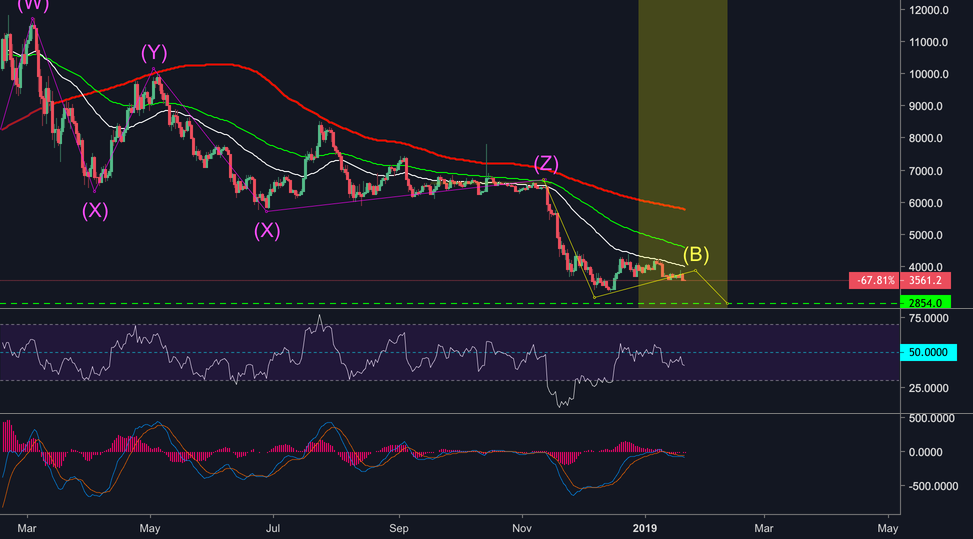
Morning people, been a while since I have published anything, but I have been chillin whist this all played its game. First BAKKT delay really made me sit back and give it time as we were all p*ss$d of about that happening….Anyway:
I am anticipating a drop again mainly because on the 4hr chart the has swung down after its 3 bumps up, which never broke us above last weeks levels. I am setting a buy order myself to add some at this lower level when it gets around that $2,800 area.
Also to back that up if this is the last correction wave in the entire bear market (which would make it the 3rd and last in grand scale), it would make a pattern, and than that means we are at the bottom… to start bear market 2018, ZIG ZAGGY pattern in the middle to late 2018, and to finish this bastard off.
I will be putting up a website soon showing my profits and losses as 2019 goes along, displaying , cash on hand and where that money is sitting…so stay tuned. My tactic from here on out is to just add each month on key levels as it stays low and lower (if thats possible), having those buy orders sitting in the book waiting to be eaten up.
Holding cryptocurrency is all very well, but these days it hardly seems to be used to pay for anything. Merchant uptake is slower than the momentum needed to reach the mainstream. The merchants still take cash, but transferring between the two is an extra step that we could do without. Paycent may just be the crypto-fiat bridge we are looking for, with a whole host of other benefits too.
[Note: This is a sponsored article.]
What is Paycent?
Paycent is, in essence, a mobile payment system. It functions as a dual e-wallet which can be funded by both cryptocurrencies and fiat within the same app. It also allows conversion from crypto to fiat and vice-versa, in real time and from within the wallet, acting as an internal exchange.
Over a thousand online merchants and counting already accept Paycent as a method of payment. However, the option of having a debit card linked to your wallet opens up 36 million points of sale in over 200 countries. This includes withdrawing local currency from ATMs worldwide.
Paycent already has an established fiat network and is collaborating with mainstream financial institutions and governmental regulators, to both expand this network and push into the world of cryptocurrencies.
They already have regulatory licenses in UAE and the Philippines, along with approval in principal in Hong Kong and Singapore. Negotiations are also underway to host the Paycent Realtime Exchange in Dubai, with the oversight of the Central Bank of UAE.
In addition to this, Paycent is in tier 2 talks to acquire a physical banking presence in the Philippines. Paycent would function as the online channel for the bank, providing financial services to the unbanked.
They are also in advanced talks with Egypt and Jordan to develop and host a unified digital payment infrastructure for their banking and government services.
Why should I invest?
Investors in the ICO starting on November 2nd will receive PYN tokens. Holders of these tokens will receive rewards paid in ETH. These rewards will initially be paid quarterly and are as follows:
33% of the aggregate exchange rate profit for crypto to fiat and fiat to crypto, converted using the Paycent dual e-wallet.
33% of the total interest profit on microloans to Paycent lenders.
Users of the Paycent Debit Card will also receive an additional 0.1% of each spend in PYN tokens. Investors of 100 or 500 ETH or more are eligible for special debit cards which increase these loyalty rewards to 0.5% and 1% of each spend.
These ‘cash-back’ reward tokens will create a secondary distribution of PYN tokens, creating an open market for PYN, with price support and increase.
Token Sale is getting nearer and we want you to be informed! These are the recommended wallets:
— Paycent (@PaycentGlobal)
How can I invest?
Paycent already concluded their pre-ICO, reaching the hard cap of 22,500 ETH in 10 days. Around 857 contributors took part from over 41 countries.
The main ICO is being held in 8 separate phases over the course of four years. There is a minimum investment purchase of 15 PYN and investors can participate using Ethereum, bitcoin, or Litecoin.
The first phase of the ICO begins on November 2, 2017, at 9 am Singapore time (UTC+8) and will last until November 30, 2017, or until the Phase 1 hard cap of 30 million PYN has been reached.
Bonus incentives are being given to encourage participation:
First 24 hours: 27% bonus PYN
Days 2 – 4: 18% bonus PYN
Days 5 – 7: 12% bonus PYN
Subsequent ICO phases are scheduled as shown below, with existing token holders receiving generous bonuses:
Phase 2 (Last week of May 2018)
Hard cap: 35 million PYN
25% bonus to PYN token holders
Phase 3 (2nd week of November 2018) Hard cap: 35 million PYN
23% bonus to PYN token holders
Phase 4 (Last week of May 2019) Hard cap: 35 million PYN
21% bonus to PYN token holders
Phase 5 (2nd week of November 2019) Hard cap: 35 million PYN
19% bonus to PYN token holders
Phase 6 (Last week of May 2020) Hard cap: 30 million PYN
17% bonus to PYN token holders
Phase 7 (2nd week of November 2020) Hard cap: 30 million PYN
15% bonus to PYN token holders
Phase 8 (2nd week of November 2018) Hard cap: 22,045,000 PYN
13% bonus to PYN token holders
For more information about Paycent please visit .
Do you think a ‘bridge’ between cryptocurrencies and fiat currency is something that the crypto community needs? Let us know in the comments below.
Blockchain on Medium [ Aplicações de Blockchain ] Rede Social: Steemit – Sua voz vale algo Iniciamos hoje uma série para falar de aplicações reais da blockchain já existentes em nosso dia a dia, elas […]
Stellar Price Moves up as $0.09 Should be an Easy Target It is always complicated to make sense of cryptocurrency markets during the weekend. bitcoin seems to be recovering slightly, yet the top markets remain […]