Bitcoin Price Watch: BTC Could Rally Above $4,000 If It Breaks $3,900
bitcoin price declined sharply below the $3,750 support and tested $3,650 against the US Dollar.
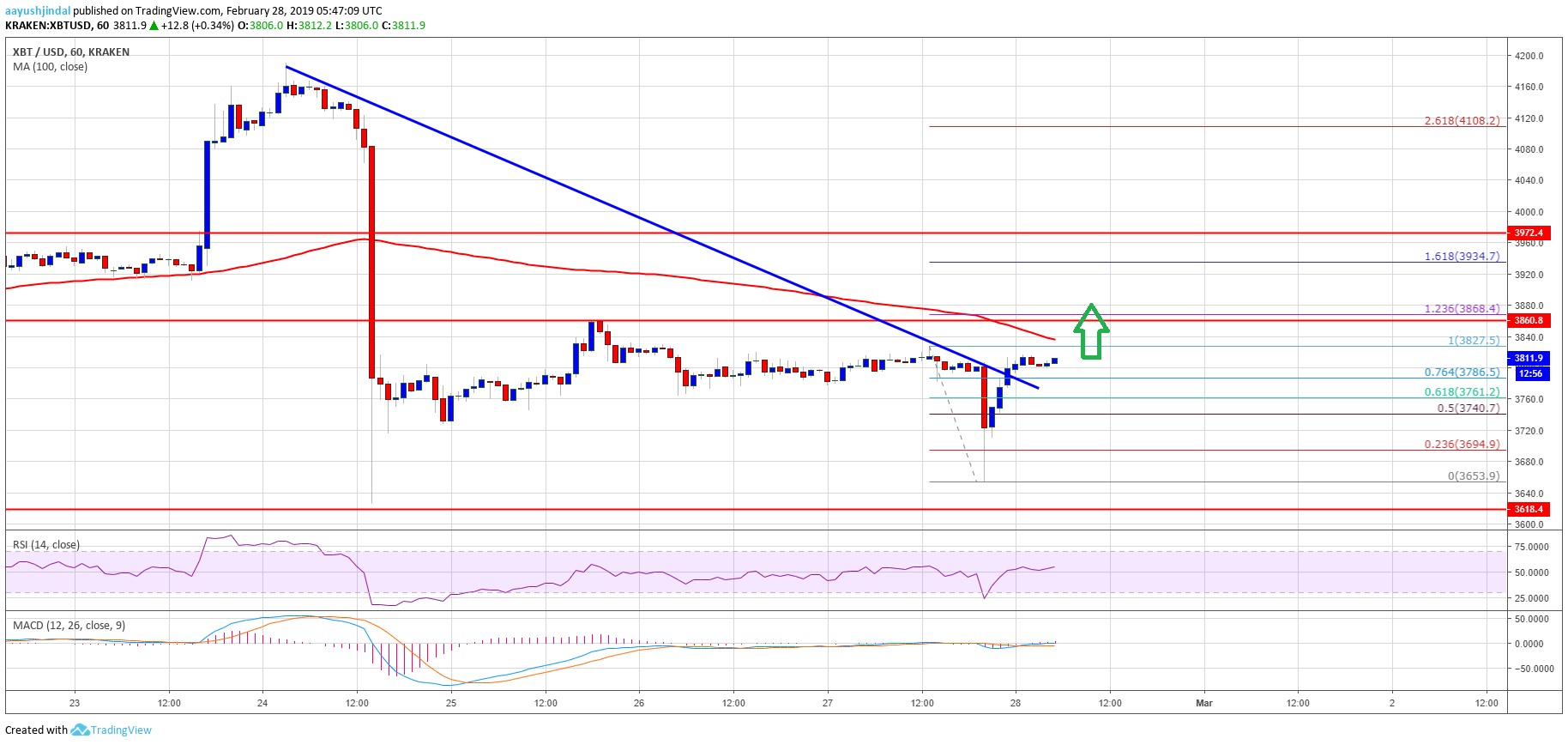
The price bounced back from the $3,653 low and broke the key $3,750 resistance.
There was a break above a major bearish trend line with resistance at $3,785 on the hourly chart of the BTC/USD pair (data feed from Kraken).
The pair is likely to gain bullish momentum above the $3,860 and $3,900 resistance levels.
bitcoin price tumbled below $3,700 and later recovered sharply against the US Dollar. BTC is pointing bullish signals and it could continue to rise towards $4,000 in the near term.
Yesterday, we discussed the if bitcoin price breaks the $3,750 support against the US Dollar. The BTC/USD pair did break the $3,750 support and declined below the $3,700 level. There was a sharp downward move and the price tested the $3,650 support. A new weekly low was formed at $3,653 and later the price bounced back. The recent recovery was strong as the price climbed above the $3,750 and $3,760 resistance levels.
There was a break above the 61.8% Fib retracement level of the recent decline from the $3,827 high to $3,653 low. More importantly, there was a break above a major bearish trend line with resistance at $3,785 on the hourly chart of the BTC/USD pair. It has opened the doors for more gains above the $3,800 level. BTC is currently trading above the 76.4% Fib retracement level of the recent decline from the $3,827 high to $3,653 low. Therefore, there are chances of more gains above the last swing high at $3,827. An immediate resistance is at $3,830 and the .
If there is a break above the 100 hourly SMA, the price could climb towards the $3,860 resistance. A successful close above $3,860 and $3,900 will most likely set the tone for a rally towards the $4,000 resistance. In the mentioned case, the price may even climb above $4,050. On the other hand, an initial support is at $3,760, below which the price could test $3,700.
Looking at the , bitcoin price is slowly moving into the positive zone above $3,800. However, it must gain momentum above the $3,860 and $3,900 resistances to climb further higher. In the short term, there could be range moves before the price makes the next move either above $3,900 or dive back to $3,700.
Technical indicators
Hourly MACD – The MACD is slowly gaining momentum in the bullish zone.
Hourly RSI (Relative Strength Index) – The RSI for BTC/USD climbed back above the 50 level.
Major Support Level – $3,750 followed by $3,720.
Major Resistance Level – $3,830, $3,860 and 3,900.
bitcoin Investor Lost Life Savings When QuadrigaCX Didn’t Issue $422,000 Withdrawal In a matter of weeks, the demise of QuadrigaCX, once Canada’s largest bitcoin exchange, has reached the front pages of mainstream media outlets worldwide. […]
2017 has seen its spate of both good and bad stories for all sides of the cryptocurrency space. Whether you believe in dutch tulips or you worship at the altar of Satoshi Nakamoto, there were reaffirming and disheartening stories for evcxzxeryone. Below are five of the stories that darkened an otherwise positive year for the industry.
Segwit2x vs. #No2x
bitcoin supporters and detractors alike acknowledged that scalability was an issue in the cryptocurrency. It triggered stakeholders in the currency and surrounding ecosystem to come together on May 23, 2017, and announce a before
the Consensus 2017 Meeting in New York (sometimes called the “New York Agreement”). The agreement dictated parallel upgrades to the bitcoin protocol, activating a Segregated Witness at a 80% hash power threshold and activating a hard fork to
double the block weight limit within six months. Here’s some on
the implication of the forks.
That hard fork, also referred to as Segwit2x, was meant to occur on November 16, 2017, but was cancelled on November 8, 2017. While the first half of the agreement was carried out successfully in August, support for Segwit2x fell through for .
Recently, there was a supposed of
the now defunct Segwit2x fork, but the development team related to this new Segwit2x is unknown and there is no association to those that were behind the New York Agreement.
Ransomware Hacks Remind Public of Criminals’ Preference for bitcoin
Although Ransomware hacks have been around for years, 2017 was particularly nasty (see our article for
four things you should know about the viruses). In May, a ransomware called shocked
the world by holding Microsoft computers hostage using an operating system exploit, encrypting the files on infected computers and demanding a $300 payment in bitcoin for their release. The hack had debilititating implications for users running
outdated Microsoft operating systems around the world, striking particularly hard at the United Kingdom’s government healthcare provider, the NHS.
The choice of payment in bitcoin seemingly caused a negative shock to the .
Finally on August 3, 2017, the belonging to the hackers were emptied. All
told, those responsible jettisoned $143,000 worth of bitcoin, leaving a much larger amount of damage in their wake.
This wasn’t the only major ransomware attack of the year of course: On June 27, 2017, one ransomware attack using a variant of the ransomware known as “Petya” took down computers in over 80 companies. Some notable victims of the attack included British Media Advertising Conglomerate ,
global law firm , international commercial shipping company ,
pharmaceutical juggernaut and .
While this ransomware attack $300 in bitcoin, they received far than
the WannaCry hackers, roughly $10,000 USD (almost 4 BTC at the time of the attack). However, the damage done to the affected companies far outstripped the gains of the hackers, with Merck, Maersk and FedEx estimated
revenues lost due to the hack at $300 million for each company.
The Cash will likely be the most controversial topic covered in this
article. Roger Ver has been very vocal in promoting the idea that bitcoin Cash is the real
. So does the subreddit ,
which he moderates. This forum is often at odds with , and one needs to look no further than to these
trending posts on each forum, respectively, to see the animosity. bitcoin Cash is the result of the August 1, 2017, SegWit fork, which allowed holders of BTC to inherit a second cryptocurrency that inherited
the transaction history of bitcoin on that date but allowed all future transactions to be separate.
The enthusiasm behind relative newcomer BCH is obvious as CoinMarketCap cites BCH as currently the fourth largest cryptocurrency by market capitalization, sometimes trending as high as .
While exchanges from Kraken to Bitfinex have adopted BCH into the fold, some, such as Coinbase, have been initially resistant to granting wallet users access to the BCH portion of the fork (Coinbase has since BCH
onto its platform but not without the controversy discussed below).
Whether its advocates are right in the belief that BCH will supplant BTC or anti-BCH proponents are right that a usurper is not in the making, the drama and infighting show no signs of waning for these cryptocurrency stakeholders.
China’s Central Bank Bans ICOs
On September 4, 2017, the Chinese government’s central monetary authority, the People’s Bank of China (PBOC), .
In a released by the PBOC’s Chinese Insurance Regulatory Commission (CIRC), token sales in the country, “should
be stopped immediately,” noting that, “organizations and individuals that have completed the financing of tokens issuance should make arrangements such as clearance to reasonably protect the rights and interests of investors and properly handle
the risks.”
While China has, , had tightly controlled potential exits
for capital leaving the country, ICO entrepreneurs remained as the country with the largest population of bitcoin
miners sought to crackdown on the new asset class.
Supporters of ICO offerings were dismayed as the world’s 2nd largest economy closed its doors to the new asset class, many cited the actions by the PBOC to be and
view the news as good for anti-scamming activities and also as temporary. This may be one of those short-term negative/long-term positive stories.
Exchange Woes Plague Coinbase, Bitfinex and Youbit.
Cryptocurrency exchanges found both great success and major setbacks in 2017. Among the setbacks:
In a Northern District of California Federal Court, Coinbase lost a court battle with the IRS which
the company to disclose identifying records of all users who received more than $20,000 in a single year between 2013 and 2015. The November 28, 2017, loss signals a likely attempt by the IRS to collect data on unreported or undisclosed gains
by U.S. taxpayers and may hint at heightened scrutiny of cryptocurrency investors’ reported returns in future years. Coinbase also closed the year on a sour note when the company it was investigating possible insider trading claims related to the company’s onboarding of bitcoin Cash for use in its wallet and trading on its subsidiary platform, GDAX.
Bitfinex also faced a rollercoaster year, in early 2017 from a $72 million
in August 2016. However, the exchange has since halted services to U.S. investors on November
9, 2017, and come under for its management of its Tether tokens. The company eventually in early December to explore potential defamation lawsuits against its more vocal critics.
South Korean Exchange Youbit its doors after a second
successful hack in 2017 resulted in a loss of 17 percent of its assets. Other exchanges have survived successive hacks in a single year, but the Youbit closure shows that not all exchanges can recover.
These are a few of the dark spots on an otherwise remarkably positive year, so it’s important to keep in mind all the fantastic progress that has been made in the space. Check out our