March 11, 2026

Capitalizations Index – B ∞/21M

Bitcoin Price Dips Below $9,000 But Tron and Verge Continue to Record Gains

Bitcoin price dips below $9,000 but tron and verge continue to record gains

Bitcoin Price Dips Below $9,000 But Tron and Verge Continue to Record Gains

Bitcoin price dips below $9,000 but tron and verge continue to record gains
Advertisement

Join our community of 10 000 traders on Hacked.com for just $39 per month.

The bitcoin price has dipped below the $9,000 mark, recording a 4 percent drop in value overnight. Despite bitcoin’s struggle, several tokens including Tron (TRX) and Verge (XVG) have recorded major gains over the past 24 hours with XVG demonstrating a 10 percent increase in value.
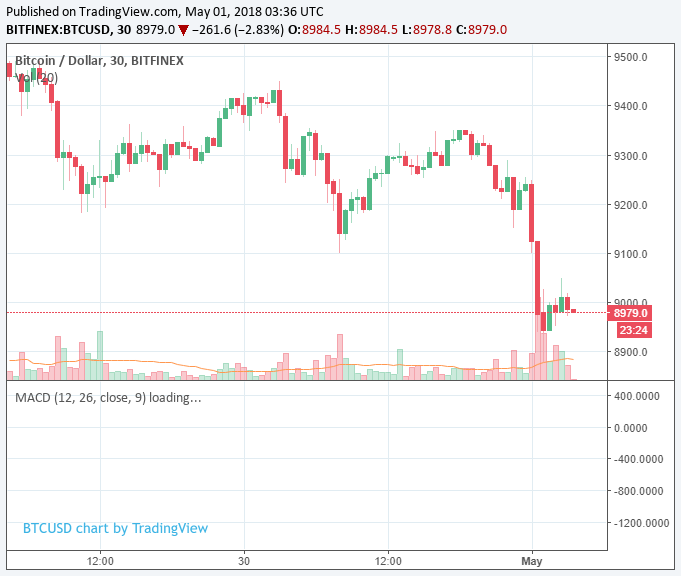
Bitcoin price dips below $9,000 but tron and verge continue to record gains

Best Performers: MANA, XVG and Tron

The best performers of May 1 are Decentraland (MANA), Verge (XVG), and Tron (TRX). The rise in the value of Tron is attributable to the rising interests from investors towards the mainnet launch of the Tron network. The Tron mainnet is expected to launch on May 31, as its founder Justin Sun revealed on social media.

Similar to EOS, Tron is yet to launch its mainnet. It released its testnet in March and since 2017, the project has been in development. Without a working mainnet, both networks are valued at $14 billion and $6 billion respectively, with a daily trading volume of above $6.4 billion.

Currently, traders are concerned in regards to a potential dump that may occur immediately after the mainnet launch of Tron and EOS, as investors in the cryptocurrency market tend to buy the rumor, news, partnership, and product launch, and dump the cryptocurrency quickly thereafter, as soon as a partnership or a product launch is finalized.

MANA, the token of Ethereum-based virtual reality platform Decentraland, has recorded a 11 percent increase against bitcoin and a 6 percent rise against the US dollar. Currently, MANA is being traded at 0.00001810 BTC, up by nearly 20 percent from the 0.00001550 BTC mark since April 30.

The demand for MANA is increasing at a rapid rate due to the rise in interest from both developers building virtual reality products on Decentraland and institutional investors such as Digital Currency Group (DCG).

Last week, DCG bitcoin and blockchain investor Travis Scher said that Decentraland could evolve into a leading virtual reality-based platform and could take off as the next big media platform. Scher noted that other investors in Decentraland are interested in the token because of its potential to be at the forefront of both virtual reality and blockchain technology development.

“First, we believe it’s inevitable that humans will spend a significant amount of time in virtual worlds in the future (both web-based worlds like Second Life and eventually in full scale VR-based worlds). So, something like DCL could become the next big social platform,” said Scher.

bitcoin Trend

The most dominant cryptocurrency in the market has struggled to rebound over the past 24 hours, closing April 30 with a loss of 2 percent and continuing its loss throughout May 1. Technical indicators and momentum oscillators suggest that bitcoin is in a neutral zone and that it is in an ideal position to recover.

The Relative Strength Index (RSI) of bitcoin is at 55 and is currently not demonstrating neither overbought or oversold conditions. If the daily trading volume of bitcoin can improve, it is possible that bitcoin makes its way back to the $9,500 region and eye a move to the $10,000 region.

Follow us on Telegram.
Advertisement

Published at Tue, 01 May 2018 04:46:44 +0000

Altcoin Analysis

Previous Article

Компания Oscar Mayer выпустила «мясную» криптовалюту бекоин

Next Article

–MarteX Coin– English Review

You might be interested in …

Here’s How SonoCoin Is Trying To Use Sound To Transfer Value

Companies are rushing to try and make peer to peer, blockchain based value transfer quicker and simpler right now and this company thinks it’s been able to do just that.


bitcoin just broke through a major resistance level and interest in the space has never been higher. Companies of all shapes and sizes are popping up, looking to take advantage of the rush to develop and establish the blockchain-centric infrastructure that’s going to serve as the foundation for technological advance for many years to come and many of these are conducting ICOs to try and pick up funding. The ICO space, however, and likely as a direct result of the above statement, is pretty crowded right now and a company that wants to stand out and – in turn – to attract investor capital through an initial offering has to serve up something unique. Reports have just hit press that a company called SonoCoin is about to launch its efforts to do just that and, at a glance, the company looks as though it certainly checks the ‘unique offering’ box.

SonoCoin has developed a blockchain based peer-to-peer value transfer system that uses a digitally encrypted audio file as its transfer token. In contrast to bitcoin, which uses a Proof-of-Work (PoW) protocol, SonoCoin uses a Proof-of-Stake (PoS) protocol to verify transactions and, again unlike bitcoin, the exchange token can be sent via any means through which a standard data/audio file can be sent – email, messenger application, etc.

So how does it work?

The company has developed an algorithm that takes a transaction hash, a secret key and the index (which is defined as the number of outputs when the coin was formed) and converts it into a .wav file.

This file can then be sent from one device to another (basically, so long as the devices have a microphone and a speaker that can emit, recognize and interpret sound, which pretty much all mobile devices do right now) and, on receipt, an application (which is already available for some devices) specifically designed to interpret these SonoCoin sound files will record and register the transaction.

And why is this news now?

The company is currently conducting a presale of its tokens and intends to move into the second phase of this presale on December 14, at the end of next week. During phase one and phase two (phase one has been active since this time last week), a total of 30 million coins will be issued. Subsequent to the presale, 40 million coins will be issued as part of the full ICO.

How successful the ICO will be remains to be seen but the assumption is that, post-completion, SonoCoin will look to pick up a listing for its coins on the major exchanges in the space – Bittrex, Poloniex, etc. and it’s at that point that we’ll really get an idea of the market appetite for this sort of alternative-format type value transfer.

Here’s the company’s Whitepaper for anyone looking to get a better idea of how SonoCoin works.

What do you think of this sort of application of blockchain technology? Will the ability to transfer value via sound files aid mainstream adoption of algorithm-based peer-to-peer transactions? Let us know in the comments section below!


Image courtesy of Tess Watson via Flickr

The post Here’s How SonoCoin Is Trying To Use Sound To Transfer Value appeared first on Bitcoinist.com.