Bitcoin Is Becoming More Decentralized, Indicates New Research
bitcoin has become more decentralized, according to Canadian financial services firm Canaccord Genuity Group.
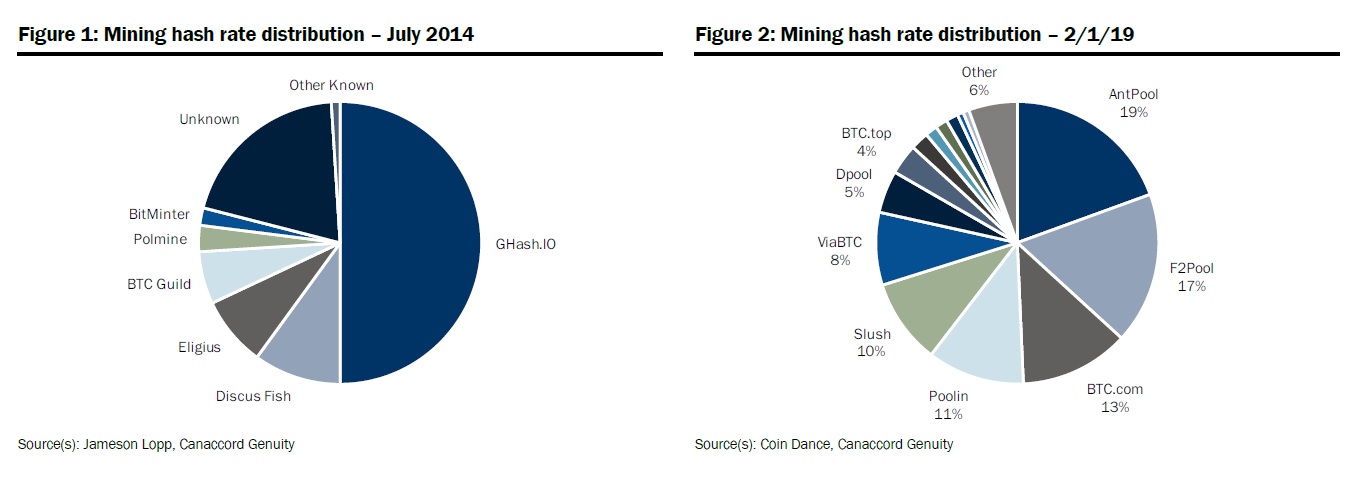
In its February report, the firm said bitcoin [BTC] was not always decentralized in its earlier days, as measured by its hashrate distribution. However, over the last few years, “increased competition” among mining chip manufacturers has led to decreasing centralization.
Giving the statistics, Canaccord said, in mid-2014, mining pool GHash.IO controlled about 50 percent of the total bitcoin [BTC] hashrate, making the largest cryptocurrency “vulnerable” to a potential 51 percent attack (controlling a majority of the hashing power allows bad actors to potentially rewrite transactions).
In 2019, however, no single mining pool controls more than 20 percent of bitcoin [BTC]’s hashrate, with five mining pools having from 10–20 percent and the remaining groups controlling less than 10 percent of the total hash rate.
bitcoin’s increased decentralization is a “foundational positive” development, Canaccord said, adding that while there are several factors that contributed to it, the most important factor has been the “commoditization of bitcoin [BTC] mining chips, as advances in ASICs [application-specific integrated circuits] have slowed allowing for broader competition for bitcoin [BTC]’s mining rewards.”
Bitmain, for instance, has seen increasing competition from Canaan Creative due to its “inability to produce a meaningfully superior alternative to the Antminer S9,” the firm said. The closer competition, it continued, has led “Canaan Creative to sell its chips to a broader audience of miners that can effectively compete with Bitmain.”
Citing ARK Invest research, the report further said that bitcoin [BTC]’s centralization as measured by the (HHI) has steadily declined from ~3,000 in 2013 to ~1,200 currently.
The is used to gauge market concentration. An HHI of less than 1,500 is considered to be a “competitive marketplace,” an HHI of 1,500–2,500 is considered to be “moderately concentrated,” and an HHI of over 2,500 is considered “highly concentrated,” the firm explained.
Anthony Murgio, 33, of Tampa, Florida, has been sentenced to five and a half years in prison for running a bitcoin exchange connected to hackers. The exchange was used to launder more than $10 million worth of funds, authorities reported.
Both Murgio and Yuri Lebedev, 39, of St. John’s, Florida, operated Coin.mx through a fraudulent company called “Collectables Club.” the U.S. Attorney’s Office for the Southern District of New York, the illegal bitcoin exchange used the firm’s misleading name to open financial accounts at banks pretending to be a “members-only association of individuals who discussed, bought, and sold collectible items and memorabilia.” Murgio and Lebedev, along with other co-conspirators, violated bank and credit card company rules and regulations by “deliberately misidentifying and miscoding Coin.mx customers’ credit and debit card transactions.”
“Lies conceived and deployed by Murgio permeated every aspect of Coin.mx’s operation, including its use of front companies, like Collectables Club and Currency Enthusiasts, to try to conceal the illicit nature of the operation,” the Department of Justice stated in its .
On January 9, Murgio to three counts regarding operating Coin.mx, which processed over $10 million worth of illegal bitcoin transactions. Murgio ran the bitcoin exchange between October 2013 and July 2015 for Gery Shalon, 33, an Israeli citizen who was responsible for hacking at least nine companies, including JPMorgan Chase, E-Trade Financial Corporation and Dow Jones. Coin.mx sold bitcoins that came from illegal online transactions, such as victim payments to ransomware attackers who sought to launder the cryptocurrencies clean.
“I screwed up badly and made serious mistakes and misjudgments,” Murgio said, showing remorse, to U.S. District Judge Alison J. Nathan at his sentencing.
Shalon, along with Ziv Orenstein, 42, on approximately 76 million household customers and 7 million businesses by hacking the nine companies. U.S. officials described their operation as a “diversified criminal conglomerate” responsible for the largest theft of valuable information from a U.S. bank. The compromised data included the names of customers, along with email addresses and phone numbers. Authorities collected evidence stating that Murgio exchanged cash for the bitcoins of Shalon’s criminal gang. Israeli police arrested Shalon and Orenstein in July 2015, and they were extradited to the United States in June 2016. Both are facing serious charges, including aggravated identity theft, wire fraud and money laundering.
“Mr. Murgio led an effort based on ambition and greed,” and constructed on a “pyramid of lies,” Judge Nathan said during the sentencing hearing at the Manhattan federal court.
On March 17, a Manhattan jury found Lebedev and his co-conspirator Trevon Gross, 52, of New Jersey, connected to a bribery scheme in an attempt to hide the illegal activities of Coin.mx from financial institutes and regulators. Both of the defendants are facing a maximum sentence of 30 years in prison. Judge Nathan scheduled the sentencing hearing of Lebedev and Gross for July 20, 2017.
Murgio’s father, Michael Murgio, 66, was also in the Coin.mx case. In October, the father plead guilty to “making a false statement to the National Credit Union Administration on behalf of his son.” By making a plea deal, Michael Murgio managed to avoid additional charges in the case, including “conspiracy to make corrupt payments with intent to influence an officer of a financial institution and making corrupt payments.” Judge Nathan sentenced the elder Murgio to one year of probation along with a $12,000 fine.
The FBI both Lebedev and Murgio on July 23, 2015, for “running an unlicensed bitcoin exchange with the goal of helping individuals launder money.”
Despite the prosecution’s request for 10 to 12 years and seven months behind bars, the Manhattan federal court Murgio to five and a half years in prison. According to , Judge Nathan considered Murgio’s “generosity to friends and support to his family” and imposed a prison sentence half as long as the prosecutor recommended.
Judge Nathan has scheduled a hearing on September 1 to decide on the amount of fines, forfeiture and restitution Murgio has to pay to the state. The operator of the illegal bitcoin exchange remains free on bail.
bitcoin UNDER $1,000 WOULD BE CAPITULATION, I’LL MORTGAGE MY HOUSE!! BUY NOW!! http://BitcoinRich.com Enter coupon code ‘HALFOFF’ Limited Time for 50% SAVINGS!! Twitter: https://twitter.com/amtvmedia Facebook: https://www.facebook.com/amtvmedia (11-26-18) In today’s video, Christopher Greene of AMTV reports […]