June 11, 2026

Capitalizations Index – B ∞/21M

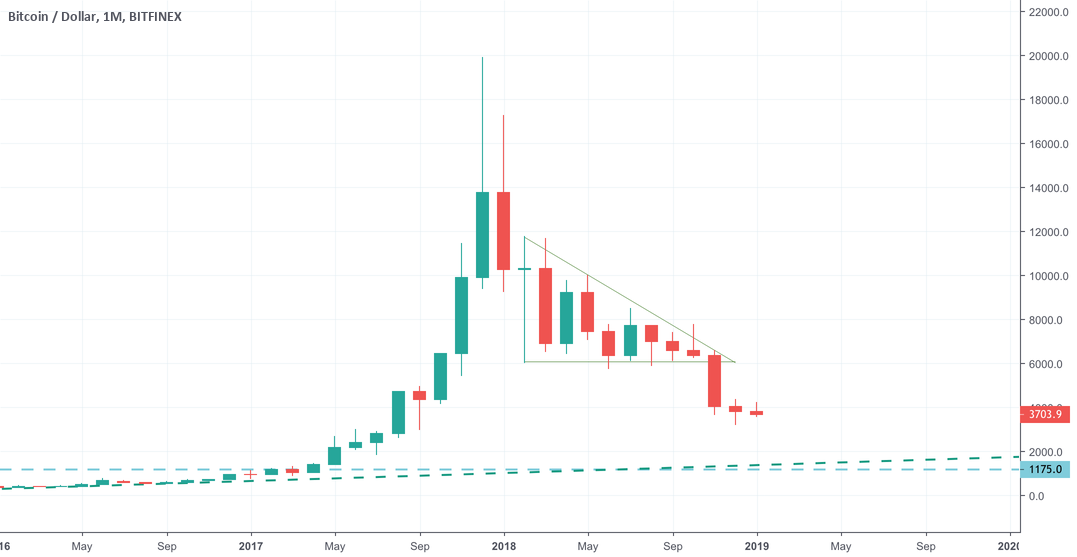
Bitcoin in monthly candles

Bitcoin in monthly candles

Bitcoin in monthly candles

Bitcoin in monthly candles

Howdy, fellows! Newbies and pros–to all of you, my deepest salutations,

First things first, see the attached idea for a simple historical look.

And also, don’t forget to give it a thumbs up, and to follow me for updates and other ultra-precious analyses from a former currency pair gourmet. Indeed, I still work for the same investment house, but now my focus is on emerging market stocks. Anyhow, I am not here to share my views on stocks, but on cryptocurrencies, and among them, the most precious one, namely, bitcoin .

First of all, it must be noted that one should study bitcoin for all other cryptocurrencies as well, because it’s still the market leader. When it booms, hardly anyone talks about altcoins, except maybe with a few exceptions-

1) Ethereum (ETH): This is clearly the most austere bitcoin follower. It reached a fantastic 35% market dominance at its peak, currently staying around a humble 10%.
2) Ripple (XRP): This is hardly a cryptocurrency, but one has to pronounce its name when it comes to trading in crypto markets, as it peaked at 25% market dominance, currently lingering around 10%.
3) All others: I follow the market dominance of “other” cryptos at CoinMarketCap, hoping that TV will have better capabilities. I believe several projects among them have the potential to have a geniuine contribution to peoples. To name one, I can utter Cardano ( ADA ), which clearly distinguishes itself from competitors.

And bitcoin enjoys a 50% market dominance. It still means a lot, especially considering it’s 5x its closest follower. So, all in all, bitcoin is still the king among cryptocurrencies. Even if one considers that the 2017 rally was accompanied with a dramatic decrease in its market share, one has also to remember that even at its lowest point (in terms of market dominance), bitcoin was the sole cryptocurrency that is known to people in its own right. Ethereum and Ripple, on the other hand, have remained being “something like bitcoin .”

The other issue is the use of arithmetic scale in charts, which I favor over the semi-log plot. On that, I will not make any further comment but will only cite Richard Shabacker:

“There are three principal types of scales used for stock charts: the straight or arithmetic scale, the logarithmic or ratio scale, and the square-root scale. Each has its advocates although the square-root scale is least used and appears to have no important advantages. . . . The advantages claimed for the ratio scale are based chiefly on the fact that the higher stocks go in price the wider the fluctuations tend to become, measured in points of movements. The logarithmic scale is supposed to compensate for this tendency by plotting actual distances on a percentage basis.

In our experience, however, we have found that the arithmetic scale is easier to use, and the distortion of patterns is much less than on the logarithmic scale. Ratio plotting tends to compress the patterns at high price levels almost to insignificance, and to exaggerate the patterns formed at low levels out of all proportion to their technical importance, making their correct interpretation extremely difficult.

As to trend lines , logarithmic charts, with one possible exception, do not ordinarily give us straight lines which can be turned to profit in trading. The one possible exception is the long-term bull market trend which tends to accelerate or curve upward on an arithmetic chart. This phenomenon appears most plainly and consistently on the monthly charts of the averages and certain of the more substantial leading stocks which follow the general market closely. . . . On the other hand, logarithmic charts are of no assistance in major downtrends, nor in either up or down intermediate trends.” (Technical Analysis and Stock Market Profits, pp . 290-1)

Okay, so, we have dealt with some preliminary issues, but it’s already been too long for a normal post. So, it’s best if you just follow me or give this a like so that you know when I update the idea with more enjoyable stuff.

Published at Thu, 17 Jan 2019 18:41:56 +0000

Previous Article

Bitcoin Drops To $3,600 – Pump Or Going To $1,500? Whales Crash Ethereum Below $50?

Next Article

Crypto Tax Havens: A Beginner’s Guide to Lenient Crypto Tax Locations

You might be interested in …

SEC/NASAA Ring in 2018 by Hinting at Need for (More) Cryptocurrency Regulation

sec nasaa

Yesterday, January 4, 2018, the three prominent figures of the U.S. Securities and Exchance Commission (SEC) endorsed the concerns raised in the North American Securities Administrators Association (NASAA)’s cautionary directive on cryptocurrencies, ICOs, and other “Cryptocurrency-Related Investment Products.” Jay Clayton, the Chair of the SEC; Michael Piwowar, the former acting Chair of the SEC; and Kara Stein, a prominent figure in the SEC and an author of the 2010 Dodd-Frank Act, joined NASAA, the association that is the voice of state securities agencies in the U.S.,  in urging “Main Street investors” to go beyond the headlines and hype to understand cryptocurrency investment risk.

While this is not the first SEC commentary we have seen on cryptocurrencies, this iteration of caution raises the imminent possibility of the SEC and NASAA intervention into the space, as the SEC-lauded directive showed that 94 percent of state and provincial securities regulators (or roughly 63 of the 67 securities regulators under NASAA) believe there is a “high risk of fraud” involving cryptocurrencies and that all of the securities regulators believe “more regulation is needed for cryptocurrency to provide greater investor protection.” 

Of note: Membership in NASAA not only comprises all 50 state securities regulators in the U.S. but also includes securities regulators in Canada and Mexico (as well as the U.S. Virgin Islands and Puerto Rico. According to Bob Webster, Director of Communications for NASAA, the survey referenced in the directive included NASAA members from the U.S., Mexico and Canada.

The SEC statement by the three most prominent figures in the organization called the NASAA release “a timely and thoughtful reminder,” reminding investors themselves that “when they are offered and sold securities, they are entitled to the benefits of state and federal securities laws.” From a legal standpoint, this comment implies that some or all cryptocurrencies, ICOs and other cryptocurrency-related investment products will be deemed by the SEC as “securities” and that those offering these products may be soon facing accusations of selling unregistered securities in violation of U.S. Securities Laws.

There is a possible point of disparity between the NASAA directive and the coinciding SEC statement: whether cryptocurrencies are “currency.” The usual definition for currency includes the requirements they serve as an accepted medium of exchange and can be a store of value for market participants.

NASAA’s directive states that, “Cryptocurrencies are a medium of exchange that are created and stored electronically in the blockchain, a distributed public database that keeps a permanent record of digital transactions” (emphasis added).

The SEC statement, however, has a slightly different interpretation of the NASAA Directive: that cryptocurrencies “lack many important characteristics of traditional currencies, including sovereign backing and responsibility.” The SEC went further, stating that cryptocurrencies “are now being promoted more as investment opportunities than efficient mediums for exchange.”

This view, unchecked, would allow the SEC to step in to regulate these “investment opportunities.” Whether there was a differing view the SEC wished to convey, or the statement was meant to convey support of the NASAA directive while opening the door for broader SEC intervention into the space, only time will tell.

One final note: FINRA, the non-profit organization authorized by Congress to be regulator in charge in the U.S. for oversight and enforcement actions against broker/dealers on behalf of investor protection, was noticeably silent in joining the SEC and NASAA in issuing a new statement (the previous two warned investors not to fall for cryptocurrency-related stock scams and gave a primer on ICOs).

FINRA Media Relations Specialist, Dylan Menguy, responded to inquiry on FINRA’s view of the statements by the SEC and NASAA by referring bitcoin Magazine to this press release where FINRA warned investors of cryptocurrency-related stock scams.

NASAA’s Bob Webster clarified the survey inclusion as referenced above in the article, and, when asked about the potential disparity discussed above, stated, “…I don’t see a discrepancy between the two views.  Cryptocurrencies are a medium of exchange and they are being promoted as investment opportunities. For clarification on the SEC’s position, you should contact the SEC.”

At the time of this writing, the SEC has not responded to a request for comment.


The post SEC/NASAA Ring in 2018 by Hinting at Need for (More) Cryptocurrency Regulation appeared first on Bitcoin Magazine.

Coinbase Rejection Sends XRP Price Into Downward Spiral

Altcoin Today Coinbase Rejection Sends XRP Price Into Downward Spiral Coinbase Rejection Sends XRP Price Into Downward Spiral It would appear the reality has caught up with XRP price speculators. As was mentioned yesterday, the […]